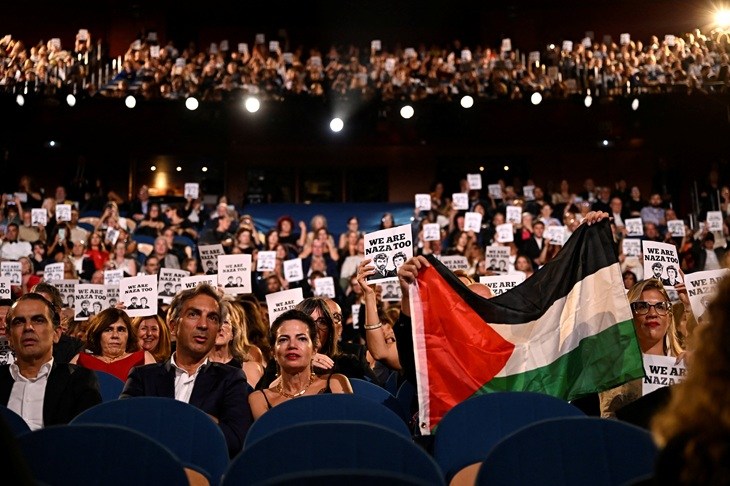
The Venice Film Festival has bestowed its Special Jury Prize upon NAZA, an 80-minute documentary by Yuval Abraham and Rachel Szor. Its official synopsis does not promise an inquiry. It announces a verdict: the film reveals, it says, the machinery behind Israel’s ‘calculated mass killing’ of Palestinian civilians. What evidence could sustain so grave an accusation? What evidence would contradict it? What responsibility belongs to the terrorist organisation that chose the battlefield, constructed it beneath homes and then left the population above it? Those questions lead into tunnels the film refuses to enter.
The war did not begin with an Israeli target list. On October 7, 2023, Hamas-led forces breached Israel’s border and entered sovereign Israeli territory. They attacked kibbutzim, homes and a music festival; murdered civilians; committed sexual violence; looted communities; and abducted 251 people into Gaza. The assault was not collateral damage from an attack upon military objectives. Civilians were among its chosen objects. Israel then went to war in self-defence: to dismantle the organisation responsible, recover its hostages and exact retribution from the perpetrators. Retribution meant consequences for mass murder, not vengeance upon a population. Any account of the war that begins after that initiating atrocity has removed cause from consequence.
Beneath Gaza lay a second city. Its passages contained command centres, communications equipment, weapons, fighters and Israeli hostages. Estimates of its total length vary, although Hamas itself once claimed roughly 500 kilometres of tunnels. How much concrete, fuel, labour and engineering went into that subterranean fortress? More important, whom was it built to protect?
Mousa Abu Marzouk, a senior Hamas official, supplied the answer in an October 2023 television interview. The tunnels, he said, had been built to protect Hamas fighters from Israeli attack. Protecting Gaza’s civilians was supposedly the responsibility of the United Nations and Israel. His admission is among the most revealing statements of the war. Hamas possessed the engineering capacity to place human beings underground. It made a deliberate decision about which human beings would receive that protection.
Here lies the war’s defining moral inversion. Israel remains legally and morally obliged to distinguish civilians, take feasible precautions and avoid disproportionate harm. Hamas’ obligations do not disappear because Israel has obligations of its own. Hamas was Gaza’s de facto governing authority. It initiated the war, embedded its military system among the population and reserved its underground protection for combatants. The international argument then transfers primary responsibility for preserving every Gazan life to the country Hamas attacked, while treating Hamas’ calculated exposure of those lives as a condition of nature. Israel is commanded to protect Gaza’s civilians from the battlefield Hamas constructed; Hamas is scarcely asked why it would not shelter the people it governed.
Where were the public entrances for families? Where were the civil-defence shelters, evacuation plans and protected chambers for children? Hamas built no comparable public underground refuge for the people it had governed since 2007. Its combatants descended. Its weapons disappeared. Its hostages were immured. Palestinian civilians remained above ground, surrounding the military infrastructure Israel had to reach.
This arrangement was neither incidental nor humanitarian. Hamas is a designated terrorist organisation, not a responsible government surprised by a conflict for which it had failed to prepare. It planned the October 7 invasion, attacked civilian communities, carried captives into Gaza and prepared an underground war. The civilians it claimed to represent became the exposed roof of its fortress.
What does NAZA do with this defining fact? Public accounts of the film emphasise 24 anonymous Israeli military and intelligence sources, photographed in darkness on Tel Aviv rooftops. Anonymity may sometimes be necessary to protect genuine whistleblowers. It also prevents an audience from judging a source’s position, access, record, motive or representativeness. Darkness is a powerful cinematic device. It is not corroboration.
Israeli citizenship does not impose silence, and criticism of one’s own government can be an act of patriotism. A filmmaker’s choice of subject and omission nevertheless remains open to moral judgment. Abraham and Szor might have turned their cameras north, where Hezbollah’s rocket and drone campaign killed Israeli civilians, forced approximately 60,000 people from their homes and burned tens of thousands of acres. The documented devastation offered abundant material for an inquiry into the purposeful attack upon civilian life. They chose instead to present their countrymen and their army as the machinery of mass killing.
Their nationality consequently becomes part of the film’s salesmanship. A foreign audience is encouraged to receive the accusation as a confession: Israelis themselves have said it, therefore the case is closed. The propagandist’s most valuable witness is the citizen whose identity appears to authenticate the charge against his own society. A film need not be commissioned by Hamas to perform Hamas’ propaganda work. It need only adopt Hamas’ mendacious moral sequence: begin after October 7, erase the tunnels, exclude Hamas’ decisions and attribute the resulting deaths to an Israeli desire to kill civilians.
That choice is not made in a vacuum. Antisemitism has already converted the Gaza war into a license to menace Jews far beyond Israel. The filmmakers cannot be held responsible for every fanatic who exploits their work. They are responsible for the foreseeable force of their framing. When Israelis present an allegation of calculated national murder while withholding the facts that bear upon Hamas’ agency and Israeli intent, they supply an international feeding frenzy with what appears to be an authenticated confession. The danger does not excuse censorship. It imposes a greater obligation to tell the whole truth.
The title itself requires precision. NAZA is not a hybrid of Nazi and Gaza. It transliterates an Israeli military abbreviation derived from the Hebrew nezek agavi – collateral damage – and denotes an estimate of anticipated incidental casualties. The truth is more revealing than the imagined wordplay. A mechanism for forecasting civilian harm, and therefore for deciding whether and how a strike may proceed, is made to sound like proof that the civilians were the objective.
The film reportedly treats those estimates as evidence that civilians were deliberately targeted. Here the argument commits its most consequential deception. International humanitarian law requires a commander to distinguish civilians from combatants, identify a military objective, take feasible precautions and assess whether expected incidental harm would be excessive in relation to the anticipated military advantage. The rule of distinction forbids making civilians the object of attack. Proportionality governs foreseeable incidental harm during an attack upon a military objective. These are related obligations, not interchangeable accusations.
A civilian-casualty estimate may reveal a defective method. It may support questions about intelligence, proportionality or precautions. It may justify investigation of a particular strike. Its existence alone cannot establish that civilians were selected as targets. In fact, performing such an estimate is part of the legal process intended to protect them. To transform the calculation itself into proof of calculated murder is to convert an obligation of restraint into evidence of guilt.
Civilian deaths occur in war. That terrible fact does not make them lawful by definition, nor does it make each death evidence of a war crime. The law asks what was targeted, what military advantage was anticipated, what civilian harm was reasonably expected and what feasible precautions were taken. NAZA evades those distinctions by moving from the existence of civilian casualties to an allegation of murderous national purpose.
What evidence of restraint does the film weigh? Urban-warfare scholar John Spencer, who studied Israeli operations and entered Gaza with the IDF, has documented mass evacuation notices, telephone calls, text messages, leaflets, broadcasts, evacuation maps and pauses intended to move civilians away from fighting. He concluded that Israel had implemented extraordinary civilian-protection measures in an urban battlefield deliberately prepared by Hamas.
Warnings do not absolve every subsequent attack. A warning must be effective, and civilians must have a practicable route to safety. Designated areas can lose their protection if combatants operate from them, although that does not extinguish the attacker’s continuing obligations. Individual operations may still be mistaken, disproportionate or unlawful. Serious allegations deserve serious investigation. None of these qualifications erases the military cost of warning an enemy before striking him.
What happens when Israel telephones a building, drops leaflets over a neighbourhood or announces the area in which it will operate? Civilians receive time to move. Hamas receives time to move as well. Fighters can escape, weapons can be relocated, ambushes can be prepared and routes can be mined. Surprise is surrendered. Israeli soldiers may then have to enter terrain whose defenders have been forewarned. A policy of calculated civilian extermination would not repeatedly compromise its own operations to reduce the number of civilians present.
Spencer has also argued that Israel’s civilian-to-combatant casualty ratio compared favourably with other difficult urban wars. That conclusion deserves consideration, although every ratio depends upon disputed totals, definitions and incomplete identification of combatants. The argument need not rest upon a single number. The documented precautions, operational sacrifices and repeated efforts to separate civilians from combat zones bear directly upon intent. Why does a film devoted to the inner workings of Israeli targeting omit the practices that complicate its predetermined conclusion?
The asymmetry becomes starker when the targets are reversed. Where does NAZA search for intention when intention requires no inference? Hamas gunmen entered kibbutzim, attacked a music festival, murdered families and abducted civilians. A United Nations commission found that Hamas and other Palestinian armed groups intentionally directed attacks against civilians and committed murder and hostage-taking. Hezbollah fired rockets toward Israeli communities. Iran and the Houthis launched missiles and drones toward Israel. Israeli civilians were not collateral to military objectives hidden beneath their homes. Terrorising the population was itself an objective.
Why does the film infer genocidal purpose from Israel’s attempts to calculate incidental harm while ignoring enemies whose attacks openly selected civilians? The legal definition of genocide requires a specific intent to destroy, in whole or in part, a protected group as such. Civilian death, however terrible or extensive, does not dispense with that requirement. Hamas’ deliberate targeting of civilians does not excuse an unlawful Israeli strike. Israel’s obligation to obey the laws of war survives the perfidy of its enemy. The enemy’s conduct nevertheless remains indispensable to determining what Israel was targeting, why civilians were endangered and what precautions were feasible.
A documentary about one military need not catalogue every offence committed by every belligerent. NAZA, however, makes a sweeping claim about the purpose of Israel’s war. Once a film moves from examining particular decisions to alleging calculated mass killing, the structure of the battlefield becomes central evidence. Erasing Hamas’ tunnels, military embedding among civilians, civilian targeting and stated refusal to shelter its own population does not narrow the inquiry. It falsifies the causal picture.
This is how propaganda acquires the appearance of moral seriousness. It need not invent every interview or fabricate every casualty. It selects one field of vision and excludes the facts that would alter its meaning. Palestinian suffering fills the screen. Hamas’ agency disappears outside the frame. Anonymous voices imply intention. Precautions become invisible. The terrorist organisation that built the battlefield is transformed into scenery, while the army compelled to fight through it becomes the sole author of everything that follows.
The filmmakers should not be silenced, stripped of citizenship, or threatened. A democracy answers accusations with evidence. Coercion would only permit the film’s supporters to substitute martyrdom for verification. Venice has given NAZA prestige; it has not given the film immunity from cross-examination.
The necessary cross-examination begins beneath Gaza. Who built the tunnels? Who occupied them? Who stored weapons in them? Who held hostages there? Who told the world that they were for fighters rather than civilians? Who left Palestinian families above a subterranean military city and then converted their deaths into an international weapon against Israel?
Until NAZA answers those questions, its darkness is not revelation. In my view, it is concealment.
Aaron J. Shuster is an award-winning cinematist, writer, producer and philosopher whose work examines contemporary issues, Middle Eastern politics, strategic culture and the civilizational forces shaping modern life. His writing has appeared in The Spectator Australia, FrontPage Magazine, Middle East Quarterly and The Observer.