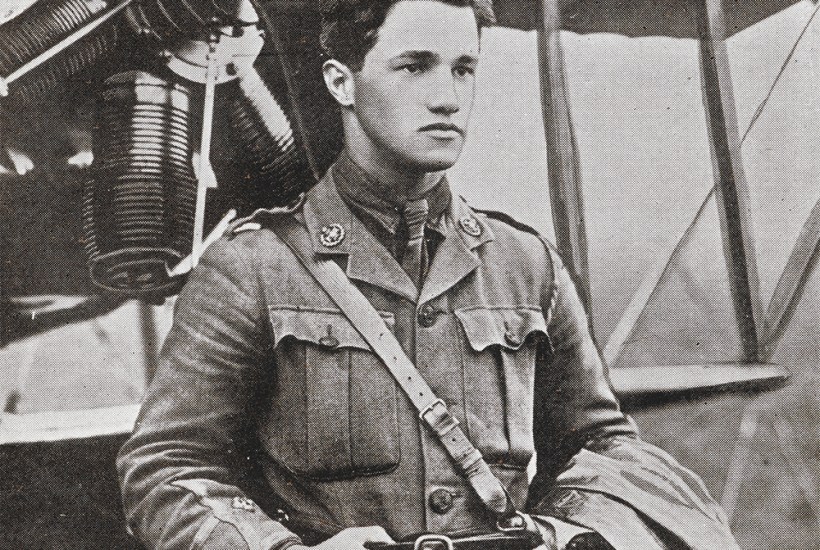
The first aeroplane flight in Britain was made in 1909 by John Moore-Brabazon, holder of the first British pilot’s licence. The same year, he strapped a basket containing a piglet to his craft in order to disprove the old adage. Pigs might now fly, but an industry didn’t – yet.
In Flying Pianos, Charles Spicer introduces a three-part cast of mavericks, Great War heroes and predominantly military champions of the earliest aeroplanes between 1906 and 1936. His evocative title is a poetic term for their elementary construction, also reflecting his breezy tone, as, despite the constant risk (plus dark pilot humour), he eschews truthful alternatives such as ‘spinning incinerators’.
Colourful flight compendiums are nothing new. The trick is to string together seemingly unrelated dreamers and doers across skies and decades. Spicer neatly lands interlinking chronological chapters via his chosen pantheon of individuals influencing British aviation. Refreshingly, not all are pilots or British; the UK was pleasingly open to outsiders in such an innovative field.
The stirring opening section, entitled ‘Winged Adventurers’, introduces us to a fledgling cottage industry, variously described as art, science, sport and ‘fantastic suicide’. This first generation of aeroplanes is the only one known under a collective term ‘Edwardians’, equally applicable to their constructors and pilots. Spicer keeps it light, despite the inevitable mishaps and permanent spectre of blunt force trauma.
The British were determined eccentrics, fuelled by rivalries both friendly (the rigorously competent French, whose terminology ‘aileron’ and ‘fuselage’ prevails today) and confrontational (the inventive Germans, with unique politics and airships challenging aeroplanes until the 1930s). The US played a cameo part at this stage. Despite their pioneering 1903 first flight, the Wright Brothers’ potential was stymied by their own secrecy. Spicer instead rightly lauds the American aviatrix Harriet Quimby for her valuable contributions (yet today only around 6 per cent of commercial pilots are female).
The book’s second section, on the airborne Great War, has to work hard and briskly to cover the rapid technical progression over four years of hell. The term the ‘Cavalry of the Clouds’ was an acknowledgement of the trenches many pilots graduated from, glossing over new horrors such as burning alive in mid-air or being crushed by forced landing. Aviation history also now becomes more general history, with audacious Zeppelins blitzing a defenceless London and embryonic legends of the next war appearing, particularly a frustratedly thwarted pilot named Winston Churchill.
The war’s galvanising effect was best demonstrated by the story of the servicemen John Alcock and Arthur Whitten Brown, first to overfly the Atlantic non-stop in June 1919 in their repurposed bomber. Even Charles Lindbergh acknowledged the two humble Brits eight years prior to his own Atlantic crossing, their feat now forgotten by a world awarding Lindbergh most of the credit. Spicer does reinforce the common untruth (first circulated in an exaggerated 1955 book) that the war-wounded Brown left his cockpit to chip ice from ailing engines with a knife. Brown’s published account describes kneeling up and out from the back of the cockpit to wipe clotted snow from the face of the overhead fuel gauge with his hand. Spicer cites both versions, yet prioritises the more colourful one over Brown’s original.
At the heart of Flying Pianos is the pilot-turned-spy Grahame Christie, who reappears from Spicer’s previous book, Coffee with Hitler. In fact, Flying Pianos feels tuned around Christie. The least known name in the cast appears across all three sections, painted from family archives (most of the book’s acknowledgements are devoted to him), but remains an enigmatic polymath.
The final third, covering the long consolidation from the armistice to the Spitfire’s origins, is the shortest and least satisfying, in part because aviation had expanded beyond any single narrative. Long-distance civil records are overlooked and the origins of airline flight get token comment. I’d have liked to have seen more about this transition as the obvious experiential link for the reader, instead of jumping into Christie’s post-aviation espionage career.
A truism of aviation books is that historians tend to prioritise academic ‘groundschool’ over communion with their quarry. I’d hoped to find Spicer following in his subjects’ wingtips with a new-found appreciation for the whistling of an aeroplane’s wires in the slipstream and the ticking of a hot engine as it cools.
These early pioneers were typically stoical, so kudos is due for rendering them into life from scant archive details a century on. We all now take flight for granted, with little knowledge of its brutal and romantic origins. Britain is celebrated for the most vital aeroplane components, wings and engines, but its heritage often goes unappreciated. Spicer’s heroes took on the intangible, unforgiving foe of physics itself. Lest we forget, we fly upon their shoulders today.
Got something to add? Join the discussion and comment below.
You might disagree with half of it, but you’ll enjoy reading all of it. Try your first month for free, then just $2 a week for the remainder of your first year.