The loud, wheezy hoot of the pit horn used to signal the end of the shift. Blaring across the town, it blew the changes. We’d all hear it. My father, as his father before him, was a GP in Ashington, a large mining town in Northumberland. Ashington was the hub of a network of subsidiary collieries including Woodhorn (now a museum), Ellington and Lynemouth, which both appropriately featured as film locations for Billy Elliot.
‘The UK went bust in 1976 under chancellor Denis Healey and had to be bailed out by the International Monetary Fund. Do we have a debt crisis today under his namesake?’
Mining was in the local blood. To work ‘doon the pit’ was a proud profession and a natural family succession. But after a postwar rejuvenation peaking in the mid-1950s, national production was already in steady, if not yet terminal, decline: cheap international competition was undercutting UK coal; in the wider locality, rapidly expanding privately owned open-cast mining had a significant cost advantage over the expensive deep-shaft mining prevalent in the National Coal Board; household consumption was falling thanks to environmental emissions legislation; commercial demand was reducing too with the demise of heavy industry.
Local unemployment was rising. By the late 1970s, the Hirst area of Ashington had such high unemployment that it was christened ‘Giro City’, with so many reliant on the weekly government Giro cheques for household income. Even if unavoidable, there was no pride ‘on the dole’; people needed work (and as importantly wanted to work for their own self-esteem); if take-home pay exceeded the state social security handouts, most took it.
Despite the loss of the town’s biggest employer when the pit closed in 1988, Ashington eventually picked itself up. New housing estates were built; the colliery yard became the prosperous Wansbeck Business Park; the enormous pit heap was levelled and landscaped into the Queen Elizabeth II Country Park; even the railway to Newcastle has been reopened for passengers, replacing the redundant line which once only carried coal to the also now defunct and demolished Blyth power station.
This is no mere stroll down memory lane. It has direct relevance to today. My own profession is not medicine but fund management. I and my ilk mark the government’s financial and economic homework. Pushing gilt yields to their highest in two decades, bond markets are sceptical. Half a century ago, welfare and social security costs amounted to 7 per cent of GDP; in 2026, they are close to 11 per cent and rising, seemingly inexorably, and yet the rates of unemployment are not dissimilar. Andy Burnham talks of the ‘wrong turns’ taken by the Thatcher governments of the 1980s when she took firm steps to restore the UK’s economic integrity and financial competence. The implication is her reforms, already diluted by successive governments, should be reversed in full.
Top of Burnham’s agenda are equality, equity and fairness. Life is unfair. Gaps can be closed but there will always be inequality. If household earnings more than 60 per cent below the national median define impoverishment, there will always be poverty; someone will be 60 per cent below the median unless everyone has an identical nominal income.
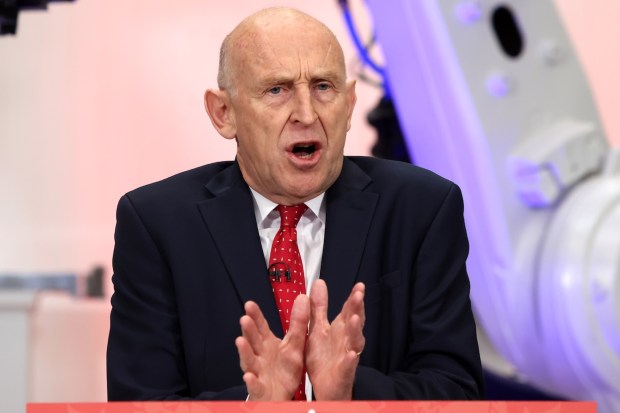
Chancellor John Healey must avoid the simultaneous welfare and taxation traps. Paraphrasing economist Arthur Laffer: benefits become entitlements; if you give people generous benefits for doing little, fewer people work and you incentivise recipients to expect more and do even less. If you increase taxation on people in work, penalising them to the point their marginal income benefits the Treasury more than the individual, rationally they will withdraw their labour (as happened in practice among NHS consultants). It destroys productivity. It is a blight on competitiveness.
Health and welfare are the government’s biggest outlays; the tax burden already weighs significantly and disproportionately on a small group of taxpayers providing a large percentage of government income tax receipts. The yawning deficit from ‘progressive’ welfare and taxation policies becomes self-fulfilling. In its latest Fiscal Risks and Sustainability (FRS) report, the Office for Budget Responsibility (OBR) explicitly warns of economic failure unless the government reins in spending; the International Monetary Fund (IMF) is equally unequivocal that the tax burden is way out of kilter, grossly imbalanced and so high that it is both unsustainable and incompatible with promoting a growth economy.
The FRS is a sobering document. It lays out the road to national insolvency. Paragraph 1.7, the prognosis in its introduction, should be compulsory reading for all adults, lectured at universities and taught in schools. The OBR models complex assumptions, forecasting 50 years hence. Its baseline conclusion is an explicit warning that without determined remedial action, by 2076 the UK’s budget deficit, the gap between income and expenditure, will have grown from 4.4 per cent of GDP today to 19.5 per cent in 2076. Debt/GDP would rise from 96 per cent to 300 per cent. The numbers are almost certainly wrong; the trajectory is highly likely to be correct.
The symptom is hyperbolic debt interest. In 50 years I will be 114 or much more likely dead: either way I will be beyond knowing or caring. But it will matter to my children and grandchildren. But most importantly and entirely relevant to the present, the deficit’s trajectory tipping point has been brought forward by almost a decade to 2036–46: put simply the fiscal train leaving the platform today becomes a runaway, uncontrollable monster in as little as ten years’ time. Knowing this, surely to ignore the warnings and to test the thesis to destruction is pure folly.
The UK went bust in 1976 under chancellor Denis Healey and had to be bailed out by the International Monetary Fund. Do we have a debt crisis today under his namesake? When bond yields make the late evening national news you can be sure there is a problem. In 2022, for example, Liz Truss’s ill-judged mini-Budget created a market panic. Today, despite the frequent reporting on them, bond markets are concerned but remain calm and rational. Gilt yields are their highest since 2007 to reflect the worsening inflation outlook and as a warning that the fiscal rules are inviolable. But we live in a fiat economy based on trust: trust has its limits. That limit is when institutional investors and foreign governments (in aggregate the main buyers of government bonds) decide that despite the best defensive efforts of the central bank, no yield is high enough to offset the risk of their never seeing their money again; they go on strike.
Which brings me to the Budget. Healey is pitch-rolling markets, parliament and the public ahead of his first ‘fiscal event’ on 28 October. The auguries are discouraging if he thinks Thatcher’s reforms, Liz Truss’s 2022 mini-Budget and Boris’s ‘hard Brexit’ are the root of our problems.
I described the debt interest as a symptom. The underlying disease which needs curing is the UK’s structural systemic weakness: a chronically unbalanced economy. It predates Brexit. We have an over-reliance on a burgeoning public sector particularly for marginal employment; too many working-age people are economically inactive and depend on benefits; a relatively diminishing private sector is heavily over-reliant on services and is under-invested and under-represented in manufacturing, from both of which flows a constant national current account deficit. These are the real underlying problems.
Quick fixes? No. Early wins? Yes. A turnaround is conditional on an internationally competitive cost base. Government must lower energy costs and create 100 per cent energy security and reliability. Private-sector financial and frictional employment costs must be reduced. Once achieved, tax incentives attracting inward investment can be offered especially for manufacturing. Rachel Reeves’s assault on IHT exemptions for family businesses (and farms) catastrophically breaks the continuity of capital, entirely inconsistent with retaining and attracting long-term investment capital; it must be scrapped. These are all directly in the government’s control.
Encourage risk-taking! Unleashing the private sector will catalyse a vibrant, match-fit, competitive economy capable of taking on the best in the world. We will never remove inequality but we certainly can facilitate conditions in which national income and personal living standards rise to everyone’s benefit.
Ashington is far from perfect. However, despite long-term deindustrialisation, it shows there is an alternative to the dystopia and dysfunction witnessed in Middlesbrough and elsewhere. Level up, not down. It’s not about hope and handouts; what people want are inspiration and aspiration. These are not wrong turns; they are essential needs. If government really gets a grip, it will give itself headroom to make choices. Investors like me will no longer need to mete out pain in higher borrowing costs to cover the risk of financial failure.
Alastair Irvine is an Investment Director at Jupiter Asset Management