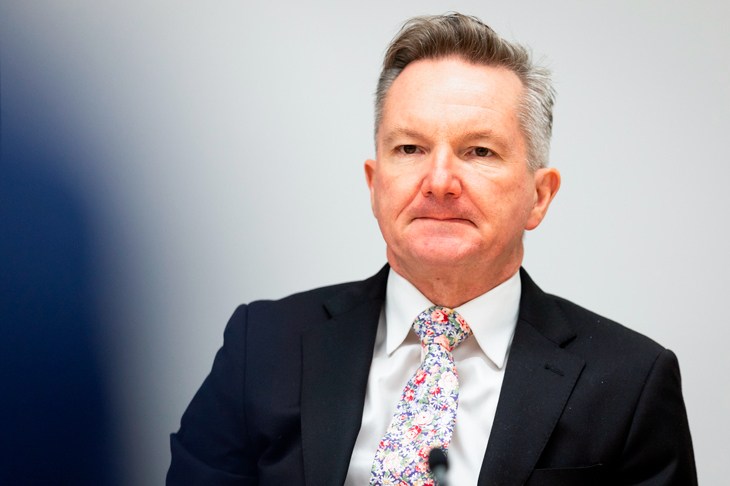
On Monday night, Climate Change and Energy Minister Chris Bowen conceded that green hydrogen had proved slower and more expensive to develop than enthusiasts had hoped, adding, ‘I never quite bought all the hype on green hydrogen at the top.’ Really?
Who knew Bowen was a hydrogen sceptic as he ploughed $2 billion into Hydrogen Headstart, the scheme or scam he described in 2023 as a ‘game changer’? Large-scale renewable hydrogen was critical to Australia becoming a renewable-energy superpower, potentially adding $50 billion to GDP and creating more than 16,000 jobs by 2050.
Questioned about his newfound incredulity, he explained that hydrogen still had a future in industrial decarbonisation even if some of the more extravagant expectations had not survived contact with economics.
It was just like EVs, he explained, which ‘just overtook petrol vehicles in Australia’.
Follow the logic? EVs outsold petrol vehicles in August in new-car sales: 27,000 battery EVs versus 25,824 petrol cars, and just like that, an argument about billions committed to hydrogen was answered with sales of Teslas and BYDs.
This is Labor’s new doctrine of ministerial responsibility: never defend the statistic when you can replace it with another one about something else.
Housing Minister Clare O’Neil has mastered the technique. In June, O’Neil acknowledged that the property market was undergoing a ‘correction’. Auction clearance rates had fallen below 50 per cent, and prices were falling in Sydney and Melbourne. She accepted that Labor’s changes to negative gearing and capital gains tax would influence the market, while arguing that higher interest rates and other factors were more important.
Then the correction was corrected.
In July, the Housing Industry Association reported three consecutive monthly falls in new-home sales, blaming higher borrowing costs and policy uncertainty. In August, the most expensive quarter of houses in Sydney and Melbourne were down more than 10 per cent from peak values. New-home sales fell almost 20 per cent over the three months of winter.
Yet when Natalie Barr asked her on Wednesday whether she was concerned that the housing market appeared to be ‘tanking’, the minister objected.
‘I don’t agree with that language at all, Nat,’ she said primly, pointing instead to housing approvals, which are higher over the longer term. Never mind that you can’t live in an approval, and the Reserve Bank expects construction activity to fall, the Minister isn’t worried, so long as you don’t mention the T-word. Tanking.
Then there is the Treasurer. Since the May Budget, he has progressively played catch-up, discovering how his reforms will devastate the economy and performing a series of awkward manoeuvres attempting to mitigate their effects. Last week the start-up arrangements changed yet again, and Treasury is consulting on the new minimum tax for discretionary trusts. Chalmers insists Treasury is consulting ‘in the usual way’: announce the policy in the Budget, work through the wreckage afterwards.
The good news is that some of those defrauding the National Disability Insurance Scheme have been brought to justice. It was hard to detect these characters just by their names – Joanne Mobbs, who was jailed for fraudulent claims; Muna El Shreffy and multiple members of the Al Sham family, convicted over the Al Sham syndicate fraud; and the unfortunate Mr Ufuk Dik, convicted after spending fraud proceeds on luxury goods. What did he do with the goods? Don’t ask.
As for the Prime Minister, he’s been busy raising awareness about how few world leaders are attending his Fijian climate jamboree and hosing down a backbench revolt, presumably over Minister Tony Burke’s plan to invite the population of Gaza to move to Australia.
Burke has been cagey about his plans, but Labor’s principle is simple: grow the pie and ignore the fact that everyone is getting a smaller slice.
The One Nation principle is also simple: shrink the pie and ignore the fact that everyone is getting a smaller slice.
Those who want to grow the pie and get a larger slice are out of luck. The party advocating that policy is running a distant third in Newspoll.
This week, shadow treasurer Tim Wilson said, ‘Reality is catching up with the Albanese government’. Right on cue, the Whyalla wipe-out finally arrived. For those lucky enough to have forgotten, fourteen years ago, during the carbon-tax debate, then Minister Craig Emerson caterwauled ‘No Whyalla wipe-out right there on my TV’ to mock Tony Abbott’s warning that under Labor’s carbon tax, Whyalla would be wiped off the map.
The town is still there, of course, but its blast furnace is being shut down, 600 jobs are disappearing, and $3 billion of public money committed to the steelworks since last year is unlikely to see steel being produced again any time soon.
Geoffrey Brooks, Professor of Engineering at Swinburne University, says the shift towards green production routes presents opportunities for Whyalla, and the local abundance of solar energy is likely to be a significant advantage for the plant’s future, but that converting the plant from coal-based technology to non-coal-based technology (using hydrogen ironmaking) will take significant investment and technical skill. Perhaps he needs to have a chat with Bowen about that before getting his hopes up.
Back in the real world, energy-intensive manufacturers like the Tomago aluminium smelter survive on government subsidies. Market-sector productivity has stagnated for a decade. Those who want to invest in business are exploring their options in Singapore, America, and any other country where hydrogen sceptics haven’t been let loose on the energy grid and the housing supply isn’t tanking.
It’s the Victorianisation of Australia. The cautionary tale of Latrobe Magnesium is a prime example. Together with the CSIRO, it developed a technology that recycles brown-coal waste into highly valuable magnesium, a critical mineral overwhelmingly supplied by China.
But just as it was poised to invest, Victoria introduced a regime that made it commercially unviable, so it’s moving to South Carolina.
That’s the reality that is catching up with all of us. It won’t be a case of last one out, turn off the lights; just blow out the candle.
Got something to add? Join the discussion and comment below.
You might disagree with half of it, but you’ll enjoy reading all of it. Try your first month for free, then just $2 a week for the remainder of your first year.