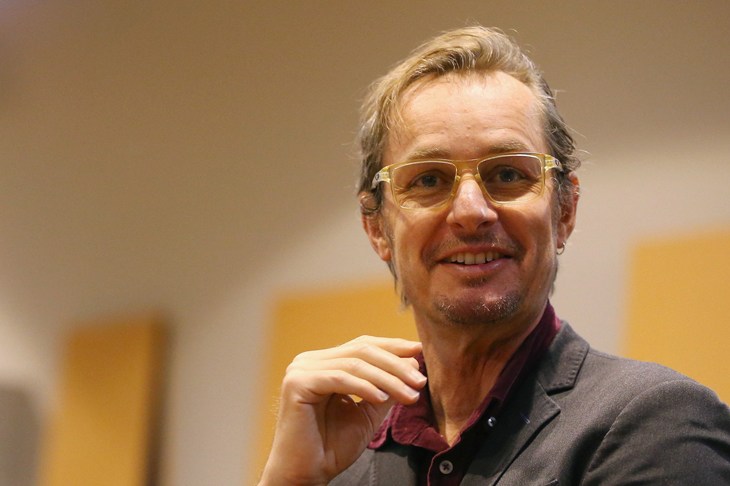
The world of artistic expression runs in a thousand ways. The Melbourne Symphony’s Spring Gala – paralleling the Opera’s Wagner spectacular – will present a performance of Brahms’ German Requiem with the dream casting of Sir Bryn Terfel, the greatest bass-baritone of his generation. David Malouf said once of a rendition Terfel had given of Schubert’s Lieder that it was the greatest musical performance he had ever seen.
Terfel opens with sacred and traditional things: Grace Williams’ Concert Overture, Deep River, Androzzo’s If I Can Help Somebody, At the River from Copland’s Old American Songs, Calon Lân – preparing the ground for the German Requiem which closes both the concert and the MSO’s two-week Brahms Festival.
Brahms didn’t want a German rejig of the Latin Mass. His Ein Deutsches Requiem dispenses with the immemorial Latin and finds its inspiration in Luther’s Bible, articulating the grief for which he required a supreme expression.
The MSO’s version comes with the conducting of Jaime Martín, the soprano Alexandra Flood and the MSO Chorus directed by Warren Trevelyan-Jones. Martín is likely to find his own plangency in the kind of dramatic articulation of this mightiest of mid-Victorian laments. (Thursday 19 November and Saturday 21 November.)
A very different concert focused on Beethoven is promised by Richard Tognetti with his Australian Chamber Orchestra, who from 12 to 25 November are presenting the Coriolan Overture, the Triple Concerto for Violin, Cello and Piano in C major, and his Pastoral Symphony No. 6. The last is a gorgeous evocation of the natural world, with a beauty of mood and proportion which – storms notwithstanding – is a long way from the titanic and towering Beethoven who sounds as though he could set fire to the world. The soloists are Tognetti on violin, Konstantin Shamray on piano, and principal cello Timo-Veikko Valve.
It’s cheering, as ever, to see that Bill Henson, that greatest of all Australian photographers, has another show at Roslyn Oxley’s gallery, opening Friday 25 September at 7 p.m.. Bill is a consummate artist, as alive to the fiction of Thomas Mann as to the sculpture of the Renaissance.
History kindles the imagination in a thousand ways. Just at the moment the Bayeux Tapestry has jumped the Channel to present the most archetypal image of eleventh-century warfare, when the Battle of Hastings in 1066 changed forever the genealogy of British culture.
It’s hard not to be grateful to the Bayeux Tapestry makers for the indelible image of those Norman nose pieces that also adorn the ancient 20th-century dramatisation in the TV Robin Hood riding through the glen with his band of men. All sorts of up-against-it writers – blacklisted Americans working in England under pseudonyms, Ring Lardner Jr among them – wrote scripts for this homage to the welfare state.
It’s funny to see in this context that the TV scriptwriter Andrew Davies has written a memoir called An Unsuitable Boy. The title – somewhat audaciously – echoes Vikram Seth’s A Suitable Boy, which is a bit like War and Peace without the intellectual architecture.
Davies made Colin Firth, as Mr Darcy, some kind of sex symbol when he presented him emerging from a lake in a drenched shirt in the 1995 Pride and Prejudice, opposite Jennifer Ehle. Davies seems to crow in delight at all the people who objected to the suggestion – depicted in the 2016 version of War and Peace – that Anatol Kuragin might have slept with his sister. Well, it’s in the text, though there’s not much to be proud of in this version, with Paul Dano as Pierre. You will get much more of the flavour of Tolstoy’s epic from the 1972 BBC version with Anthony Hopkins.
Davies’ real achievements were the original House of Cards with Ian Richardson, and then those deliberate imitations of serial form – the self-knowing version of Bleak House with Gillian Anderson as Lady Dedlock and Anna Maxwell Martin as Esther. This was followed by an equally faithful Little Dorrit, with Claire Foy in the title role and Tom Courtenay as her debt-ridden dad.
Davies knew, intimately and emphatically, how much Dickens had in common with the serial writers of the 1950s television screen.
It’s fascinating to see that an eminent classicist, Professor Patricia Easterling, has died. She was a close associate of Mary Beard, and was fascinated that Iphigenia could accept her sacrifice by her father Agamemnon, but her mother Clytemnestra saw only the darkest, most despicable murder. Easterling was, in her Cambridge days, a great backer of performing Ancient Greek plays in the original language.
It would be a great thing if Jane Montgomery Griffiths, who directed some of them at Cambridge, were to do the Greeks in the original here. The adoptive Australian actress – compared in her youth to Diana Rigg – burns up any ‘classical’ stage that dares to display her gifts. In 2010 she played Clytemnestra in Sophocles’ Elektra – the play which impelled her to learn Greek – in Anne Carson’s translation, with Zahra Newman as the avenging daughter.
It’s good to see Rob Brydon is playing Herod for a week in early-November in the London revival of Jesus Christ Superstar.
It’s hard to say the same of the NT Live’s The Misanthrope with Sandra Oh, in Martin Crimp’s new version, with Alceste turned into Alice, a celebrated novelist. It came across as stimulating but crass and over the top. In 1973 the National did it with Alec McCowen as Alceste and Diana Rigg as Célimène. An eminent Australian actor did not realise until the following day that Tony Harrison’s translation – so fluent and precise and understated – was actually in rhyming couplets. Molière does not have Shakespeare’s ability to sum up a thousand worlds, or Sophocles’ supreme economy, but he is an absolute master of dramatic form, and belongs with them.
Got something to add? Join the discussion and comment below.
You might disagree with half of it, but you’ll enjoy reading all of it. Try your first month for free, then just $2 a week for the remainder of your first year.