There are two leading trends in Australian politics which are firming against Labor , and which, I suspect, will hold through to the next election.
The first is one I arrived at before seeing Peta Credlin’s recent eloquent call: the Australian electorate has given up on Anthony Albanese. The second is that Senator Pauline Hanson has firmly consolidated her position as the preferred leader of a growing body of Australians defined by their deep patriotism and their common sense.
The beginnings of the current surge behind One Nation became apparent even during the last federal election,
This was demonstrated in the decisive swing in the Hunter electorate and One Nation winnng the contest with Labor for the sixth NSW Senate seat. Notably, One Nation’s NSW Senate candidate, Warwick Stacey – who served with distinction in both the Australian and British armies – has long been a leading, dedicated member of Australians for Constitutional Monarchy (ACM).
Because my conclusions on politics have often differed radically from the commentariat’s consensus, I feel I should point out that I have been blessed with actual experience in front-line political campaigning. The most significant dated from when, to my surprise, I was invited to serve as the second National Convenor of ACM. This was shortly after the 1998 Constitutional Convention and leading into the 1999 referendum on until now. Contrary to the overwhelming projections of almost all the mainstream media and the political establishment, ACM’s sole and lean Australia-wide campaign triumphed nationally, carrying all six states and around 72 per cent of federal electorates.
I was, of course, merely one among many devoted Australians. My principal advantage lay in chairing the executive in daily meetings where our tactical countermeasures were forged. On the anniversary of that historic victory, we inaugurated our annual National Conference and have convened it every single year since – the only 1999 campaign organisation to have done so.
I am delighted that this year our conference keynote Senator Neville Bonner Dialogue will be held with Senator Pauline Hanson over lunch on 13 November. It promises to be a fascinating exchange, demonstrating that far from having no policies, One Nation is uniquely also addressing the profound, long-term constitutional and civic questions confronting this nation. Details will soon be available on the ACM Facebook page and across our social media platforms.
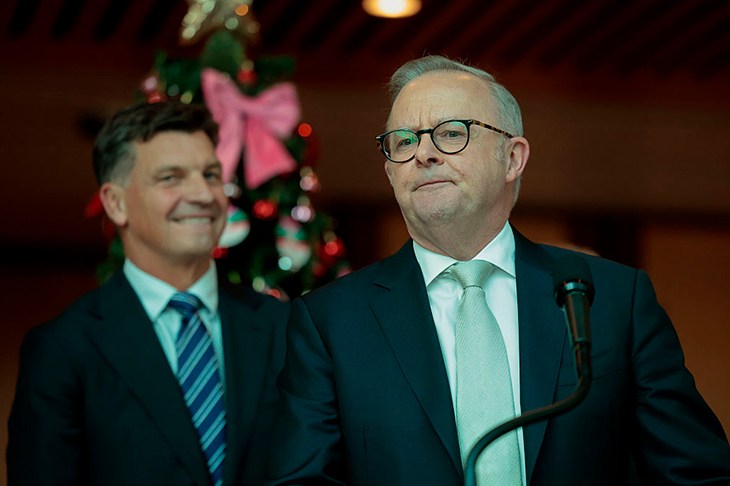
Meanwhile, the firming of Senator Hanson’s influence has also had a salutary effect on the Coalition itself. Her electoral presence has helped ensure that two good men – Angus Taylor and Matt Canavan – have emerged as steadfast conservative leaders. Even the ‘Labor-lite’ faction, the ‘moderates’, probably concede that their notion of a compromised ‘broad church’ is, if not completely buried, comatose. In that respect, it is following the republican movement into political irrelevance.
This conservative resurgence is accelerated by the electorate’s visceral recoil from Anthony Albanese. The prime ministerial mask slipped entirely with the sordid revelation of his machine firing off a vicious dirt sheet targeting independent MP Helen Haines for simply holding the government accountable over gross pork-barrelling. For the Prime Minister then to feign wide-eyed innocence, deny the undeniable, and even claim the dirt sheet was a ‘praise sheet’, demonstrates that we possess a first minister representing a new low in political accountability. No wonder Australians are giving up on him.
While the press gallery engages in its ritual dance of selective amnesia, ordinary Australians recognise that the promised era of ‘kinder, gentler politics’ was always a cynical sham.
Yet this abandonment of basic integrity in parliament is merely one symptom of a far deeper institutional rot now afflicting the Commonwealth. Parallel to these political manoeuvres, there is a profound, simmering public anger regarding the administration of justice. In recent weeks, I have detected widespread annoyance over high-profile prosecutions where authorities have resorted to ‘show arrests’ and theatrical techniques. Under the rule of law, the state must never stoop to orchestrating public spectacles that will inevitably generate trial by media. The fundamental principle of the rule of law in criminal trials – the presumption of innocence – is being actively dismantled.
We have seen this in the treatment meted out to Australia’s most decorated soldier, Ben Roberts-Smith VC. That our nation’s highest-honoured warrior should be subjected to this ordeal is an appalling scandal.
Much of this crisis traces back to the ill-advised decisions to downplay traditional courts martial by centralising military prosecutions under a Canberra-based Director of Military Prosecutions stripped from the operational command structure and potentially lacking combat experience.
We saw the ruinous failure of that regime in the 2011 McDade case, where commandos were hauled before the courts on manslaughter charges for doing no more than responding, as soldiers must, when coming under live fire.
This error of the political class was compounded by Australia’s unwise ratification of the Rome Statute for the International Criminal Court contrary to the US example, and the subsequent incorporation of battlefield conduct into the domestic Criminal Code. If any allegations against Ben Roberts-Smith warranted examination, they should have been tested while he was under army jurisdiction through a general court martial.
The very idea that a civilian-style commission of inquiry could retrospectively adjudicate events occurring years earlier in a brutal, foreign combat zone – against an unconventional enemy wearing no uniforms and hiding among the population – was fundamentally infeasible. Yet the resulting Brereton Report was treated by military bureaucrats and politicians as if it contained settled, proven facts. The ultimate outrage occurred when Attorney-General Michelle Rowland approved a prosecution brief emerging from the $300-million Office of the Special Investigator – one of only two briefs advanced from what seems a bloated exercise.
What is totally unacceptable to fair-minded Australians is that Roberts-Smith has been advised he will not even appear before a jury for five years – a delay that could easily stretch into seven, nine, or more years. The process has become what the 1689 Bill of Rights expressly forbade as ‘cruel and unusual punishment’. It is an inversion of British justice that few Australians of common sense and goodwill will long tolerate.
The next government should advise the exercise of the Royal Prerogative of Mercy and stop this torture.
Got something to add? Join the discussion and comment below.
You might disagree with half of it, but you’ll enjoy reading all of it. Try your first month for free, then just $2 a week for the remainder of your first year.