They were both films that stay in the mind from a lifetime ago. Peter Pan is J.M. Barrie’s contribution to the mythology of the world. Some of the greatest actors had a go during the pantomime season at the role of Captain Hook but the version that took the world by storm was the Disney one – with songs like ‘Never Smile at a Crocodile’ – of this saga of a London family – John in a top hat, the dog Nana – and the stately Wendy, not to mention the Lost Boys made for the most magical of mystery tours. There were local attempts to rival it – one at Melbourne’s Princess Theatre with Mary Hardy, the novelist Frank’s sister – but Tinkerbell the fairy was central to the Disney vision of Neverland and the world of romance that ranged from Davy Crockett to Robert Louis Stevenson’s Kidnapped with Australia’s Peter Finch as the dashing hero Alan Breck Stewart.
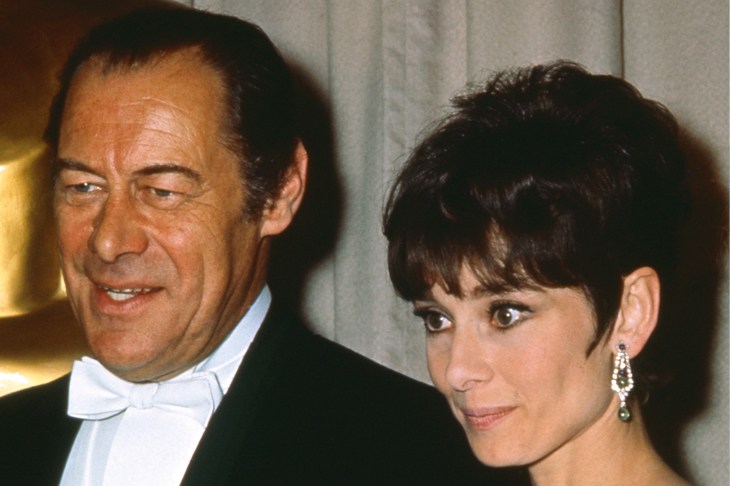
If Stevenson was one master of the ripping yarn then there was Sir Walter Scott before him with his extraordinary tales of knights in shining armour in the midst of the Crusades. In fact, the film that stays in the mind has the rather bland title King Richard and the Crusaders though it’s the subtitle that gives the game away: The Talisman and it is one of the most seductive of Scott’s medieval books. The movie has George Sanders as Richard the Lionheart, Virginia Mayo as Lady Edith Plantagenet and Laurence Harvey – who did Of Human Bondage and The Manchurian Candidate – as Sir Kenneth, the Knight of the Sleeping Leopard. Then there is an enigmatic figure who fights Harvey in desert sands and then ministers to the Lionheart who has fallen to a poisoned arrow. He is a man of great suavity, dark and brilliant, played in this version of The Talisman by Rex Harrison. King Richard and the Crusaders came out in 1954 and within a couple of years Rex Harrison with his wonderfully clipped English, much-admired by Shaw, was on the Broadway stage as Henry Higgins opposite Julie Andrews’ Eliza Doolittle in My Fair Lady.
He’s tanned with dark hair in the Walter Scott film but Scott’s chivalric glory and treachery sold like Harry Potter. The Talisman is a companion piece to Ivanhoe which Sam Neill did for British television – playing the villainous Brian de Bois-Guilbert – with a colossal panache he found embarrassing to remember though the rest of the cast included his mentor James Mason as Isaac the Jew.
Edmund Wilson said Scott wrote in a plum-cake style like Gogol the Russian master of The Overcoat. Well, Dostoyevsky who knew everything about how much drama you could fit on the page said, ‘I came out from under that overcoat too.’
It’s interesting to see that Benedict Andrews together with Cate Blanchett and Nina Hoss are doing an unusual piece of combination theatre in which the tossing of a coin determines whether they perform first Sophocles’ Electra and then Ingmar Bergman’s Persona, or vice versa. Some devotees of King Richard and co. were terrified by Liv Ullmann and Bibi Andersson because it was like a symbiotic delineation of madness though with the passage of the years this Sixties drama of faces coalescing has its own aspects of grim angular humour.
It’s all a long way from the spectacularism of The Talisman which readers may be surprised to learn has Rex Harrison at one point singing a song which he famously had little skill at hence his invention of Higgins’ Sprechgesang. The voice we hear, partly off-camera, certainly sounds like his though Hollywood has always been tricky where audio is involved. It’s also the case that Scott presents the sultan as a figure who is not only wily but essentially enlightened and good. It’s interesting to be confronted with the spectacle of a great Saracen leader who wants peace and mercy to prevail though it makes for a very dynamic cloak of enigma and compassion.
Any standard reference work will tell you that Saladin was a dazzling foe. Although he retained Jerusalem after Coeur de Lion won back the towns along the coast Saladin allowed open access to pilgrims and the crusaders were awed by his chivalry. Even Dante places him in the Limbo for good pagans: ‘and I saw alone the Saladin’. Even in Shakespeare’s Henry IV the old usurping king imagines he will die like a crusader in Jerusalem whereas that is simply the chamber where he lies.
King Richard and the Crusaders is performed in what is almost high Australian. This does not include either of the women, who simply speak American English, nor Harrison, Sanders and Harvey, but it does encompass half the supporting cast. The Australian actor Michael Pate, who did Matlock Police in his later days and played Archbishop Malone, the Mannix-like figure in the television version of Frank Hardy’s Power Without Glory, plays a villain in King Richard who uses a sort of loose but high-toned accent, an Antipodean equivalent of high American but much more relaxed.
Are we building a monument to cultural nationalism in Canberra with the Lyric Theatre? Well, why not? We continue to need a national theatre which will open shows in the national capital and then take them to Sydney and Melbourne perhaps alternating classic and modern Australian work. But we need a national level of achievement parallel to the Ballet and the Opera. Some people would say the Sydney Theatre Company under Cate Blanchett and her husband Andrew Upton was a substitute national theatre not only with Benedict Andrews’ progressivism but with guest directors like Philip Seymour Hoffman or Liv Ullmann directing Blanchett in A Streetcar Named Desire. It should be taken for granted that this theatre will exhibit a level of achievement where any performer or conductor or choreographer in the world should be proud to perform with it. And we should prize our Neil Armfields as well as Kip Williams with his solo cinematic extravaganzas like Dorian Gray with Sarah Snook. There is also the expectation with Iain Sinclair that here is a world-standard director who can take the vision of theatre and simply realise it with a dynamism which is equal to upper-level cinema.
Got something to add? Join the discussion and comment below.
You might disagree with half of it, but you’ll enjoy reading all of it. Try your first month for free, then just $2 a week for the remainder of your first year.