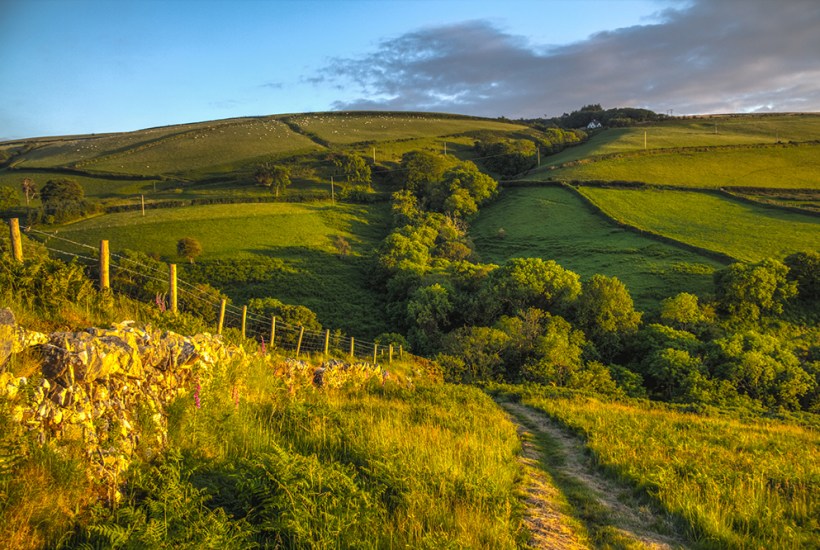
‘How long have they been here?’ ‘Three generations.’ ‘Ah, just grockles, then.’ Exchanges such as this must have taken place in countless Devon villages. A ‘grockle’ is a Devonshire term for a tourist or incomer. I suppose it could be offensive. But being called a grockle is not usually a term of abuse and in general the word is spoken with a half-smile rather than a grimace. Not least because, in Devon at least, ceasing to be a grockle and becoming its opposite – the local lad or girl – is a generational endeavour.
I am definitely a grockle. I moved to Devon from Huntingdonshire when I was 20 to work on a dairy farm near East Worlington. (Not to be confused with West Worlington, since although within chucking distance of each other they fought on opposing sides in the Civil War.) Fatally, although I still return to Devon occasionally for farming work, I now live in London, perhaps the spiritual home of grockledom.
But I could have lived in Devon until I was 90 and still have been a grockle. My employer’s late father, Michael, who had been a Devonshire farmer for more than six decades, used to joke that he himself was still a grockle. Why? He was born in London and only realised that he wanted to be a farmer when he was evacuated to the countryside during the war. A near lifetime of work in Devon’s fields was not quite sufficient to make himself a true Devon local.
I was once having a pint in a pub a short drive away from the farm. It was in either Black Dog or Nomansland, which are names of villages not public houses. I went outside for a cigarette and found myself standing next to two young farmers. After a while and a few drags – conversation not being frivolously started in Black Dog or Nomansland – one of them commented on the weather. Probably it had been raining either too much or not enough. Suitably refreshed, talk of the weather led to further conversation.
Whose farm do you work on? Tim Wall’s. What farm’s that? Rackleigh. Where’s that to? East Worlington. But there the conversation ended. ‘Worlington? Few miles away that, that is.’ Which made me think I might have achieved the impossible. Being mistaken as a foreigner from East Worlington.
Ironically, I felt less of a grockle on the rare times I went all the way down to Exeter. In the summer, we sometimes went drinking in the pubs on a Saturday evening. I was like wide-eyed Cain Ball in Far from the Madding Crowd who, visiting the city of Bath, also realised too late that ‘God didn’t provide’ em with victuals as well as drink.’ Eventually, at God knows what time, we’d try to find our parked car at the Quay and toss coins for who had to use the steering wheel as a pillow. We were always glad to get back to the safety of the farm after a night abroad in south Devon.
Roger Scruton, who was himself a newcomer to his own part of rural England, wrote he learnt from country people ‘the value of many things: of patience and sacrifice, of rooted loves and settled customs’. I have learnt such lessons, too, through meeting men like Michael, who may have been a grockle but was the archetype of the Devon man.
Got something to add? Join the discussion and comment below.
You might disagree with half of it, but you’ll enjoy reading all of it. Try your first month for free, then just $2 a week for the remainder of your first year.