Every so often something comes along that is so bad it fills the soul with wonder and dismay. It seems like a denial of nature that the upshot should be as bad as it is and it is all the weirder when criticism is the subject of the story. All things being equal, dire criticism is part of the descriptive apparatus of a review. Kenneth Tynan (the great critic of the 1950s who wrote with such eloquence about classic theatre) denied the greatness of Vivien Leigh’s Cleopatra by quoting South Pacific, ‘And she’s broad where a broad should be broad.’ In other words, she looked so alluring that everyone forgot about the acting.
And there’s plenty of this sort of thing. Tynan said that Alec Guinness played Richard II at the top of his voice and it was the peculiar quality of Sir Alec’s voice to have no top. Tynan said of the young Richard Burton, ‘He carries his cathedral with him.’ Then again it was Dorothy Parker who described the young Katharine Hepburn as going through every shade of feeling from A to B but what an inappropriate recipient she was for that put-down.
And so it goes. ‘Critic’ is the top insult in Waiting for Godot as Vladimir and Estragon are dishing out their duet of infamy and insight. But Beckett knew what he was doing when he angled to get Buster Keaton and Marlon Brando to play his tramps just as John Gielgud (who came to bitterly regret his judgement) described Godot – to Ralph Richardson and Alec Guinness, no less – as ‘a load of old rubbish’. It ended up being performed in its first run, by a group of young actors which included Paul Daneman, Richard Burton’s comrade-in-arms at the Old Vic, who went on to play King Arthur in Camelot on the 1964 Australian tour.
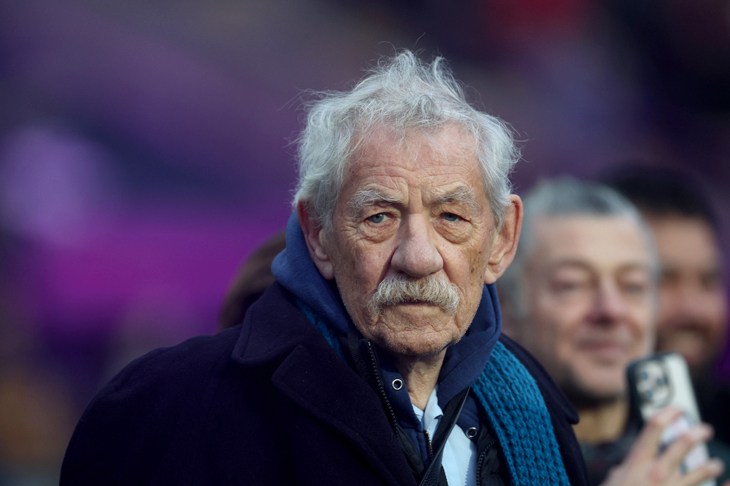
Well, Sir Ian McKellen has given some of us our more dazzling moments in the theatre. A deadly and devastating production of Strindberg’s Dance of Death with the great Frances de la Tour, a Waiting for Godot classical in its phrasing but full of cadence and glory with Roger Rees, and two performances of the Trevor Nunn production of King Lear first at Stratford and then in Melbourne, the latter with the formidable Frances Barber as Goneril and as great an approximation to Shakespeare’s greatest tragedy as you could ever expect to see.
It’s odd then to see Ian McKellen fronting a truly awful film called The Critic. He said to me once, ‘You know with critics that although they might appear to get it right that is all it is… it’s a happenstance, a fluke, you should count yourself lucky but that’s all it is.’ Well, I had spent thousands of words, over a couple of supplements, doing what I could to establish just how great the Ian McKellen/Trevor Nunn King Lear actually was and why. We spent a lot of time with McKellen who was playing Sorin the uncle in Chekhov’s The Seagull and who fell dramatically ill the day we took him to lunch at the Press Club.
So it’s weird to see him in a piece of work as shoddy and shambling as The Critic. If the theatre is one of your central interests you’re likely to have heard of James Agate, the major critic of the inter-war period, famously eloquent and acerbic. Wasn’t it Agate who had said of Laurence Olivier’s first, boyish Hamlet, ‘The greatest performance of Hotspur I have ever seen.’ Hotspur, you’ll recall, is the impetuous Geordie rebel lord who leads the insurrection against Henry IV. He is dashing, full of fire, the opposite of introspective. ‘Doomsday is near,’ he cries, ‘die all, die merrily.’ A young Sean Connery role.
So what in the name of God is happening with The Critic? It has a distinguished cast but the upshot is ridiculous. McKellen’s critic gets involved in setting up a liaison with the most deadly effect and the silliness of the scenarios is a gross insult to the actors involved whose considerable talents are put to such shoddy use in this silly and drivelling piece of tosh. Newspapers are cutting back and a magnate played by the great Mark Strong is lured into a relationship with the beautiful Gemma Arterton who is represented here as a wooden talent whether in Webster’s The White Devil with its riddling dance of evil or in that supremely plangent Shakespearean comedy Twelfth Night.
There are improbable shooting ‘accidents’, there are improbable deaths by water. The fine actress Romola Garai – who played Cordelia, Lear’s daughter, with McKellen on stage – is here as Mark Strong’s daughter. It’s all such a waste but then waste is the name of the game here. Patrick Marber who wrote Closer – which was filmed, brilliantly by Mike Nichols with Julia Roberts, Jude Law and Clive Owen back in 2004 – has written a puny sketch of dreadful subjects. Oswald Mosley’s Blackshirts are on the march, there is police brutality against gays and there is also – very unattractively – internecine treachery among gays and the upshot at every point is a shockingly superficial fiddling with the shadow of history.
It’s sickening, it’s offensive in its rapid silliness and asinine stupidity. Every so often a grand figure like Lesley Manville will appear like a guest at the table of a group of idiots fiddling with a storyline that would make Agatha Christie look like Tolstoy.
Patrick Marber should bury his head in shame. His previous efforts like Don Juan in Soho at least had the benefit – in London – of Rhys Ifans (even if Marcus Graham seemed an improbable Australian substitute). But The Critic degrades anyone involved in it.
All of which makes it deeply cheering that Greg Carroll who knows about every aspect of theatre has persuaded Glenn Elston (famous for his Shakespeare in the Botanical Gardens) to do a production of one of the greatest modern plays, Harold Pinter’s The Homecoming – which Peter Hall did on stage in 1965 and then for the American Film Theatre. Greg Carroll’s production has Richard Piper in the Paul Rogers part of the father from hell, Ben Geurens perfectly cast as Lenny and Kate Kendall as Ruth. Kendall was a dazzling Beatrice in Glenn Elston’s Much Ado About Nothing in 2014.
It opens at the Athenaeum Theatre on September 17.
Got something to add? Join the discussion and comment below.
You might disagree with half of it, but you’ll enjoy reading all of it. Try your first month for free, then just $2 a week for the remainder of your first year.