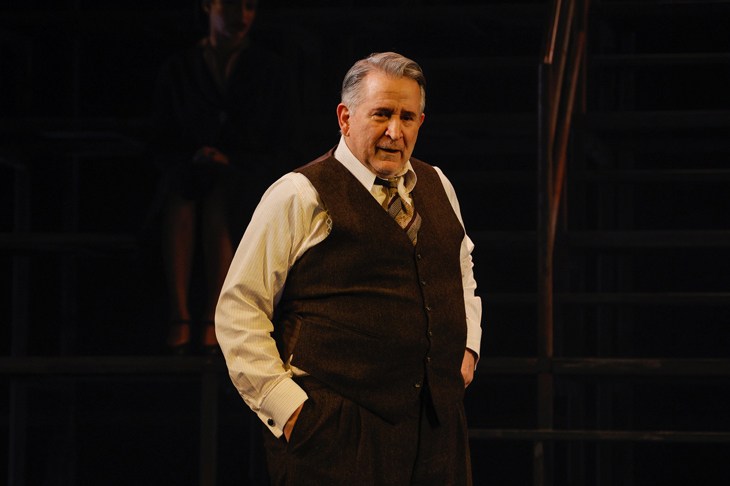
It’s more than 75 years since Lee J. Cobb opened in Elia Kazan’s production of Death of a Salesman and the passage of time has simply confirmed Arthur Miller’s claim to have produced the great American play. Death of a Salesman is the great theatrical indictment of the New Deal and all its bright hopes for a world that would look after its most vulnerable members. It is not a sentimental melodrama, it is a fully-fledged tragedy and its power and grandeur are breathtakingly manifest in this revival of Neil Armfield’s production and the extraordinary range of Anthony LaPaglia in the leading role of Willy Loman. And the tragedy of this poor, suffering, deluded character is to think there is more than indifferent tolerance in the world that has chewed him up and now spits him out.
There has been a string of Willies since Lee J. Cobb essayed the role – and which led to Cobb’s bewildered testimony before the House Un-American Activities Committee in 1953. The production we saw in London with Brian Dennehy would be hard to beat and people rave about the late Philip Seymour Hoffman as Willy Loman under the direction of Mike Nichols (the man who gave film an idiom, swerving and effortless for Albee’s Who’s Afraid of Virginia Woolf? with Burton and Taylor). Notwithstanding this, Anthony LaPaglia is as great a Willy Loman as you could wish for.
He looks utterly overblown and decrepit and has a highly credible authority which works against itself like a deadly physical ailment. The booming, then rattled, New York bass is from the outset a horror waiting to find articulate form. He talks of blacking out at the wheel of a car, he can’t remember the last few hours let alone the point of an existence so precarious. At the same time he is sustained and blinded by the story he tells himself about his intrinsic worth. The dark truth, of course, is that the story is true because Willy is loveable though he is also a poor player, strutting and fretting and signifying nothing to a resolutely capitalist world mitigated (but by how much?) by a Keynesian vision that knows the price of everything and has little time, then no time, for the man who asks for the relics, the mere crumbs of human necessity.
Death of a Salesman is a twentieth-century Lear of human transience presenting the emotional stigmata where the voice of love, even and especially true love, brooks no divergence. Anthony LaPaglia plays this ruined monarch of the dwindling retail trade like a god, full of madness and clamour and delusion. Everyone should see this Willy Loman: his characterisation is a monument to a world that had enough pity and terror to conceive of him. Anthony LaPaglia stumbles and fumbles as he brings to this devastating portrait of charm-school Americana, pitiless in its self-exposure, the dreams it concocts like a madman who can do no other.
Neil Armfield’s production allows Anthony LaPaglia the scope and size for a performance of hair-raising scariness as everything falls apart. For most of the action the cast sit in shadow in raked rows watching what happens. Neil Armfield has always tended to find a congenial empty space as the adjunct to what he can place inside.
In this production, it results in a confused exposition both in depiction and tempo and we are left in doubt at any given moment whether we are in the domain of flashback or present tense action. It does have the effect of highlighting Willy’s two sons, Josh Helman’s Biff, a tearaway man of supposed purpose, and Happy, Ben O’Toole, as the brother who tries, in the face of a difficult world, to get on with things. The highlighting of these two works with a lot of dramatic vivacity though a bit confusingly. Helman has plenty of anger as he recalls the delusions of his past. Ben O’Toole, one of our very finest younger actors, finds hopeful songs to sing in a slithering world. They both achieve what Death of a Salesman demands and they are full of colour and restraint but the overall effect – with O’Toole for a long stretch in white underpants – is a bit camp, a bit boys’ own.
In themselves these scenes highlight the tawdriness of what the Loman boys have sunk to but there is also a needless temporal confusion. We are so sure Willy will die, this is after all a play called Death of a Salesman, as sure as anything in the Shakespearean repertoire that we classify as a tragedy, yet we’re still confused about where we are and when something is happening: and the sons are boys, not young men.
Marco Chiappi as Charley brings a new elegiac lament to the plight of Willy Loman but his mellifluous actor’s voice sounds a different note to anything else in the play. As Loman’s wife Linda, Alison Whyte speaks her own elegy and the way she says she cannot cry, and where are the people who knew Willy, will produce the tears that are choked off. This is a very great play and with Anthony LaPaglia at the helm this production is liable to awe audiences and harrow them.
Arthur Miller had success with All My Sons and with A View from the Bridge for the revival of which Anthony LaPaglia won a Tony. Salesman is 1949. The Crucible which follows it in 1953 is also a masterpiece – with witch trials in late seventeenth-century Salem – and it is written in a crypto-older English which is rhetorical but highly original. It also has the extraordinary quality of allegorising the very condition of which it is a critique. Miller went on to marry Marilyn Monroe and wrote a film, The Misfits, directed by John Huston which featured not only Monroe but the legendary Clark Gable, the man who frankly didn’t give a damn.
The Nicholas Hytner film of The Crucible with Daniel Day-Lewis as Proctor, Winona Ryder as Abigail and Paul Scofield as Judge Danforth will ensure the play, like Salesman, will live on. (Daniel Day-Lewis also married Miller’s daughter.) There are arguments about the conscious grandeur of Scofield but Miller’s role in the pantheon looks like lasting forever.
But if there is one play that’s the Oedipus Rex of its day it’s Death of a Salesman.
Got something to add? Join the discussion and comment below.
You might disagree with half of it, but you’ll enjoy reading all of it. Try your first month for free, then just $2 a week for the remainder of your first year.