When asked his thoughts on the Iran and Iraq war, Henry Kissinger is reported to have said:
‘It’s a pity both sides can’t lose.’
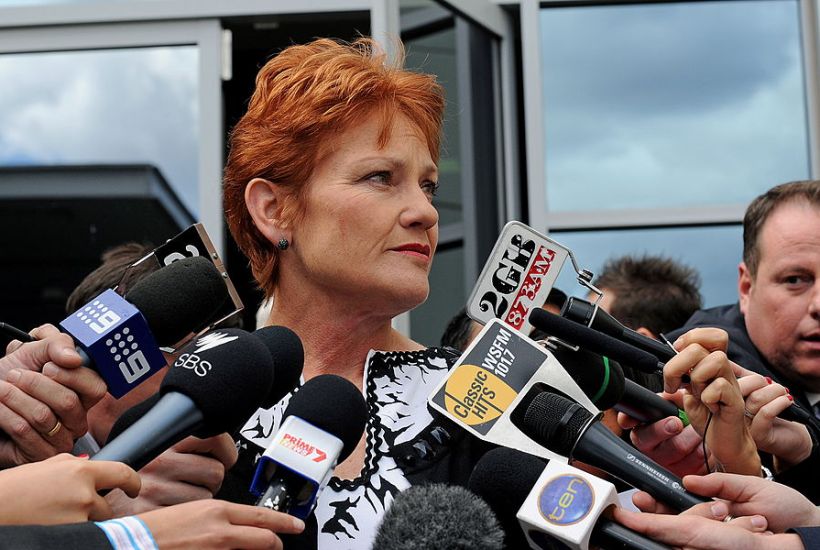
That is exactly the sentiment I feel reading about Pauline Hanson taking her section 18C case to the High Court, after being found to have broken federal law by telling Mehreen Faruqi to go back to Pakistan.
This is not about Hanson. I would not have said what she said, but I think the finding against her was ridiculous, and I wholly support her right to say it. I hope she wins.
18C is an abomination. Repeal it, salt it, bury it.
But I am every bit as angry about the means by which she is challenging it. The implied freedom of political communication was created out of whole cloth by the High Court, and is every bit as rotten as the law it is now being used to attack.
Understand what the implied freedom actually is.
It is not in the Constitution. You may read the document front to back and back to front, and you will not find it.
It was magically located in 1992 by a High Court that went looking behind the text and, to nobody’s great surprise, found what it went looking for.
It was conjured.
Then, in the finest tradition of the judiciary, the court built a multi-step balancing test around it, so that only judges can say when it applies.
If Barton, Deakin, Griffith and the rest had wanted a free speech guarantee, they knew exactly how to write one. The Americans managed to put it in their Bill of Rights. And every Commonwealth Parliament in the 125 years since has had the chance to legislate a proper protection.
Instead, we got 18C, defamation laws that make London look permissive, and a national anti-bullying policy for adults. Oh, and ACMA and the eSafety Commissioner.
Please do not read this as an argument against free speech. It is the opposite. I want free speech so badly that I refuse to accept this counterfeit version of it.
A freedom that exists because seven people divined it from the metaphysics of the Constitution can be undivined by seven different people.
Rights found in penumbras can be lost in penumbras. There is no ratchet. There is only the composition of the bench and the mood it is in.
So put it in the Constitution. In English. Unambiguous, entrenched, referendum tested, in a section with a number you can cite without a footnote explaining which balancing test currently applies.
Until then we are all Pauline Hanson, standing outside the courtroom, applying for permission to speak.
What we urgently need is a referendum that codifies a real freedom of political communication, not a made-up one.
Until someone has the courage to hold such a referendum, here is my hope: a creative coalition of High Court justices who find that 18C is unconstitutional, and that the implied freedom is exactly what it looks like, nonsense.
This might create the political conditions for such a referendum to be required.
On the 18C industrial complex and the implied freedom brigade, my view is Kissinger’s. A pity both sides can’t lose.