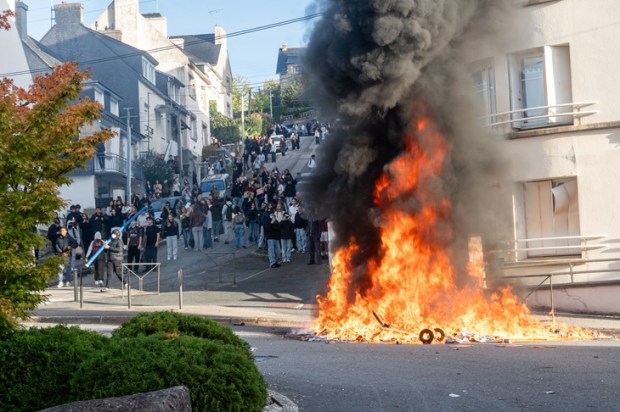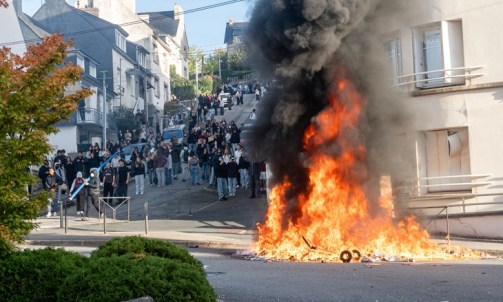
More than 190 hectares of coastal vegetation were destroyed by fire over the weekend in a region just south of the Channel port of Boulogne. Investigators have said some of the many migrants camped on this stretch of the Northern French coast as they wait to cross to England in a small boat could be to blame.
Migrants are told that once they set foot in England the chances of them being deported are infinitesimal
The Pas-de-Calais prefecture has said that two lines of enquiry are being pursued: that the fires were a result of ‘the usual way of life’ of the migrants or a consequence of a ‘gendarmerie operation’.
A local newspaper, La Voix du Nord, described a confrontation last Wednesday between a group of migrants and some gendarmes, during which one of the latter fired a tear gas grenade. ‘When gendarmes are attacked, they have the right to defend themselves, so they will continue to do so,’ said a spokesperson for the prefecture. However, the authorities have also received reports of ‘deliberate arson attacks, aimed at destabilising the emergency services’.
In other words, some migrants may be starting fires among the parched vegetation to distract the gendarmes who patrol the coast on the lookout for people smugglers at work.
This is not the only new development among the thousands of migrants who live among the dunes that run from Calais to Boulogne. It has also been noted that there are a growing number of women and children.
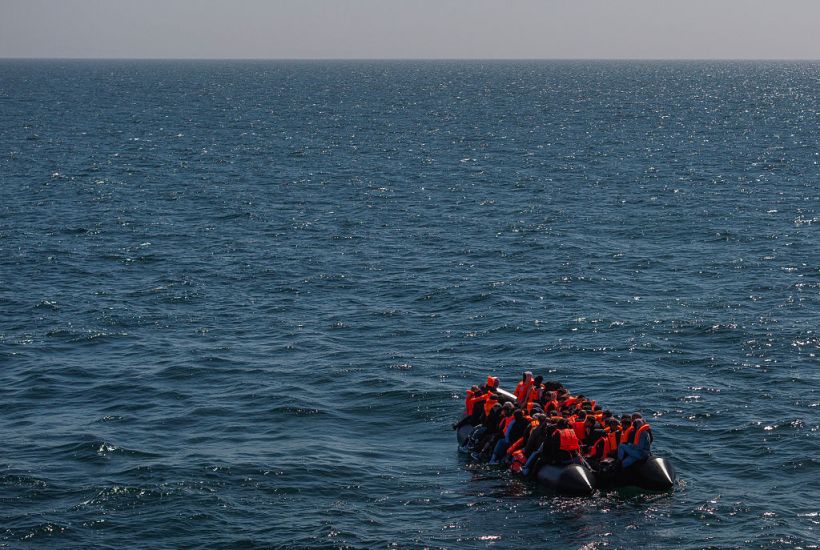
On August 4 one of the new ‘mega-dinghies’ deployed by the smugglers foundered and the 173 people on board had to be rescued. There were 50 women and children among them. The previous week three women drowned attempting to reach England.
Aid organisations working with migrants in northern France are aware of this recent phenomenon. Angèle Vettorello, who works for a group called Utopia 56 in Calais, has said that often ‘about 50 per cent of the people who remain after an attempt to board a boat are women and children’. She adds that similar percentages can be found in camps ‘along the entire coast’.
The Refugee Women’s Centre (RWC), which helps find shelter for women and families in northern France, says that this trend became more noticeable in 2024. That year they assisted 2,200 women and 2,100 children; last year they helped nearly 11,000 women and children. Those figures are set to be surpassed in 2026.
Four nationalities figure prominently among these women and children: Afghans, Sudanese, Somalians and Eritreans. Aid organisations have expressed concern for their welfare because of the greater risks of human trafficking and sexual exploitation.
They are also more vulnerable to accidents in the chaotic rush to board a boat before it is launched by the smugglers. There is little chivalry among the migrants jostling for their turn to reach England. It is a survival of the fittest.
The main reason for the increase in the number of women and children in northern France is attributed to the ‘the tightening of European policy’.
In June this year the EU’s Migration and Asylum Pact became fully operational. As I wrote at the time, Britain is now ‘the weak man of Europe when it comes to border control’.
The people smuggling gangs are not only well-organised but they are also fully informed of the legislation aimed to curb their trade; they are aware where the weak points are.
This is why in the seven months of 2026 irregular crossings across the central Mediterranean into Italy are down 55 per cent but they are up 37 per cent across the western Mediterranean into Spain. The smugglers know Spain’s Socialist Prime Minister Pedro Sanchez is a soft touch.
Ditto for Britain’s Labour government, regardless of who is prime minister. Migrants are told that once they set foot in England the chances of them being deported are infinitesimal. Not so in one of the 27 EU countries.
One measure in the EU’s Migration and Asylum Pact is the use of ‘return hubs’, offshore facilities in safe non-EU third countries where irregular migrants and rejected asylum seekers will be detained prior to their deportation. The only two leaders who object to return hubs are Sanchez and Emmanuel Macron.
Nonetheless, France remains general an unwelcoming country for illegal migrants. Women and children who arrive on the northern coast are entitled to one night in emergency shelter; then they have to fend themselves in one of the many camps dotted among the dunes.
No wonder Britain, with its free hotels, healthcare and SIM cards, is seen by migrants as the Promised Land for men and women alike.