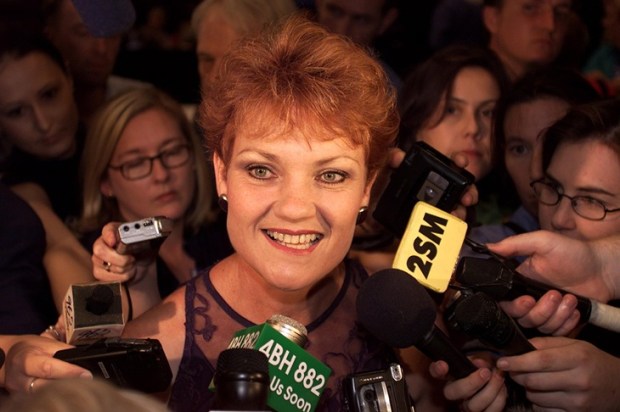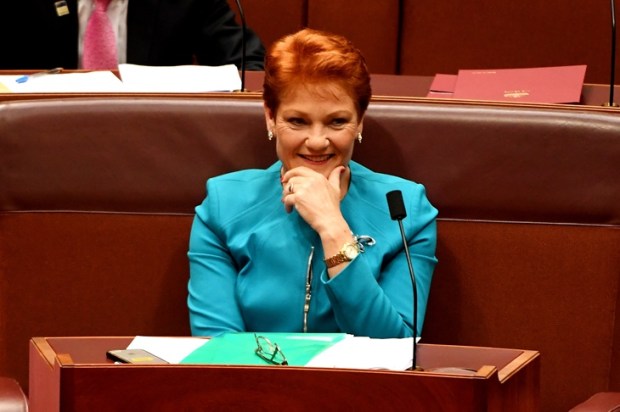
Pauline Hanson is improving her position and making it less likely that this manifestation of One Nation will splutter out. At the same time, it is almost impossible for One Nation to translate its superior first preference vote over the Liberals, and probably Labor, into a governing position.
That’s one of the conclusions I draw from my latest qualitative poll conducted between July 3 and July 9, which drew 1,053 responses.
Because it is qualitative research, quantitative figures are indicative, not precise, but they are still a good gauge of what is happening.
While we know from Newspoll and others that Labor’s vote has dropped this year, maybe to as low as 29 per cent, or lower, and One Nation’s has maintained around 29 per cent, with the Liberals on 17 per cent or thereabouts, there has been movement in perceptions of Hanson and Taylor, albeit from low bases.
Six months ago, amongst our sample Hanson had a net -22 per cent approval, which has now improved to net -15 per cent. In January, in net terms, Sussan Ley was on -58 per cent; today Angus Taylor is on -42 per cent. Not good, but heading in the right direction.
Meanwhile Anthony Albanese’s net approval is -19 per cent, little changed from January and only four points better than Hanson’s.
But the next election is not going to be a beauty contest based on the leaders.
On the question of whether each of the parties deserves to be in government, Labor is well ahead on -9 per cent net, One Nation next on -33 per cent, with the Coalition in last place on -66 per cent.
That is the first paradox. One Nation can rival or surpass both major parties on first preferences without voters thinking it is ready to govern. And the Coalition, despite being the alternative government for most of the past century, now scores even worse on that test.
This doesn’t really reflect voting intentions, with our sample splitting 55 per cent to 45 per cent Labor against the Coalition and 56 per cent to 44 per cent against One Nation. That means in a straight two-party contest One Nation needs one percentage point more to win than the Coalition, but they are both behind in what would be landslide-win-to-Labor territory.
Except that Australia does not conduct national elections as one straight two-party contest. It conducts 150 individual contests under compulsory preferential voting, and that makes the relative positions of One Nation and the Coalition much more complicated than their national primary votes suggest.
If voters have to choose between the Coalition and One Nation, 68 per cent choose the Coalition versus 32 per cent for One Nation.
That is never going to be the choice at a national level, but it will be the choice in any number of seats and strongly suggests a substantial underlying advantage for the Coalition wherever a count ultimately comes down to Coalition versus One Nation.
That advantage, however, only matters if the Coalition candidate survives long enough to use it. This is where the order in which candidates are excluded becomes crucial.
In very safe Coalition seats Labor’s primary vote will often be low. If Labor is eliminated while both the Coalition and One Nation remain in the count, Labor and Greens preferences are likely to favour the Coalition strongly over One Nation. That gives the Coalition a substantial defensive advantage.
One Nation therefore does not necessarily need to top the primary vote to win such a seat. Nor does it need to obliterate the Coalition vote. What it needs is to stay ahead of the Coalition candidate until the Coalition is excluded.
If the Coalition is the first of the three major contenders to leave the count, its preferences can then carry One Nation past Labor, even where Labor was first on primary votes.
Things get more interesting as the margin of safety on the non-Labor side decreases. In more marginal seats the crucial contest may therefore be between One Nation and the Coalition over which of them survives to the final count against Labor. First preferences will usually be the largest determinant of that, although preferences from minor candidates can also determine the order of exclusion.
If One Nation is excluded first, its preferences mostly flow to the Coalition and can put the Coalition over Labor. If the Coalition is excluded first, its preferences also mostly flow to One Nation and can put One Nation over Labor.
But those two flows are not equal: One Nation voters preference the Coalition more strongly than Coalition voters preference One Nation.
In the most marginal seats, Labor is therefore more likely to win because the percentage of Liberals preferencing One Nation is lower than the percentage of One Nation voters preferencing the Liberals.
Preferential voting creates an asymmetry. One Nation can severely damage the Coalition without necessarily replacing it seat for seat. And a Coalition weakened by One Nation can leave Labor winning seats even where a clear majority of primary votes have gone to parties of the right.
This is more or less what happened in South Australia, with a rural/metropolitan frame over the top complicating things a little. There was also a strong move to One Nation, not the Liberals, in the safest Labor seats, turning them marginal, but still leaving them Labor.
In the end One Nation took all of its seats from conservatives and its spectacular rise in votes did not produce an equivalent increase in the number of non-Labor seats. It displaced Liberals and former Liberals much more successfully than it displaced Labor.
That might sound like very bad news for One Nation, but there is another model of what can happen, and that is Farrer.
Farrer is itself a very safe seat. Labor didn’t run, which complicates things a little, but there was a soft Labor proxy in the Teal-ish Independent Michelle Milthorpe, who won 28.1 per cent of first preferences.
In this case, Liberal candidate Raissa Butkowski won 12.4 per cent of first preferences and the Nationals Brad Robertson 9.8 per cent, further dividing the traditional Coalition vote, while the One Nation candidate, David Farley, won 39.5 per cent.
The important point is not simply the size of Farley’s lead. It is where the Coalition candidates sat in the order of exclusion. Both the Liberal and National candidates were behind Milthorpe. Once they were excluded, the contest was no longer One Nation versus Coalition, where centre-left preferences could have favoured the Coalition. It was One Nation versus Milthorpe, and Coalition preferences overwhelmingly favoured Farley.
That is the mechanism One Nation needs to reproduce elsewhere. It does not necessarily have to beat Labor on first preferences. It needs to beat the Coalition candidate and keep doing so until the Coalition is excluded. If Labor is first, One Nation second, and the Coalition third when the decisive three-candidate stage is reached, One Nation has a very strong chance of winning on Coalition preferences.
Which leads us to what this next election, in my opinion, should be about.
Why did Farley win? He was the right candidate for the right seat with the right issue. The election was won two months out at the preselection stage. Once the candidates were selected the seat was always going to swap hands.
(For what it’s worth, I backed my judgment at the time with a princely $30 on Sportsbet, so this is not a rewriting of history to shape it to the outcome.)
Water was the key issue in Farrer. Farley was the only candidate on the right side of that issue as far as electors were concerned. And he had the right personality and CV for just that sort of rural/urban seat.
Farrer therefore supplies the other half of the electoral equation. Preferential voting establishes the rules of the contest, but candidate selection can change the order in which the principal candidates are eliminated. Moving enough voters from Coalition to One Nation to put the Coalition candidate below Labor may be sufficient to change the winner of the seat, even without substantially changing the combined non-Labor vote.
The lesson from Farrer is that the next election will partly be about which non-Labor party can preselect the right candidates for the seats and for the Parliament.
If the parties of the right are smart, that is how they will also frame it.
It should not be about changing the government, even though the government may change hands as a result of brilliant candidate selection and campaigning.
Nor do voters have to believe either the Coalition or One Nation is presently capable of governing for this strategy to work. In fact the polling suggests most of them don’t.
The Liberal and National Parties are where they are now in significant part because of poor candidate selection. They’ve selected many people who don’t think like their own voters and take those voters for granted. They will never win back trust until they fix that.
They need to apologise for their past behaviour, and nothing says sorry more than removing the miscreants. Leaving them there screams insincerity.
Which is One Nation’s opportunity.
Pauline has taken to saying she’s ready for government. That is a mistake.
What she is ready for is holding the mainstream parties to account, and she can plausibly do that by providing electors with a choice of personnel.
Despite his bad performance Albanese is the preferred Prime Minister, but he’s only in that position because most think neither One Nation nor the Coalition is up to governing.
They also can’t see either winning in their own right, far less governing in some sort of alliance. So there is no harm in One Nation and the Coalition admitting this. Voters will welcome the truth.
They do not need to ask voters to believe in a government which the voters themselves think is implausible. They need to ask a much simpler question: who is the best non-Labor person to represent this electorate?
What both parties need is to commit to holding Labor to account and finding the best candidates to represent the 46 per cent of Australians whose first preference would go to one or the other of them.
That changes the nature of the contest between them.
They should cease hostilities against each other, in the sense of treating the other party as an enemy which must be destroyed, except to the extent that two front-running candidates in a preselection might be hostile to each other.
They should compete ferociously for the right to represent each electorate, while recognising that the supporters of the losing conservative candidate will very often be needed to elect the winner.
Then they should run the next election like a primary election between two rival factions of the same entity, because, with half of traditional Coalition voters now voting One Nation, that is what they in essence are.
Under compulsory preferential voting the electorate can conduct the primary and the general election on the same ballot paper. Voters can decide whether the One Nation or Coalition candidate is the better representative of the non-Labor side, and their later preferences can then decide whether that candidate or Labor wins the seat.
People don’t believe either can win, so stop talking about winning. Give voters other and better reasons to vote One Nation or Coalition, and then see what the next election brings.
Find the right candidate. Fight the right local battle. Give voters a reason to replace a bad MP or retain a good one. Let the electorate decide which non-Labor candidate survives. Build a better Parliament one electorate at a time.
We might all be surprised at the result.