In an age of social chaos and moral confusion, as in times of tyrannical government, there will be a desperate quest for action – action which promises to offer justice, freedom, and equality, or any number of other seemingly legitimate goals. Such action sometimes involves the breaking of the law.
It is in our human nature to try to justify to others what we are doing. Except in rare cases, most people usually comply with legal commands due to fear, social pressure, habit, or acceptance. Hence, questioning and disobeying the validity of laws should not be taken lightly, not just because of the dire consequences that may befall the questioner, but because such a questioning may result in punishment and be potentially perceived as morally reprehensible.
Our latest book, The Legal Right to Disobey Law (Sidestream Press, 2026), deals with these issues and seeks to answer the burning question: under what circumstances it is legal to disobey a law that has been adopted in accordance with the formal requirements of the State legal system. This book thus endeavours to present a jurisprudential case for the legal right to disobey enacted laws that are deemed to be grossly unjust. As such, it is a guidebook on how people can lawfully practice civil disobedience.
This book seeks to achieve its purpose by first addressing the concept of civil disobedience (Chapter Two), followed by a review of the Higher Law principle in respectively ancient Greece and Rome, in a Christian framework, and in a Western constitutional framework (Chapter Three, Four, and Five).
Chapter Six deals with the doctrine of ‘lesser magistrates’ and their right, even duty, to resist immoral orders emanating from a higher authority. An excellent example of the doctrine of the lesser magistrate is offered in Chapter 7 that deals with the East German border guards who failed to resist immoral orders.
As we are endeavouring to anchor the right to free speech (and freedom of the press) in a higher law jurisprudence, we discuss free speech in the context of its contribution to the maintenance of a democratic form of government, the rule of law, its role in serving a diverse society, and its relationship to civil disobedience, followed by a review of the increasing prevalence of civil disobedience in the West (Chapters Eight, Nine, Ten, Eleven, Twelve, and Thirteen).
This is followed by an attempt to bring together the insights gained in this book into some concluding sobering comments in which we argue that the ‘right to resist’ is a mega-right (Chapter Fourteen).
But what exactly is ‘civil disobedience’?
The term ‘civil disobedience’ is generally applied to refer to the refusal of a person or group of persons to comply with ‘unjust’ laws, enacted by the state, which are objected to in themselves or by what they represent, permit, or tolerate. Many political, judicial, philosophical, and religious commentators, have argued that there is a legal right to disobey a grossly unjust law. The history of Western Civilisation is replete with courageous examples of people, who demonstrated, through their actions and advocacy, that justice is not identical with unquestioned obedience to the enacted laws.
Whatever one makes of these arguments, it is simply not possible to deny the relevance of this jurisprudential approach in the development of Western legal systems. They can be traced to the classical legal philosophy of the ancient Greeks and Romans, through several Christian Medieval writers, and down to modern times. Accordingly, arguments supporting principles of a higher or natural law are enshrined in all the most significant legal documents in Western constitutional history, including the English Magna Carta (1215) and Bill of Rights (1689), the American Declaration of Independence (1776), and even the French Declaration of the Rights of Man and the Citizen (1789).
The circumstances giving rise to an individual’s legal right to disobey laws that are deemed to be incompatible with higher law principles have been the subject of an enduring jurisprudential debate since the end of the second world war. The Nuremberg trials of 1945-46 attributed individual criminal responsibility for crimes against humanity performed in obedience to superior orders or done pursuant to the laws of the ruling regime. This has become known as the ‘Nuremberg Principle’. This Principle contributed to a revival of natural law thinking in the West, especially in post-war Germany.
The right to civil disobedience is undoubtedly protected by Paragraph 2 of Article 19 of the International Covenant on Civil and Political Rights (ICCPR) according to which, ‘Everyone shall have the right to freedom of expression.’ This is because the right to freedom of expression protects the democratic process by affirming actions which support freedom of political communication. Moreover, some actions may come within Article 19 because they are clear examples of what is known in the relevant literature as ‘symbolic speech’. In instances of symbolic speech, civil disobedience and freedom of expression may thus overlap conceptually.
What is more, a well-known American law professor, the late Harrop A Freeman, confirmed that civil disobedience does come within the protection offered by the First Amendment to the United States Constitution, which incorporates the freedom of expression clause. For support, he directly referred to Musser v Utah (1948) where the US Supreme Court stated that the ‘position, that the state may prevent any conduct which induces people to violate the law, or any advocacy of unlawful activity, cannot be squared with the First Amendment’.
It is possible, therefore, to conclude that citizens are morally justified to disobey legislative commands that are incompatible with well-known principles of the Rule of Law, which are also derived from our long-held legal traditions of constitutional government. If the government fails to respect freedom of association, movement, religion, and speech, the people will find themselves in the uncomfortable situation of having to exercise their right to resist. In such cases, use of the right to resist would effectively function as a mega-right to ensure that laws (and orders given in reliance on these laws) which are inconsistent with the ordinary exercise of these freedoms, are not enforced.
An individual’s legal right, even duty, to disobey human rights-infringing laws, and the relevance of natural law in this context, have again become topical because we live in troubled times. Observers of social, economic and political developments sense that Western values and traditions are under relentless attack in Australia (and throughout the world), and that governments seek to incrementally suppress free speech for the sake of maintaining the elusive goals of ‘multiculturalism’ and ‘social cohesion’. This focus on ‘social cohesion’ is evident in the terms of reference for the Commission on Antisemitism and Social Cohesion, announced by the Prime Minister, Anthony Albanese, on January 8, 2026.
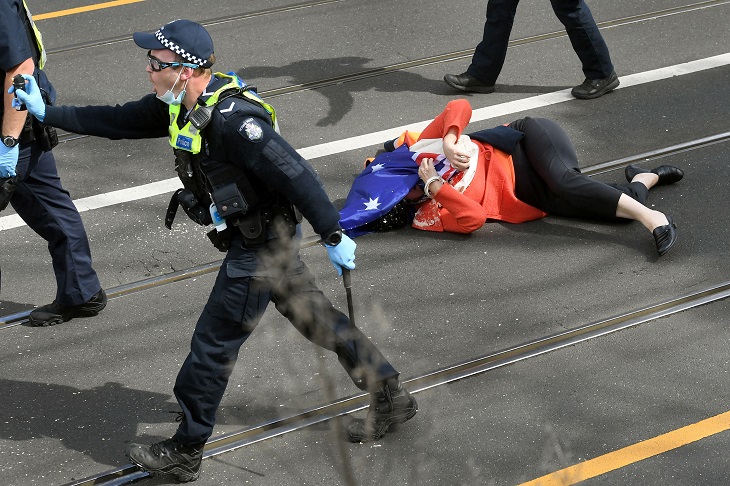
It goes without saying that the requirement that any act of civil disobedience be lawful assumes, inter alia, that the act is proportionate to the alleged injustice that caused a person to disobey the positive law. According to the principle of proportionality, government decisions should be logically and cogently related to their objectives. In the context of the alleged pandemic, for example, many emergency measures adopted by governments around Australia (and throughout the world) were unnecessarily authoritarian and, therefore, the protests and violations of the law may well have been a proportionate response, especially when these measures were adopted without parliamentary oversight.
More fundamentally, it is entirely self-evident to us as law professors that Australians are endowed with some important constitutional protections as derived from the notion revealed by the High Court of ‘a free society governed in accordance with the principles of representative democracy’. That so being, then the people of this great nation have a right to struggle for the preservation of the legal-institutional framework by lawfully resisting governmental measures that grossly violate their fundamental human rights. How this all should work is carefully explained in our book.
Augusto Zimmermann is foundation dean and professor of law at Alphacrucis University College. He served as associate dean at Murdoch University. He is also a former commissioner with the Law Reform Commission of Western Australia.
Gabriël A. Moens AM is an emeritus professor of law at the University of Queensland and served as pro vice-chancellor and dean at Murdoch University.
Moens & Zimmermann are the authors of ‘The Legal Right to Disobey Law’ (Sidestream Press, 2026). This book can be purchased from Oxford Printery here.