The civil war between the Coalition and One Nation began in earnest last week, so let’s talk about it.
To begin, picking a fight with One Nation has its benefits for the Coalition, chiefly, it distracts them from fighting each other over policy direction. After the Liberals and Nationals split twice under Sussan Ley regarding Net Zero, Angus Taylor and Matt Canavan seem to have a non-aggression pact in place. And boy do they need it, with the Coalition routinely beaten by the so-called fringe alternative of One Nation. When viewed separately, the Liberals and Nationals are polling badly.
Yes, calling your Populist challenger ‘fringe’ holds significant risk. If they are ‘fringe’, what does that make the Coalition when they lost the Farrer by-election?
Assigning labels in politics is dangerous. Nigel Farage ran into this problem last week. He pitched his Clacton by-election as an epic struggle between the Establishment and the people, and has ended up facing a satirical protest character behind which the Establishment can hide. We know what the real dynamics are, but to the average punter, Farage has taken on the persona of the Establishment against … uh … Binface.
Staging a Holy War against One Nation makes the Coalition feel much better about themselves. They can sit in a united party room and face their spears in the same direction. It’s the wrong direction, but they’re not stabbing each other at the moment.
The plan is simple. Destroy One Nation. Take back the voters. Do a bit of quick math on the combined conservative vote. Beat Labor. Side-eye the Teals. Take back power. Avert existential crisis. Then do what they always do … nothing. Because the reason the Coalition keep failing as a government hasn’t been addressed. At all.
This is the difference between employing a strategy to win an election compared to promoting strategy capable of running a government. You can argue the merits separately, but One Nation is not involved in a typical election campaign, they are pitching future governance. That is their major appeal to voters. There is a semblance of a tangible vision. The voter can imagine what might happen. How things might change. A few outcomes that have a real shot at working.
Is the vision perfect? No. And given how far away the election is, the policies remain in the testing phase.
Instead of hiding them and releasing them a week before the election so they cannot be scrutinised or stolen, One Nation has chosen to crowd-source policy and allow voters to improve or dismiss each one. They use their livestreams to ask voters what is impacting them the most, then create policy to help.
This carries some polling risk. Not every policy works. But every attempt feels like progress and if the Coalition sat down and scrolled through the thousands upon thousands of comments across One Nation’s social media platforms, they could witness this revolutionary type of policy reform.
It is effectively a virtual membership vote, on everything, all the time.
Perhaps this is the way politics will be done in the future. While everyone is mulling over new software to connect official members to party votes, One Nation shrugged and opened the gates, trusting its advisors and politicians to make value judgments based on raw feedback.
Instead of obsessively silencing social media and trying to regulate public opinion, they have embraced it. This makes people feel valued.
The converse is true of the delegate-led system of the Liberal Party which is tightly controlled and actively avoids the noise of ordinary members. Somehow, despite how top-heavy and controlled this approach is, it manages to produce policy that feels rushed, plagiarised, and inconsequential. Death by focus group, I believe they call it.
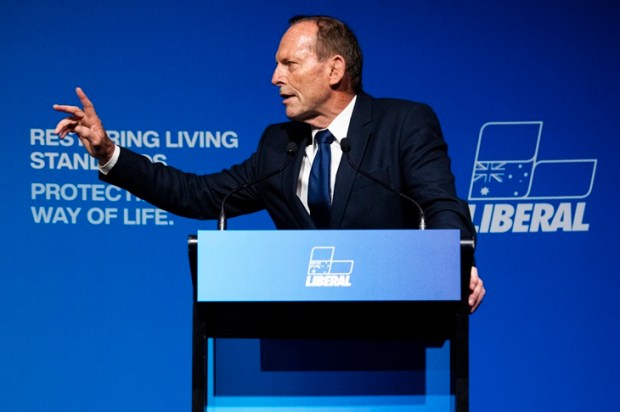
That was one of the complaints about Angus Taylor’s recent speech at the Sydney Institute. A few comments said it felt as though he had ChatGPT perched on his shoulder. It is not a view I share.
Taylor is treading water in a rip. The swell already happened. Former leaders wandered into the fast-flowing water. He is trying to remain stable while expending energy going nowhere. Taylor can see the shore. He can identify the problem. But he lacks the insight to swim sideways out of the existential current.
His speeches are that of a scholar, not a revolutionary.
They are perfectly functional for board meetings but listen to him yourself and see if Taylor managed to break through scripted grievance and unspecific promises to reach the heart of the listener.
Would you follow this man into battle? Because politics and conflict are inseparable. Politics is an evolution of actual war, taking thousands of years to move from the battlefield to Parliament, and people recognise this, even if they are unaware of why. This is the first age of politicians who have forgotten their history and subsequently, they think elections can be won on bland economic promises and policy tinkering.
The Greens, Labor, and even the Teals do not make this error. They correctly frame elections as a cultural confrontation and battle for the future and then gaslight the Coalition into not fighting culture wars. The Coalition cannot afford to keep making this mistake while conservative voters remain the most persecuted group and Western Enlightenment is thrown to the wolves of communism and Sharia Law.
This is not a pitch for Hastie. It is my view he would be a mismatch for the current strategic problem.
My point is that when you watch Taylor’s speech, read his article, or listen to recent interviews, his growing urge to push back masquerades as strength, but feels as though it might stem from frustration with voters choosing One Nation rather than empathy for the destruction of Australia.
The Liberals are preoccupied with the existential crisis of their party. Voters are worried about the extinction of their culture, ethnicity, and nation.
Taylor should meditate on why Argentinian Libertarian Javier Milei won, against all the odds. His rise to power is often left out of the conversation in favour of Maga or Reform, but Milei was fighting late-stage progressive politics.
He rose from the dystopia Australia faces if nothing is done.
And his approach is far closer to One Nation, where One Nation promises to rip the Climate Change grift out of the public-funded system just as Milei walked along the whiteboard, picking off wasteful departments.
Meanwhile, Taylor and Canavan spent a good week protecting the Paris Agreement. Will they dismember the Department of Climate Change? Remove over a dozen groups and bodies attached to it which bleed the Treasury dry? Will they stop the solar, wind, and battery projects destroying farmland, rainforests, and water reserves? Will they stop the colonisation of our energy grid by a foreign power? Find me a voter that believes they have the nerve for this task.
Yes, One Nation needs to work on how the cost of their policies will translate through the economy and what can be done to make everything add up. The Coalition are too frightened to even scratch out a plan on a post-it note. They simply will not do it. And yes, I understand the complex mechanics of why, but I can confidently say that refusing to address the problem is a choice, not an impossibility.
The strategy of attacking One Nation is not about Pauline Hanson. Both the Coalition and Labor tried that approach, only for those attacks to turn into a meme and then a $5 million donation war chest.
Instead, they are going after One Nation policies. Not because the policies are bad or imperfect. But to destroy the policies in the public arena so no one can ask the Coalition to adopt them. It is a way of protecting themselves from policies the public want but the factions reject.
Kill the policies while they are in the nest of One Nation. Then, every time they are raised, write them off as toxic One Nation ideas.
This is not a vote-winning approach.
It signals to former Liberal voters that not only are they being slurred by the left with moral falsities, but that the Coalition are an unreformable, recognisable failure that cannot fix the nation because of an out-dated, parochial view of a political landscape that no longer exists.
John Howard distilled this accidentally as a guest speaker on a panel I attended last year. He assured the audience that Australia’s famous Anglo-Celtic scepticism would protect the country from Labor’s bad policies, as it had done in the past. Are the Anglo-Celtics in the room with us in Western Sydney? The people, and their ethos, are being outnumbered. While not always expressed eloquently, this is One Nation’s whole point about multiculturalism.
The first line of Angus Taylor’s article is correct: Australia is in an economic crisis.
And the Coalition played a large role in putting us there.
We can sit here and talk about Labor’s nightmare socialist dream all day, but as someone who reviewed policy drafts during the Morrison government, Coalition policy had its fair share of insidious, ill-thought-out, utterly devoid of real-world logic, incoherent nonsense. Day after day.
I lost my faith in the Liberals by reading their policy, not through social media meme wars. They are unseated by the detail of their own words and my eternal frustration with their lemming-like behaviour.
The only reason conservative voters are ‘lighting a match’, as Taylor writes, is because the Liberals refuse, point blank, to acknowledge their inability to do anything useful with power.
Labor reforms. It reforms catastrophically. But you can never accuse Albanese of wasting power. The Liberals simmer. They clog up Parliament with regulation that shouldn’t exist. They borrow policy thought bubbles from the World Economic Forum and United Nations. They ignore obvious unintended consequences. They turn a blind eye or, worse, feed the progressive public service to keep it quiet.
Next week, Angus Taylor is going to be back where he started on the multicultural discussion when Tommy Robinson drops his interview with Pauline Hanson. It won’t make any difference what’s said. Australians will look at the redhead wandering the streets of Luton and think, oh shit!
And on and on it goes, until the Liberals do the one thing voters have told them from the start: change your policies.
Alexandra Marshall is an independent writer. If you would like to support her work, shout her a coffee over at donor-box.