Headlining the latest climate talkfest taking place this month, The Guardian gushed, ‘Historic breakthrough: Colombia climate talks end with hopes raised for fossil fuel phaseout.’ And though the article soberly noted that most of the world’s biggest emitters were absent from the group of 59 participants, they labelled this as a strength since the participants were a ‘coalition of the willing’.
This is a path down which the EU and UK continue to hurtle. Indeed, this year the EU commenced a program of systematically defining imports by category and source to levy an equalisation tax on products by exporter. As it is phased in, it is intended to cover hundreds of thousands of different products with different rates for each of the world’s 200 countries, a gargantuan process that would, if implemented, redefine the basis of world trade.
But it won’t be implemented. The fact is the EU is a regulation-corroded set of nations – many of which are nice places to visit – with a 15 per cent and declining share of the world economy.
Australia has its own set of self-imposed penalties – the Safeguard Mechanism – which requires declining emissions baselines for ~215 large industrial facilities emitting over 100,000 tonnes of CO₂ per year). That involves some 11 million tonnes of additional reductions by these large firms; at a cost of $39 per tonne this costs them over $400 million a year, an impost that is rising annually.
This cost is additional to that all businesses must incur as a result of governments forcing the replacement of low-cost, reliable coal generation by high-cost, intermittent wind and solar energy.
This replacement of modern controllable technology by energy that is far less dense and intrinsically dependent on natural elements has already more than doubled electricity costs, as shown below for New South Wales.
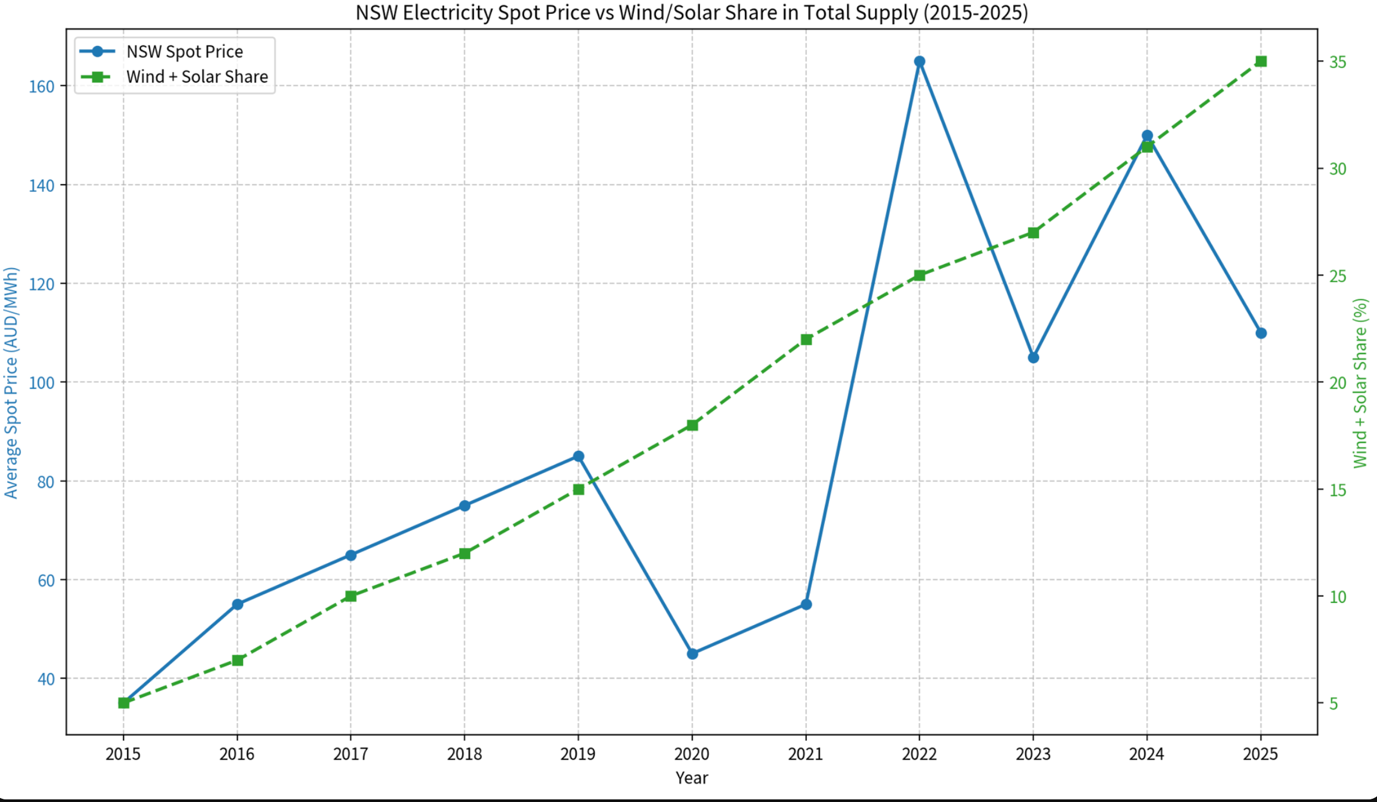
Over that same period in the US (where requirements for increased renewables have been less radical than in Australia), electricity prices increased by only 30 per cent.
Recognising the harm their policies were doing to Australian competitiveness, the Albanese government commissioned a report which recommended a frontier tariff along similar lines to that being introduced in the EU. Needless to say, while benefiting some import-competing businesses, this would increase costs for other businesses and for consumers generally.
The assault on hydrocarbons has proven to be a familiar case of a regulatory measure leading to unanticipated detrimental outcomes, prompting calls for additional regulatory measures that compound the original damage. Doubtless, carbon taxes on imports will entail additional harms and necessitate subsequent tiers of regulation, all of which augment the damage of the original measures.
There are cases where measures to ban or drive out the supply of products bring little economy-wide cost. But hydrocarbons comprise four-fifths of the world’s energy while 60 per cent of the world’s fertilisers are replaceable only at massive cost in many sectors of production. These uses are not optional luxury goods but are essential to the bedrock of modern world livability.
Energy regulations are not alone among virtuous egalitarian slogans in leading to the opposite of the outcomes claimed.
Thus, housing rent controls (currently prominent on the Greens agenda) lead rental property owners to leave the market or cut back on maintenance, resulting in fewer available properties and higher rents for those not fortunate enough to be initially allocated a fixed-price rental home.
Similarly, ‘land redistribution’ shifts farming into the hands of those with little expertise, as in Zimbabwe, where the key tobacco and maize crops dropped 75 per cent and 30 per cent respectively, transforming the nation from the ‘breadbasket of Africa’ into a net importer with malnutrition becoming common.
In the case of hydrocarbons, some of those who are sloganising for their elimination either think the detrimental effects are worth it or that something will turn up to offset them. But we now have had 20 years’ experience of measures to squeeze out hydrocarbons, and the outcome in terms of living standards is plain to see.
This month’s Colombian UN meeting is a last hurrah of the declining rump of activists promoting the Net Zero ideology.
In the UK, even the Labour Party grandee, Tony Blair, is urging his comrades to abandon the cause, and will undoubtedly be listened to more closely as his party examines the loss of 75 per cent of the seats it sought re-election in.
In Australia, Coalition MPs, other than those in Teal seats, are reading the public mood and accepting a need to exit the cause.
In both the UK and Australia however, the issue for Conservatives and the Coalition is whether they can remain viable rather than joining the populist parties (Reform/One Nation) to which most of their own supporters and some of those supporting Labour/Labor are switching. And both countries have the task of identifying strategies to reverse the damage without having to pay compensation to those benefiting from the subsidies that the Net Zero policies have entailed.