It is surely reasonable to expect that, after the trial of Cardinal Pell and the arrest of Alan Jones, the authorities would have learned a lesson. As the US Supreme Court noted in Berger v. United States (1935), prosecutors should be driven not to win, but to see that justice is done.
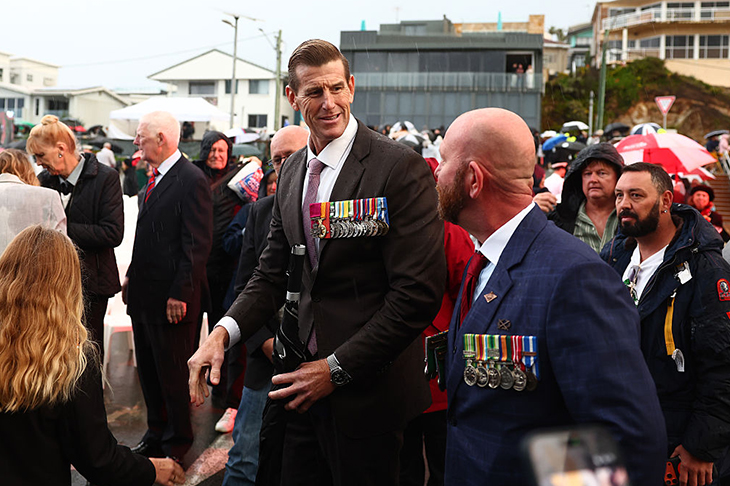
The misuse of theatrical techniques in the arrest of Ben Roberts-Smith VC, together with the apparent collaboration with a favoured media outlet, devalues and demeans the golden thread of our ancient criminal law: the presumption of innocence. It rarely stops there. Meanwhile, the corollary identified in 1471 by Chief Justice Sir John Fortescue holds true today: ‘I would rather that twenty guilty men should escape the punishment of death, than that one innocent person should be condemned….’
Just as those who flouted the presumption of innocence in their theatrical, TV-driven arrest of Alan Jones would later radically change the charges against him – thus denying him the precious right to a jury trial – so those who denied Cardinal Pell’s jury access to crucial evidence (from which would have flowed a veritable sea of reasonable doubts), also forced him every day of his two long trials to pass through a mainly hostile media intermingled with a large, noisy rabble demanding his head. It was as if he were in a tumbril on the way to the guillotine, a tumultuous media spectacle within earshot of the jury. Our heroic soldiers do not risk their lives in foreign lands for the core standards of this ancient democracy to be so disgracefully undermined by those entrusted with the very duty of honouring them.
The proceedings against the celebrated Victoria Cross recipient, Ben Roberts-Smith, have moved beyond the realm of legal inquiry into a managed spectacle doing enormous damage to the armed forces. The point is surely that if this bizarre, delayed process had been followed in the world wars, we could well now see the flag of one of our former enemies flying over our capital.
Meanwhile, just as the prosecutorial authorities in this case refuse to explain the apparent transgressions in his arrest and what appears to be media collaboration, so a fundamental question remains unanswered by the High Command: why did they not handle the ‘rumours’ and ‘claims’ referred to in the Brereton Report within the military jurisdiction through a general court martial?
By the time Ben Roberts-Smith was compelled to take the desperate route of a defamation suit to defend his reputation, the window for a command-led resolution had been wide open for over a decade. By failing to convene a ‘warrior jury’ of senior officers to test these allegations, the High Command allowed a vacuum to form – one that was inevitably filled by a media campaign marred by a significant ethical breach and a huge payout, all culminating in an unacceptable ‘civil conviction’ in the Federal Court.
With the coming criminal trial, we can thank our Founders for constitutionally mandating the jury as the ultimate bulwark against state oppression. Such a jury can intuitively recognise when the authorities, trying to hide the fact that they cannot prove their case beyond a reasonable doubt, are overreaching. The jury is then likely to deliver a ‘not guilty’ verdict that requires no explanation and leaves no room for appeal.
It should be stressed that the current crisis has been compounded by the politicians’ error in centralising military prosecutions under a Director of Military Prosecutions stripped from the command structure and not necessarily having combat experience.We saw the first ruinous failure of this system in the 2011 case, R v. McDade, where commandos were charged with manslaughter for no more than simply responding, as soldiers do, when under fire.
Meanwhile, the High Court of Australia surprisingly refused Roberts-Smith’s appeal on the ground that it raised ‘no question of legal principle’. No question of principle? Surely, a civil court finding of murder on the balance of probabilities must raise questions of principle which a High Court bench, as the guardian of the common law, should consider.
In a defamation case similar to Roberts-Smith’s, where a media defendant relies on a defence of truth, one solution would be for parliament to require that all issues – including any damages – be determined by a jury of twelve, most of whom should have substantial combat experience – a desperate need exposed in the McDade case.
A finding that the defence of truth had been established should, of course, require a unanimous vote. Such a ‘warrior jury’ would bridge the dangerous gap between civil and criminal standards, ensuring that a soldier’s reputation is only forfeit when proven to the satisfaction of those who truly understand the lethal context of the battlefield, including one with guerrillas disguised as non-combatants.
A wise attorney-general would have this year delivered the coup de grâce to this jurisprudential imbroglio. The brief that reached the First Law Officer’s desk was a vessel long abandoned to the Sargasso Sea of managerial delay. It arrived encrusted with the barnacles of a $300-million ‘sunk cost’ of the obviously superfluous Office of the Special Investigator (OSI). Choked by the weeds of a civil finding, it was a wreck so structurally compromised by media contamination that it could no longer be expected to float in the pure stream of a criminal trial. Surprisingly, Attorney-General Michelle Rowland rubber-stamped the OSI recommendation.
Obviously, justice can no longer be assured by a trial. No jury can ‘un-know’ a decade of headlines or a judicial finding of murder. This has been exacerbated by the undermining of the presumption of innocence. As the authorities clearly will not guarantee a pure stream of justice free from media contamination, there is at this late stage – apart from an exercise of the royal prerogative of mercy – only one way now to stop a process which this nation will long regret.
This would be not only to counter the prosecutorial abuse of process but also to restore the morale of the armed forces and remove the outrage that affects this nation. Just as Judge Advocate Westwood dismissed the charges in the McDade case as wrong in law, the judge hearing the prosecution of Ben Roberts-Smith should order a permanent stay of proceedings.
Got something to add? Join the discussion and comment below.
You might disagree with half of it, but you’ll enjoy reading all of it. Try your first month for free, then just $2 a week for the remainder of your first year.