In 1983, Yuri Bezmenov, a former KGB agent and defector, delivered a chilling lecture on ideological subversion. Speaking at UCLA, he described a long-term process designed not to defeat an enemy on the battlefield, but to dismantle its soul from within. According to Bezmenov, the most critical stage is the demoralisation phase, which takes 15 to 20 years – the time needed to educate a generation, from primary school through higher education. Today, as we witness the growing rift between young men and women – especially in Western countries like Australia – Bezmenov’s warning feels less like Cold War history and more like a blueprint for our present era.
This shift is clearly reflected in the latest data from King’s College London (KCL) and Ipsos. The research highlights a staggering generational divide: Gen Z women are now significantly more likely to identify as feminists than any previous generation. In Australia, this divide is particularly acute, with 53 per cent of Gen Z Women identifying as feminists, compared to just 32 per cent of their male counterparts. This 21-point gap – the largest of any generation in Australia – signifies a fundamental breakdown in shared identity and values between the sexes.
Bezmenov’s 15-year timeframe aligns perfectly with the typical academic journey. During this period, students are often taught that traditional structures – such as family, relationships and even biological realities – are inherently oppressive. This monoculture in education allows certain ideologies to be, as Bezmenov warned, ‘pumped into the soft heads’ of students without opposition. The main goal is to reshape how individuals see reality, conditioning them so thoroughly that they cannot accept facts that challenge these new beliefs.
While Bezmenov rightly identified academia as the main centre of indoctrination, it’s not the only institution contributing to ideological subversion. Politics is shaped by culture. Over the past decade, media and cultural narratives – often influenced by women or those sympathetic to feminist perspectives – have reinforced this framing. These narratives rarely hold women accountable for their role in shaping discourse. Recent fictional shows like Adolescence and documentaries such as Louis Theroux’s Inside the Manosphere reinforce the idea that masculinity itself is inherently flawed, rather than simply experiencing challenges. ‘Toxic masculinity’ is understood less as an aberration and more as the logical endpoint of pursued manliness. Traits like fortitude, tenacity, autonomy, stoicism, resilience and strength are no longer praised as masculine virtues but are now regarded as ‘problematic’. Notably, research from the British think tank Demos found that half of all misogynistic tweets were sent by women. Imagine my shock! Misogyny is not the exclusive domain of men. Finally, gender parity!
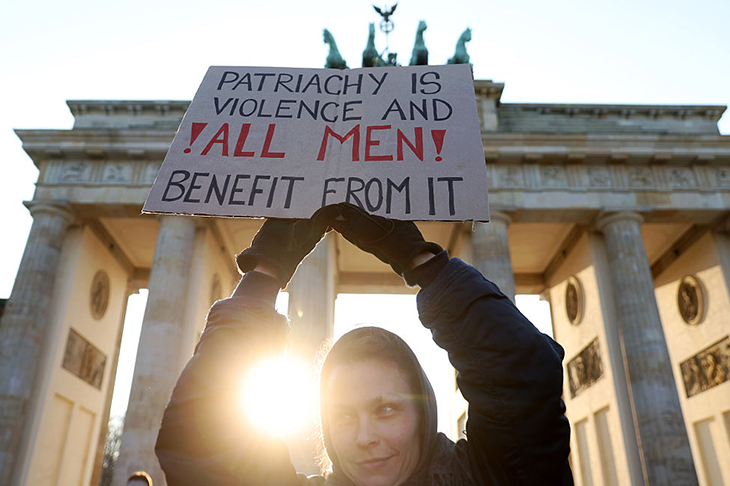
For young women, this indoctrination often shows up as a deep distrust and aversion toward the opposite sex. Intersectional feminism has fostered an environment where young men are no longer seen as peers or potential partners, but as agents of a patriarchal system that must be dismantled. This is not simply a social trend but a measurable psychological shift. The left-of-centre New Statesman magazine recently published results from a Merlin Strategy survey showing that only 35 per cent of women under 25 have a positive opinion of men. For the youngest cohort – those under 25 – this figure plummets to just 11 per cent. By the time a young woman leaves university, she has been conditioned to view half the population with suspicion, which can lead to demoralisation.
The KCL data shows that 51 per cent of Australians perceive high levels of tension between men and women, a figure higher than in many other Western countries. While it can be difficult to quantify feelings, this tension is supported by evidence of diverging values. As young women are radicalised, the Household, Income and Labour Dynamics in Australia survey finds that Gen Z men are reacting by adopting more traditional views on gender roles, likely as a response to their growing sense of marginalisation within the cultural conversation.
As surely as ‘Terfs’ is followed by ‘must die’, the institutional grip of this chromosomal cartel is starting to loosen. The upside-down clown world of feminism is finally being set upright. The KCL data supports this: 57 per cent of Gen Z men believe efforts to promote women’s equality have gone so far that they now discriminate against men. Additionally, the KCL data shows a shift back to traditionalism, with 31 per cent of Gen Z men now agreeing that a ‘wife should always obey her husband’. As a result, young women emerging from 15 years of indoctrination often find themselves in a society where men their age are not only ideologically different but sometimes also hostile to the very feminist ideals they have been taught to embrace.
Demoralisation has reached such an extent that relationships are now frequently sacrificed on the altar of political purity. Even a simple difference in political opinion is perceived as a moral flaw. According to Merlin data, 74 per cent of Gen Z women say they would find it difficult to date someone who did not share their views on social justice.
This political homogeneity shrinks the dating pool to the size of a kitchen sink, as women are conditioned to see dating someone with ‘wrong’ views as a form of self-betrayal. When political beliefs become the ultimate litmus test for every social interaction, it reinforces an ‘us versus them’ mentality – precisely what Bezmenov predicted would lead to destabilisation.
The result of this 15-year process is a generation of women who are academically accomplished but socially and emotionally demoralised. Rather than feeling empowered by their independence, many experience a growing sense of pessimism. They are taught to see the world as fundamentally sexist and men as their primary adversaries. After graduation, many find their worldview shaped to prioritise conflict over collaboration. As Bezmenov observed, once someone is demoralised, ‘the facts tell him nothing’. No amount of gender studies degrees or career achievements can compensate for declining birth rates and the erosion of social cohesion.
The goal of subversion was never to make women happier or more secure; it was to destabilise Western society by turning people against each other. The cavernous divide between Australian Gen Z men and women is a clear sign that this process is reaching its final stages.
Got something to add? Join the discussion and comment below.
You might disagree with half of it, but you’ll enjoy reading all of it. Try your first month for free, then just $2 a week for the remainder of your first year.