With the New South Wales share of the Goods and Services Tax falling to 82 cents in the dollar, Premier Chris Minns is understandably complaining. Australia is replete with similar problems created over the years by cabals of centralist politicians and activist judges. Yet at Federation, Australia already stood at the pinnacle of the global ledger, with a per capita income roughly 50 per cent higher than even that of the United States.
A key moment in our downward slide was when a uniform GST was introduced in 2000 to replace a band of lucrative state taxes once approved but now invalidated by the High Court. Instead of the replacement GST being distributed to the state where it was actually collected, a socialist principle was adopted to distribute the GST so all states could provide the same level of service. The self-evident result is the more a state is mismanaged, the more GST it gets.
The latest example of this capricious interference in state funding was in 2023, when a Victorian road-user charge on electric vehicles was found to be unconstitutional.
The GST debacle has demonstrated that this country – at great cost to Australians – is no longer a true federation. As a 2007 expert report to the Council for the Australian Federation demonstrated, if Australia reverted to being a true federation, like Germany or Switzerland, the economic gain – the ‘Federation Multiplier’ – would be equivalent to 10 per cent of GDP today, about $280 billion. And this wouldn’t be a ‘one off’, it would be a permanent, annual improvement to our national prosperity, driven by the efficiency and innovation that only genuine competition between states ensures.
The great US Founder who so influenced ours, Alexander Hamilton, set out what is fundamental to any federation of sovereign states. ‘Individual states,’ he wrote, ‘should possess an independent and uncontrollable authority to raise their own revenue for the supply of their own wants.’ The more efficient and successful a state, the more it should be rewarded, not, as in Australia, milked to subsidise the profligacy of its neighbours.
Federations are effective only when they are competitive. An excellent local example was when Queensland’s Sir Joh Bjelke-Petersen abolished that evil scourge, death duties. For farmers and small business people, this parasitic tax would often take around a third or more of a family’s property just as they were mourning the deceased. By ending it, Bjelke-Petersen presided over the increasing migration of both people and capital to Queensland. Other states were eventually forced to follow, as did the Canberra politicians who had been so disgracefully greedy they had joined in the frenzy over the dead with a federal ‘estate’ duty. That’s how a real federation works.
The decline of our federation was not an accident; it was a constitutional heist. Even that committed federalist, Alfred Deakin, foresaw that the states would eventually become ‘tied to the chariot wheels of the Commonwealth’.
The High Court has effectively rewritten the Constitution to strip the states of their intended role. This judicial activism began the moment the original High Court bench – the very men like Griffith and Barton who actually drafted the document – was replaced. By abolishing the ‘reserved powers’ doctrine, the Court ignored the structural reality that powers not explicitly granted to the Commonwealth were obviously intended to remain with the states – our equivalent of the US 10th Amendment. Its judicial destruction turned a partnership of equals into a hierarchy of master and servant.
You have to wonder whether, when the judges decided the Australian Constitution should be more centralist than either our founders intended or the people approved, they ever asked themselves whether there would be teams of high-quality politicians available with the ability to both run the federal government of this enormous country as well as run the states to a degree never contemplated. This is especially so when the electoral system was subsequently designed to maintain what is now an ossified duopoly, particularly when it delivers a hard-left government camouflaged as centrist.
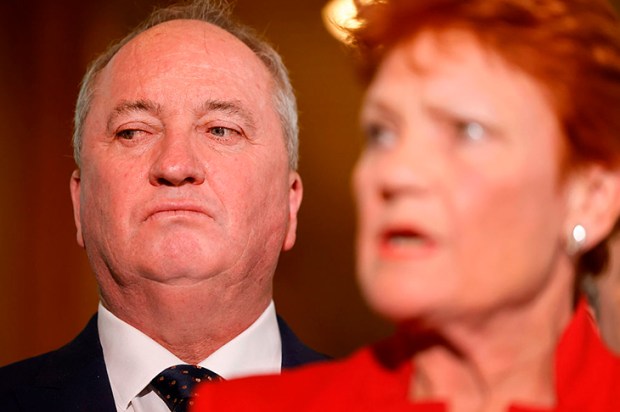
This hollowing out of the political class is precisely why we should warmly welcome the competition brought into politics by One Nation, and why this column recommended in the last election Australians reward their common-sense policies with their first preferences. Rather than attacking One Nation, Nationals leader Senator Matt Canavan should thank them for his welcome ascent to the leadership and follow them all the way in their Trumpian climate assessment as the ‘giant scam’, which Robert Gottliebsen concludes will deliver the biggest financial disaster since Federation. As this column has long suggested, ‘Just follow the money’. As for ‘the’ science, just read one of our most distinguished geologists, Emeritus Professor Ian Plimer. And now that the Coalition has finally woken up about the net zero nonsense, the fundamental question is posed eloquently by IPA fellow Simon Davidson: ‘Must we always have Paris?’
The dramatic surge in One Nation’s polling has served as a necessary wake-up call for the Coalition. Competition is vital for political parties too.
The fact is that instead of a true federation, we have ‘guided provincialism’, to which One Nation alone is opposed.
Canberra collects over 80 per cent of all tax revenue, much more than in any other federation, and gives about half to the states. In the 2025-26 Budget, nearly half of tax given back – approximately $95.9 billion – is as ‘tied’ grants for specific purposes, allowing even an incompetent or wasteful government in Canberra to pull all the strings.
The contrast with our neighbour, Singapore, is particularly damning. At the island’s independence in 1965, Singapore’s gross domestic product per head in real terms was less than a quarter of Australia’s. Australia’s is now less than half of Singapore’s and falling dramatically. The result is that in comparison with Singaporeans, every Australian family of four is, according to IMF statistics, missing nearly half a million Australian dollars in annual economic value while the politicians are busy arguing how to redistribute the remaining crumbs of a shrinking pie. For this service, Australians have to pay more tax, approximately 34 per cent of GDP – than efficient Singapore, whose tax share is only about 14 per cent of GDP.
More and more, it is becoming clear that an extraordinary part of our taxes is wasted by our delinquent politicians. Given that the essential point of Federation was defence and with the world’s largest island to defend, how is it possible we have fewer reserves, 33,270, than Singapore with 252,500?
The Argentina of the South Seas indeed.
Got something to add? Join the discussion and comment below.
You might disagree with half of it, but you’ll enjoy reading all of it. Try your first month for free, then just $2 a week for the remainder of your first year.