Australia is in the longest run of falling per capita output since the Australian Bureau of Statistics began publishing the series. Real wages have gone nowhere for more than a decade. Business investment sits near generational lows. Housing is unaffordable, energy is expensive, and the productive sectors that once underwrote national prosperity are in retreat.
This did not happen by accident. It is the predictable result of a political class that has lost both the interest and the ability to foster economic growth and has quietly substituted a different objective in its place: the management of redistribution.
The trouble is that one cannot redistribute what has not first been produced. Every turn of the redistributive wheel weakens the productive engine underneath it, which generates fresh demands for redistribution, which weakens the engine further. This is the vicious cycle in which Australia is currently trapped.
It starts with slowing growth. It moves to no growth. It ends, as it has now, in negative growth. This is the road Australia is travelling, and it leads to serfdom.
Two hundred years ago, French economist Jean-Baptiste Say offered an alternative, writing that, ‘It is the aim of good government to stimulate production and of bad government to encourage consumption.’ By this measure, Australia has been very badly governed for a very long time.
Say’s deeper point was about how economies function in the long run. A baker does not bake to eat his own bread. He bakes to exchange them for the cobbler’s shoes, the butcher’s meat and the doctor’s services. His production is his demand for the goods and services of others. The supply he brings to the market is what allows him to draw on the supply of everyone else. Before anyone can consume, someone must first produce. Before anyone can spend, someone must first earn.
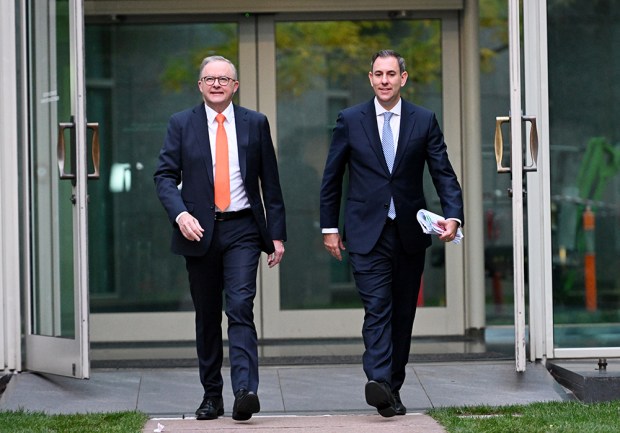
Canberra has forgotten all of this. When the economy slows, the instinct is to hand out cash. When inflation rises, the response is to subsidise consumption. When industries struggle, the solution is another industry package. Treasurer Jim Chalmers has even claimed that without government spending, Australia would have entered recession, as though this were a defence of his settings rather than an indictment of them.
The same confusion runs through the wages debate. Figures released by the ABS show that over the year to December wages grew by 3.4 per cent. But over the same period the consumer price index rose by 3.8 per cent. Real wages therefore went backwards. For households, that is what matters. Yet the governing class behaves as though a little more public spending, a few more subsidies and another transfer scheme will somehow make the country richer.
The assumption running through all of it is that if only people would spend more, the economy would grow more. But spend what and produced by whom? You cannot consume your way to prosperity any more than you can drink your way to sobriety. Demand without supply is just inflation, and supply does not appear by fiat.
Government does not create wealth. It redistributes it, and in doing so erodes the incentive to create it. Milton Friedman put this clearly when he wrote that, ‘The only way in which you can redistribute effectively wealth is by destroying the incentives to have wealth.’
Every transfer, subsidy and middle-class welfare scheme chips away at the reward for producing and enlarges the reward for rent-seeking. Once the political business of a country becomes the administration of transfers rather than the encouragement of enterprise, the best minds in government stop asking how to grow the pie and start asking how to slice it. And the best minds outside government stop building firms and start building relationships with Canberra.
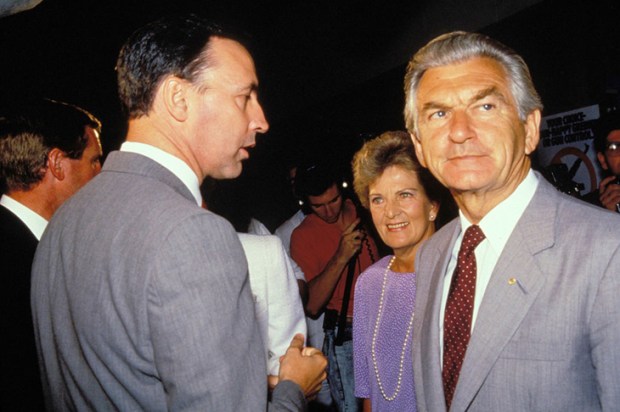
Australia once understood the alternative. Hawke and Keating floated the dollar and brought down the tariff wall. Those reforms exposed Australian industry to world prices and world capital, and a generation of growth followed. That prosperity was the product of hard political work, much of it unpopular at the time, done by people prepared to spend political capital rather than hoard it.
Meanwhile, Australian manufacturing has withered under the combined weight of energy, tax and industrial relations policy. The tax system rewards asset speculation over productive investment. Small business owners spend more time navigating red, green and black tape than serving customers. Universities churn out heavily indebted graduates in some fields that produce no tangible wealth while the trades beg for apprentices. And still the political class insists the answer is more spending.
The sharpest example is housing, where the supply problem is impossible to disguise. Young Australians have been priced out of the market, and for once there is broad agreement on why: governments at every level have made it ruinously expensive and slow to build. Planning rules, zoning, heritage, infrastructure charges and approvals timelines have strangled supply in the cities where demand is strongest. The political response is not to restore supply but to subsidise demand, through first-home buyer grants, shared equity schemes and rent assistance, each of which bids up prices further and deepens the dependence of the next generation on the state.
That is the cycle laid bare. Policy throttles supply. Prices rise. Government steps in with transfers funded by a shrinking productive base. The transfers dull the political pressure to fix the underlying cause, so the cause is not fixed. Rinse and repeat across energy, childcare, aged care and education and you have the Australian economy of the last quarter century.
The road back runs through production. Cut taxes. Cut regulation. Cut middle-class welfare. Index the tax brackets. Lift the compliance burden on small business. Make energy policy serve industry rather than ideology. Every one of these is a supply-side measure, and every one of them works by letting Australians produce more, not by paying them to consume more.
Australia cannot have a generous welfare state without a productive private sector to pay for it. And it cannot lecture the world about its climate virtue while exporting the commodities that power the factories it blocks at home.
The choice is not complicated, though it is uncomfortable. Australia either rediscovers the habits of production, or it continues down the current road…
Production first. Supply first. Everything else follows.
Got something to add? Join the discussion and comment below.
Dimitri Burshtein is a Senior Director at Eminence Advisory. Peter Swan AO is professor of finance at the UNSW-Sydney Business School.
You might disagree with half of it, but you’ll enjoy reading all of it. Try your first month for free, then just $2 a week for the remainder of your first year.