It is easy to forget that what we think of as ‘constitutional democracy’ covers fewer than half of the world’s sovereign states.
Constitutional democracy as we know it was developed in England over the course of about 500 years, and was only fully consolidated with universal suffrage in the early years of the 20th Century.
It was facilitated by having a monarch who was increasingly becoming a figurehead while retaining the power to dismiss a government that was exceeding its authority.
A significant precursor to constitutional democracy was the leadership of Robert Walpole, 1721-42, the first to be called by the, originally pejorative, title of ‘Prime Minister’. Walpole was the first such leader not to be impeached for the ‘high crimes and misdemeanours’ (which led to the execution of Charles I) or otherwise punished upon leaving office; provision for judicial-style impeachment ceased to exist in the UK after 1806 and is not part of the Australian system.
The conditions that nurtured English constitutional democracy were threefold.
First, a limited franchise in which the (more numerous) poor had no vote and therefore were unable to use political power to expropriate the wealth and income of the minority. Secondly, an acceptance, quite rare in the history of organised nations or empires, under which the gold standard prevailed, and governments had to balance their budgets and could not, except in periods of dire necessity, incur debts to be paid by future generations. And, thirdly, where those who failed to win elections accepted government by the majority.
This third condition also required restraint by the majority. The American Civil War stemmed from a large minority fearing that Lincoln’s Republican victory meant their property rights in the form of slaves would be seized. Similarly, the Spanish Civil War was triggered by fears that the 1936 election results foreshadowed land expropriation and nationalisation. And the military overthrew Chile’s Allende Government in 1973 when (with a vote of under 40 per cent of the electorate) it gained government and embarked upon an aggressive policy of expropriation, wage hikes, and deficit spending that within a few years were crippling the economy. Radical post-1945 nationalisation programs in Britain and France ignited no similar opposition.
With its legitimisation of revolutionary seizure of power, elements of the political left reject constraints on their ability to act in the name of the proletariat; once having seized power communists in Russia, China, North Korea, and elsewhere have never tested the popularity of their actions in free elections.
The latest assassination attempt on President Trump has called into question the acceptance of his election victory. White House Press Secretary Karoline Leavitt accused Democrats of putting the President’s life in danger with inflammatory rhetoric. ‘When you read that manifesto of this shooter, ask yourselves, how different is that rhetoric from this almost-assassin than what you read on social media and hear in various forms every single day? The answer, if you’re being honest with yourself, is that there is no difference at all.’
Trump ushered in a political agenda involving reduced spending and a deep-seated reversal of energy policy accompanied by attacking the global warming fundamentalism that had justified the previous administration’s decarbonisation strictures. He also initiated a more rigorous prosecution of illegal immigration.
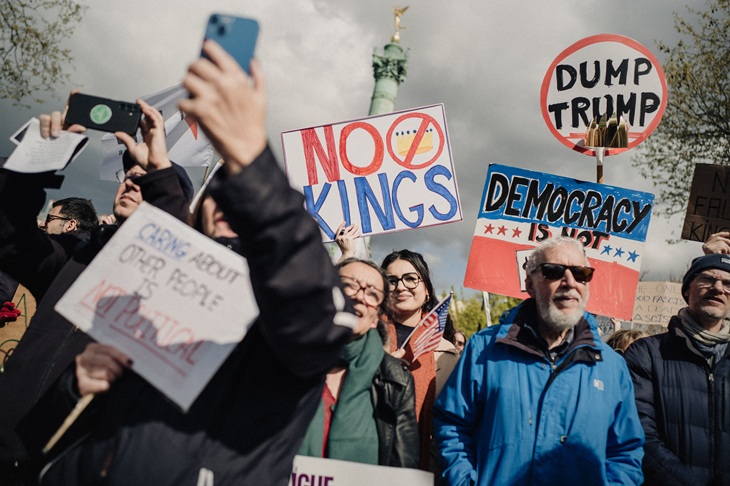
These have ignited ‘No Kings’ demonstrations in June 2025, October 2025, and March 2026 with up nine million reported participants who accuse him of somehow undermining democracy.
Policies on energy and immigration analogous to those of Trump are likely to be introduced following elections in Australia over the next two years and in the UK. In both cases, grossly incompetent governments have brought spending and energy policies that have paralysed their economies with high-cost renewable energy requirements, impediments to fossil fuel developments and government spending that has cannibalised investments and productivity.
Will we see a similar level of venomous opposition?
One difference from Trump’s America is that other countries (the EU, as well as the UK and Australia) will benefit from observing the success of the Trump Administration’s rejection of green energy policies. That success and the awakening caused by the Iran crisis is already influencing policies of Labor and the Liberals/Nationals in Australia (as well as Labour and the Conservatives in the UK) that have adopted similar policies to those of the incumbent governments. Added to this, in both Australia and the UK, environmental opposition to wind and solar along with their transmission lines degrading rural areas has arisen while the emergence of One Nation in Australia and Reform in the UK has demonstrated the political imperative of reversing course on energy policies.
The problem for Australia and the UK is how to unravel energy policies that are in place and being nurtured by vested interests in the bureaucracy, industry, and well-financed environmental groups which provide grants to activists of some $60 million a year. Moreover, government contractual lock-ins (in Australia likely to be renegotiated at even higher cost to the taxpayer and energy consumer) could entail tens of billions of dollars in compensation, costs that will suffocate the economy for many years.
Perhaps we need to renew the power of impeachment!