The world is fixated on the situation in the Strait of Hormuz, but it should be watching the waters off Taiwan, where the supply of something far more critical could disappear overnight.
Taiwan is separated from China by a strait just 180 kilometres wide. On that island is produced something more valuable, and far less replaceable, than oil: the semiconductors that power 21st Century life.
Every GPU Nvidia designs. Every advanced chip inside your smartphone, fighter jets, and the data centres running artificial intelligence.
They are all made by one company, in one place.
Taiwan Semiconductor Manufacturing Company (TSMC) is the world’s largest manufacturer of advanced semiconductors, and it operates under the nose of the world’s most dangerous authoritarian regime.
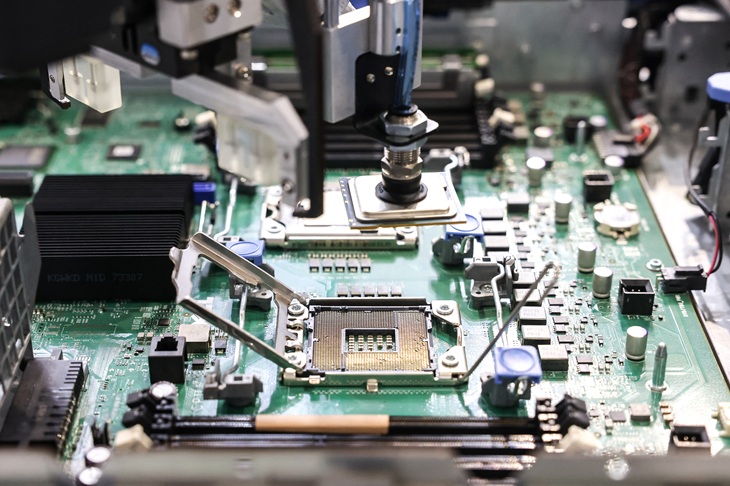
To understand why this matters, consider what it takes to make a two-nanometre chip.
A tin droplet moving at several metres per second is struck by a laser to make it wobble, then hit again at precisely the right moment to turn it into plasma – 50,000 times a second.
These lithography machines are the most complex manufacturing systems ever built. They exist almost exclusively in Taiwan, and have powered its economic ascendancy.
Since 2020, Taiwan’s stock market has tripled, eclipsing London’s FTSE, driven largely by TSMC, whose shares are up 680 per cent.
The consequences for global markets of losing access to Taiwan’s chip supply would dwarf any energy shock.
There are no strategic reserves of chips. No equivalent of an International Energy Agency to release stockpiles. There are no alternative suppliers to turn to.
Several advanced fabs operate in the United States, South Korea and elsewhere. But the most advanced chips, at two nanometres and below, are produced almost entirely in Taiwan, at a scale no competitor can match.
Once broken, these supply chains could take a decade to rebuild.
As much as I liked the 1990s, I have no interest in going back just yet.
In recent months, US officials have quietly warned executives at Apple, AMD and Qualcomm that a Chinese blockade of Taiwan could bring the American tech industry to its knees.
It’s why US Treasury Secretary Scott Bessent recently called Taiwan’s chip concentration the ‘single biggest threat to the world economy’.
Yet the issue remains largely confined to think tanks and insurance models.
Few are seriously planning for a disruption, just as few anticipated the invasion of Ukraine or a closure of Hormuz.
That ended well.
‘Strategic ambiguity’, the term used by the United States and its allies, is a smokescreen for having no plan at all.
The United States has fired more than 3,000 Tomahawk, Patriot, and other missiles since the beginning of the Iran war, stockpiles that could take up to six years to replenish, and officials privately concede that America could not fully execute its contingency plans to defend Taiwan in the near term.
Washington believes China is unlikely to move before 2027, but expects action before the hundredth anniversary of the People’s Republic in 2049.
That is a wide, dangerously vague window. There is reason to think it could happen sooner.
Beijing has been watching Iran demonstrate something important: you do not need to sink ships to disrupt global trade. You only need to create uncertainty.
China is better placed than almost anyone to endure a prolonged standoff.
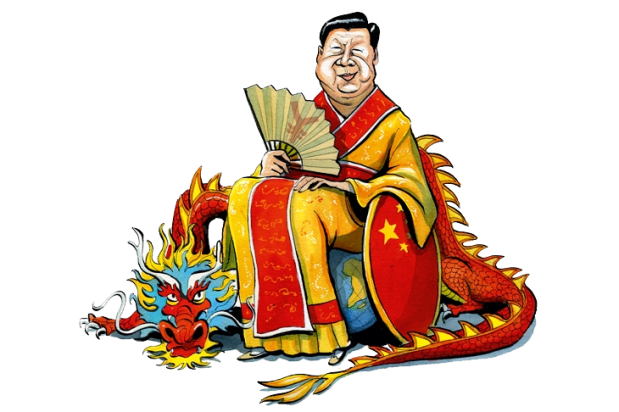
Xi Jinping’s fortress economy holds 69 per cent of global corn reserves, 60 per cent of rice, and 51 per cent of wheat.
Only 6 per cent of China’s energy consumption is exposed to disruption in the Strait of Hormuz.
The CCP’s own newspaper has boasted that China holds the world’s ‘energy rice bowl’. Beijing has been preparing for exactly this kind of attrition.
So, while the Allied world is running on low-power mode, burning through its arsenals and scrambling for energy security, China is in the strongest position it has ever been to move on Taiwan.
We look back now with disbelief at how we allowed such a critical chokepoint to sit in the Strait of Hormuz, in the shadow of an authoritarian and extremist regime.
The question is whether we will act before the Taiwan Strait teaches the same lesson Hormuz just did, only at a cost we cannot yet imagine.
Building sovereign semiconductor capability is expensive. The opportunity cost of not building it is beyond calculation.