The discourse around Anzac Day this year was dominated by the reaction to ‘Welcome to Country’ ceremonies. These ceremonies now have a prominent role in the Dawn Service at many locations and, for the second year in a row, were met with outrage and derision from some sections of the crowd.
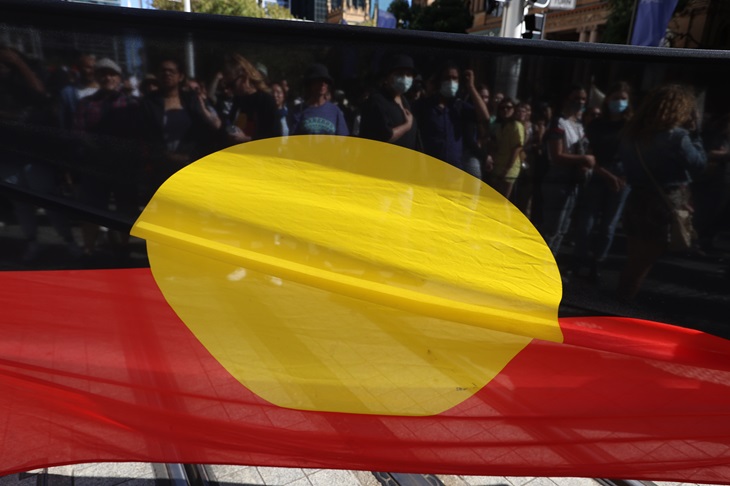
At the marvellous Shrine of Remembrance in Melbourne, Mark Brown, an elder of the Bunurong people, delivered the ‘Welcome to Country’. Some people cheered, but the boos were what got attention.
This reaction reflects a broader split in the community. Many Australians see these ceremonies as a magnanimous gesture by Indigenous people. Others object to the idea of welcoming non-Indigenous Australians in their own homeland. But the first perspective is the one most of our leading institutions support – including the Returned and Services League.
Personally, as a conservative, I think welcome ceremonies have the potential to reflect important values, such as love of homeland and respect for our ancestors. And I believe that the unique status of Indigenous people should be reflected in our civic ethos.
But context matters.
Activists claim Australia exists on ‘stolen land’ and that the British settlers who founded this nation were ‘invaders’. If you believe that, you will have a particular view about the meaning of any ‘welcome’ extended to the descendants of those settlers.
So, I am open to the idea of welcome ceremonies, in theory. But I am guarded, in practice. I want to find out exactly what is being said. So that is what I have done.
A Welcome Directed Inwards
Brown’s address is here, starting at 13:20:
I took a few minutes to transcribe it. I think it’s worth showing in full. Any error is mine.
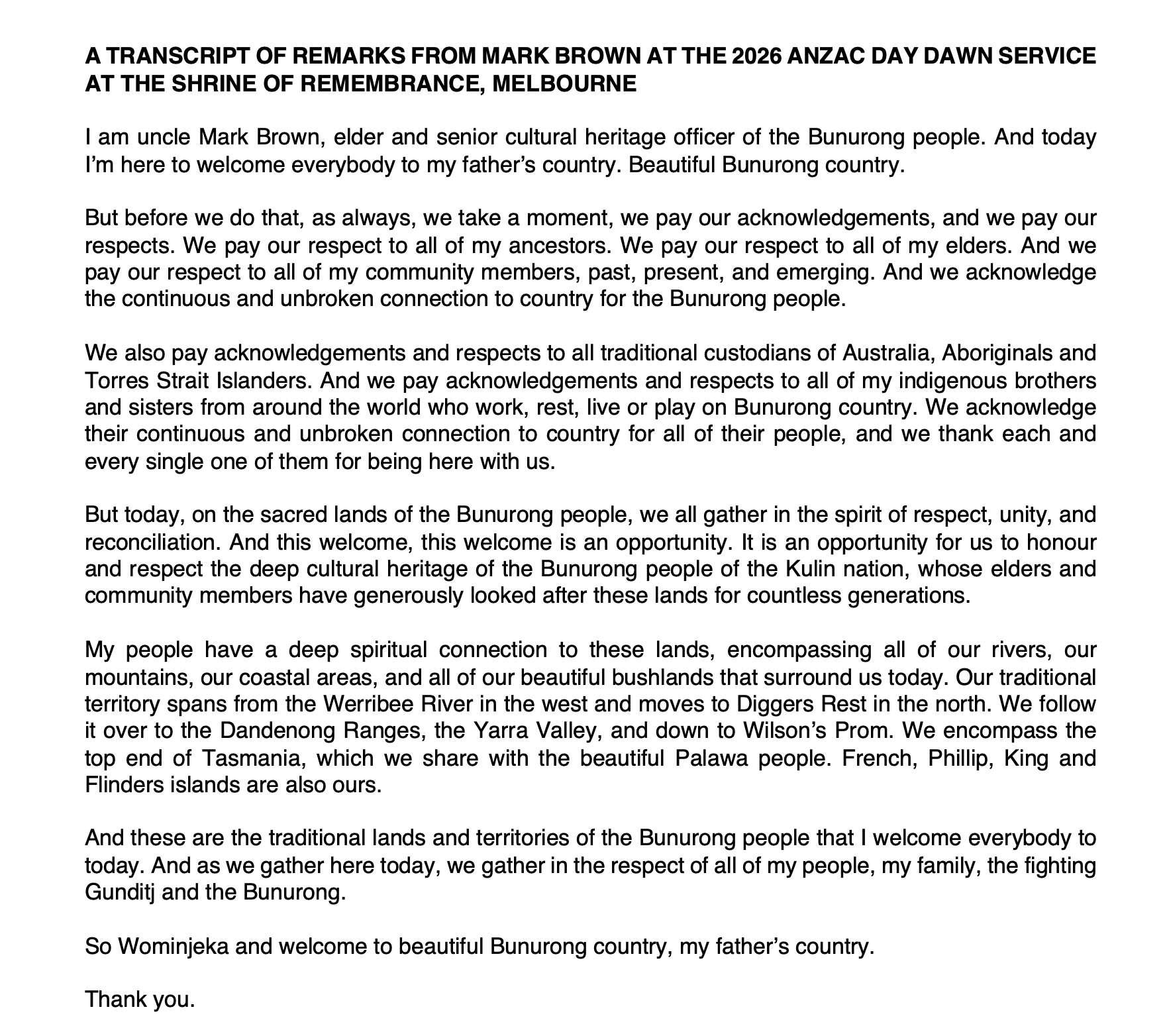
At first glance, you may think that this address is very welcoming – after all, the word ‘welcome’ is spoken five times. But it’s worth looking closely at each of those utterances.
The first reference states the nature of the address. The second and third describe its purpose – to honour and respect the heritage of the Bunurong people. The fourth notes the territory to which the address applies. Only the fifth mention of the word ‘welcome’ is actually directed at the people standing in the dark at five o’clock in the morning.
The address is devoted almost entirely to two things. First, it pays acknowledgment and respect to the Bunurong community and indigenous people more broadly. Second, it defines the extent of the traditional territory of the Bunurong people and describes their connection to it. The actual welcome to other people is perfunctorily tacked on at the end.
People can make their own assessment of the address, but it is my personal opinion that it is very inward-looking. I think it is fair to say that Brown’s focus is almost entirely directed towards his own community. However, a welcome, by its nature, is supposed to be an act directed outwards. Brown paid a lot of acknowledgement and respect, but not to people outside of his community.
It is also striking that the Welcome said exactly nothing about the event and the day. He made no reference to the Anzacs or those currently serving – not even the many Indigenous people who have worn the uniform of Australia. The only martial reference was to ‘the fighting Gunditj’, a people well-known for their fierce resistance to the settlement of their lands.
The nature of this address, and others like it, could cause some people to raise questions about the ideas that motivate a ‘Welcome to Country’.
Why People Boo
Many Australians find the idea of ‘Welcome to Country’ objectionable. It inherently suggests we are classified as ‘hosts’ and ‘guests’. And that creates the impression that the ceremony is used to send a message that is actually divisive – that this continent ‘always was, always will be’ the sovereign territory of Indigenous people and that the rest of us are here legitimately only at their invitation.
Defenders of these ceremonies will insist that this is an uncharitable interpretation of their meaning and purpose, but do they honestly think all of these ceremonies are offered as a generous welcome? The execution matters enormously when a concept is contested. And what many Australians experience at these ceremonies is not inclusion but its opposite.
For decades, prominent activists, academics, bureaucrats, and politicians have criticised the British colonisation of Australia and questioned the very legitimacy of this nation. This critique is now embedded in our society. That, in turn, raises questions about the status of the descendants of those colonisers. If you are told that your ancestors were ‘invaders’, you might have doubts that people who think that way really consider you to be ‘welcome’ here.
The defence of the message is illustrative. Last year, in response to a similar reaction to a Dawn Service welcome, critics were told that their lineage traces back to settlers who arrived here merely 235 years ago. It was further stated that those critics are ‘welcome’ to trace their roots back to their ancestral lands and to the countries from which their forebears came.
It is fair to question whether this sort of response reflects a belief that non-Indigenous Australians share a deep connection to the country and are, indeed, ‘welcome’.
If Australians are constantly sent a message that we suspect casts us as outsiders in our own nation, we are eventually going to push back against that. We will start to reassess what motivates the idea that we should be ‘welcomed’ on so many occasions.
And some of us will boo.
Our cultural elites have nobody to blame but themselves for this. If you conduct a ceremony that is, in its logic and execution, aimed at asserting Indigenous sovereignty rather than welcoming the crowd, you should not be surprised when some in the crowd declines to feel ‘welcomed’. The reaction is not a failure of the audience. It is a failure of the ceremony.
The Politics of Respect
Politics is not only about the distribution of resources. It is also about the distribution of respect. Who gets honoured? Whose ancestors are celebrated? Whose connection to this country is treated as profound and whose is treated as contingent?
In contemporary Australia, our civic ethos has arrived at a strange and unstable settlement. Indigenous Australians are accorded a unique and respected status – rightly so. Migrants and their contributions are celebrated – deservedly so. But a similar respect is not afforded to the descendants of the settlers who founded this nation and who built so much of its institutions, infrastructure, and culture.
Australians with British ancestry are taught that our ancestors invaded this land. We are told our history is a catalogue of shame. And we are sent the message that the legitimacy of our presence here is conditional. This is not a sustainable basis for national unity.
Indigenous people do indeed have a special connection to this land. And – again, in theory – I quite like the idea of an elder of that community sharing their understanding of that connection and welcoming others. A genuine welcome would recognise the reality that a broader group of people now belong to this country and have a deep connection to it – a connection that should be all too evident on Anzac Day.
But it is my view that this is not what happened at the Shrine. The people at that event were there to pay their respects to men and women who most certainly did not see themselves as guests on someone else’s country. But they were told that only one group of people have a special connection to the land the Anzacs fought for.
Anzac Day was – and still should be – seen as a day of national unity. But that is not possible if the descendants of the Anzacs are also regarded as the descendants of invaders.
If these welcome ceremonies are to deserve our respect, they need to make the audience feel that they belong, that this country is theirs too, that the ancient Indigenous connection to this land enriches rather than takes priority over their own connection to it.
In other words, welcomes must be actually welcoming.