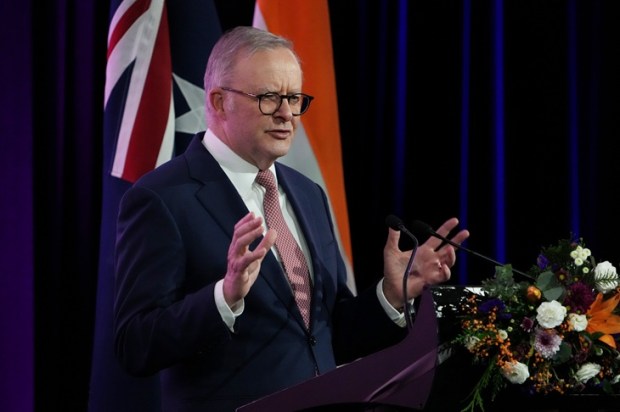
Andrew Leigh, the Assistant Minister for Productivity, is one of the Albanese government’s staunchest defenders of immigration. And he is one of its most vocal critics of One Nation, accusing the party earlier this week of ‘trying to make people angry rather than come up with solutions’.
Leigh’s criticism of One Nation is nothing new. Nor is his advocacy for immigration. When he was an academic 20 years ago, he published an article which noted the benefits of immigration, and which also attacked One Nation in severe terms. But in that article, Leigh was also very open about the negative impact that diversity can have on society.
Perhaps Leigh should look back at his old research to understand why support for One Nation is surging today.
Leigh PhD More Candid Than Leigh MP
In 2006, Leigh was a professor of economics at the Australian National University, not long after completing a doctorate at Harvard. Around this period, he was busy publishing academic papers on a range of topics, including several on the impact on society of greater diversity.
Helpfully, Leigh published an article summarising his research and perspectives that is much more accessible than a standard economic paper. Leigh cited the ‘economic and culinary effects’ of immigration – yes, he really said ‘culinary’ – but he was also much more candid than he is now about the downsides of immigration. In particular, he explained how diversity tends to reduce both trust in a society and solidarity, in the form of support for welfare spending and other forms of income redistribution.
On trust, Leigh’s research closely echoed that of US academic Robert Putnam, who famously found that diversity reduces trust because people ‘hunker down’ to avoid those who are different. Leigh found that Australian survey data also showed a negative correlation between trust and ethnic diversity.
Leigh is very familiar with how common this relationship is. His article cites studies that show that diversity lowered productivity among British fruit-pickers, reduced census completion rates in America, and hampered school fundraising efforts in Kenya. Leigh was not just theorising at the macro level. He was aware of real-world, ground-level evidence about how diversity imposes costs on communities.
On solidarity, Leigh’s research echoed that of another US researcher, Alberto Alesina. Alesina and his colleagues found that a major reason why the welfare system in America was typically less generous than in Europe was because America was more racially diverse. According to Leigh, the simplest explanation for this is that ‘people are less generous to those who are different from them’.
Leigh crunched the numbers for Australia and found we are more like America than Europe. He concluded that ‘our high level of linguistic diversity helps explain Australia’s relatively small social welfare sector’. But he also looked at the state level and found that Queenslanders were particularly opposed to income redistribution. And who did he blame for that?
Pauline Hanson.
The Professor Attacks
In 2006, Hanson was in the political wilderness. After being elected to federal Parliament in 1996 and forming One Nation in 1997, she lost her seat in 1998, was expelled from One Nation in 2002, and failed to win a Senate seat as an independent in 2004. Nevertheless, Leigh was very vocal in his criticism of Hanson in his 2006 article, using language not normally associated with an economics professor.
Leigh speculated that weaker support for welfare programs in Queensland was probably because ‘racially driven politics has been stronger in Queensland than in any other state’. He accused Hanson of using ‘hatred against racial minorities as a way of building an anti-redistribution constituency’. And he characterised the emergence of One Nation as an example of ‘anti-minority, anti-welfare demagoguery’.
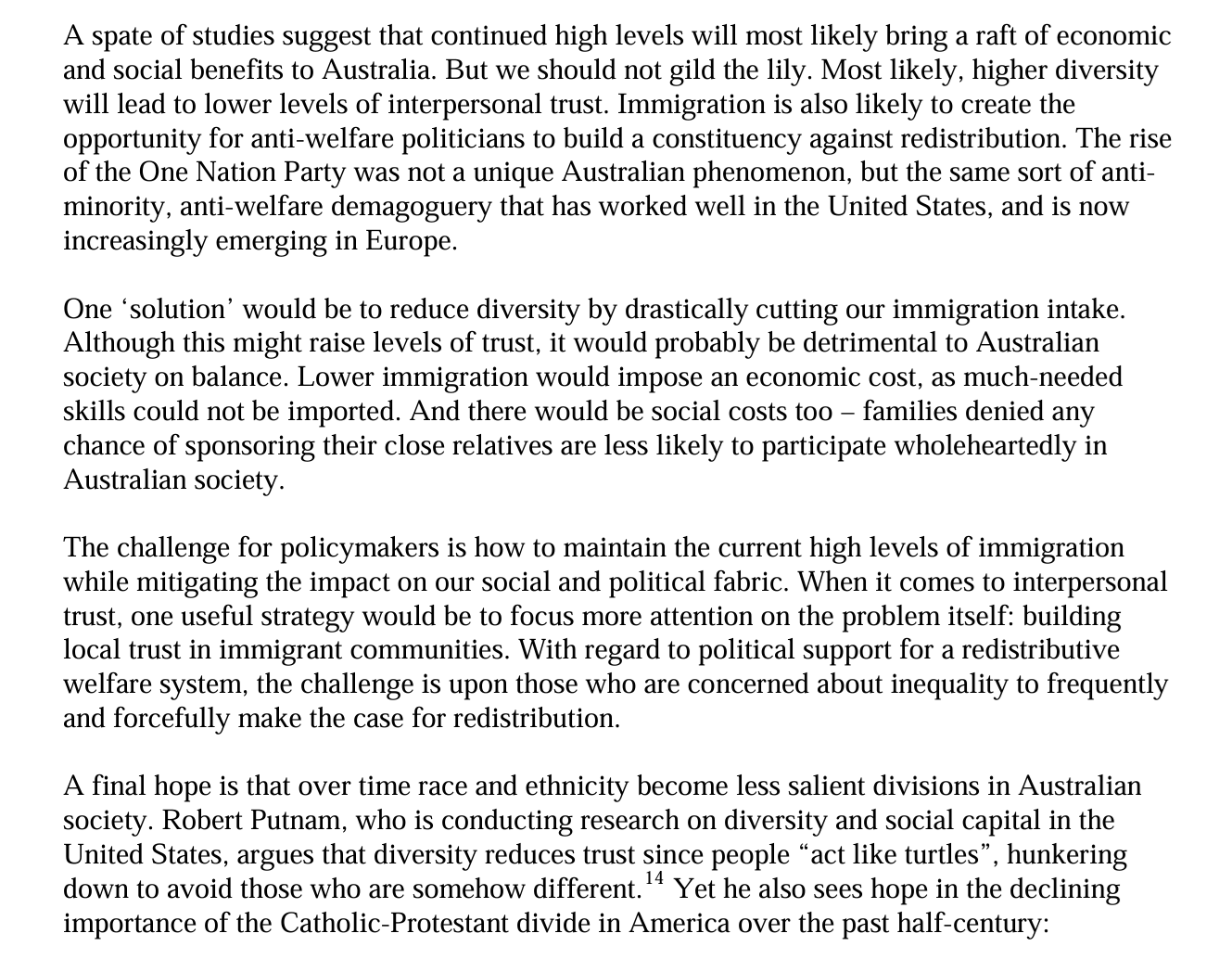
Section of Andrew Leigh’s paper.
As you can see, his criticism of Hanson and One Nation today is nothing new.
Let’s be clear about Leigh’s position in 2006. He thought immigration was good for the economy, but he also acknowledged very openly the research showing that higher levels of diversity tend to reduce social trust and solidarity. And he was worried that nasty right-wing demagogues would exploit this for political purposes.
So what did he recommend? Doubling down.
Trade-offs? What Trade-offs?
Leigh is a Labor true believer, through and through. He joined the ALP in 1991. He clearly shares the ALP’s self-conception as a movement motivated by a strong sense of solidarity and a firm commitment to public services and welfare spending.
Leigh is also a strong advocate for high levels of immigration. In an X post this week, he spoke of how ‘migrants build our homes, power our economy, and strengthen our communities’. He believes Australia’s immigration system is working well.
Back in 2006, Leigh was also adamant that policymakers should ‘maintain the current high levels of immigration’. Having explained in detail how diversity reduces trust and lowers support for welfare spending, Leigh basically shrugged his shoulders and concluded that Australia needs ‘more of the same’.
Leigh’s suggested ‘strategy’ for dealing with the trade-offs associated with the impact of more diversity was very vague and underdeveloped. In fact, it was basically non-existent. He talked about ‘building local trust in immigrant communities’ and the need to ‘make the case for redistribution’. He expressed ‘hope’ that divisions would ‘over time’ become ‘less salient’.
In 2006, Leigh basically dismissed the trade-offs with bland platitudes and wishful thinking. But now, in 2026, Leigh seems to ignore those trade-offs altogether. Gone are references to his previous research on how diversity reduces trust and solidarity. Now we just have the standard rhetoric about the economic and cultural benefits of immigration.
But the growing support for One Nation suggests voters recognise those trade-offs.
Hanson Does Not Do Circumspect
Those sympathetic to Leigh’s ideas have gotten their way over the last 20 years. In 2006, he noted that the most recent census had shown the foreign-born population of Australia at 23 per cent. In 2024, it was 31.5 per cent. Both major political parties, when in government, have relied on high levels of immigration to keep the economy growing.
Leigh was hopeful that things would work out fine. That’s debatable.
Coincidentally, the Scanlon Foundation’s annual Mapping Social Cohesion Survey was initiated shortly after Leigh’s article was published. Over the two decades since, it has recorded a steady decline in measures of pride in the Australian way of life and the sense of belonging in Australia. Much has happened since 2006, and it would be simplistic to attribute these trends to any single factor. But this survey certainly does little to suggest that trust and solidarity have improved as Leigh had hoped.
One of the big things that has happened since 2006 has been the return of Hanson from the political wilderness. In 2013 she regained the leadership of One Nation and in 2016 she was elected to the Senate. Since then, One Nation’s share of the primary vote has steadily moved higher each federal election. Now it is riding high in the polls.
Although Leigh’s paper from 2006 may partly attribute One Nation’s support to demagoguery – his public criticisms are now more circumspect. But he also seems reluctant to engage seriously with the possibility that voters are more concerned about the very trade-offs his own research once highlighted.
Hanson does not do circumspect. She does not speak like an economics professor, and she has always been willing to criticise the scale and pace of immigration. And many of her arguments about the need for immigration to be consistent with social cohesion reflect the very points that Leigh once made.
Twenty years ago Leigh acknowledged that continued high immigration risks undermining social trust and solidarity. He supported it anyway, arguing that immigration boosts the economy. Now he just focuses on the benefits.
There are trade-offs. And more voters, it seems, now want the trade-off Hanson proposes.