There is a phrase that has quietly colonised the male psyche, one that doubles as internet meme and genuine behavioural diagnosis: ‘monitoring the situation’.
You know the type.
He has three browser tabs open – two of them live conflict maps, one a Telegram feed from a correspondent whose credentials are unclear but whose posting frequency is not. He has not been to the gym. He has not called his mother back. But he can tell you, with unsettling confidence, the precise difference between an F-15 and an F/A-18 based on the angle of their tail fins.
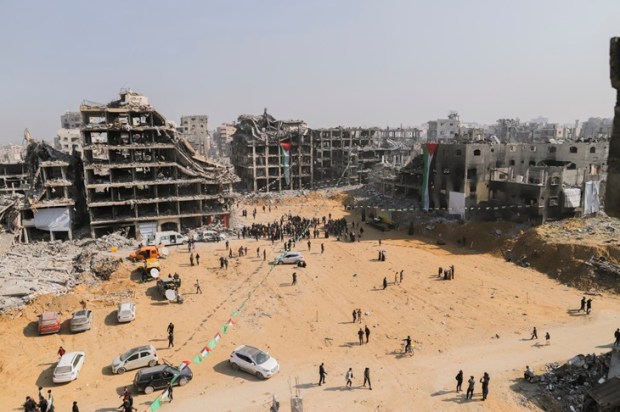
The phrase became internet-famous during the recent flare of geopolitical tensions – most acutely in the Twelve Day War last year, in which Israel launched pre-emptive strikes on Iran. As it happens, I was stranded in Tel Aviv during that particular episode, which lent my own monitoring of the situation a certain motivational clarity. When there are missiles in the sky above you, refreshing your feed ceases to be a personality disorder and becomes, briefly, a matter of survival. For most practitioners of the art, however, no such justification exists.
The meme, at its core, mocks the passive yet obsessive tracking of global crises via social media – the compulsion to refresh one’s feed through every escalation, ceasefire rumour, and retaliatory strike. But to dismiss it as mere doomscrolling with a more dignified name is to miss what it actually reveals. This is not a quirk of the digital age. The terminology is new, made possible by X accounts that stream live footage directly from the battlefield to our phones. The phenomenon, however, is as old as men.
‘One hour of life, crowded to the full of glorious action, and filled with noble risks, is worth whole years of those mean observances of paltry decorum, in which men steal through existence, like sluggish waters through a marsh, without either honour or observation.’ – Walter Scott
Evolutionary psychology offers one lens: the Male Warrior Hypothesis, which proposes that men have been selectively conditioned for intergroup conflict as a mechanism of survival and status. Successful aggression historically translated into resources, territory, and mating opportunities. The man who understood the battlefield – who could read its chaos and anticipate its turns – was the man who mattered. That instinct does not simply dissolve in peacetime. It finds alternative channels.
For centuries, those channels were institutional: the emperors watched gladiators, kings attended jousting tournaments, Victorian gentlemen followed war despatches from the front with a glass of port and a grave expression. Today, the institution is a smartphone and the despatch is a grainy drone video with 400,000 views. The medium has changed. The underlying appetite has not.
The Jewish author Alfred Kazin famously described war as the ‘enduring condition of the 20th Century man.’ One suspects Kazin would find the 21st Century entirely on-brand. Trotsky, in a different register, observed that you may not be interested in war, but war is interested in you. To which the modern monitor of situations might reasonably reply: Well, my revolutionary friend, I am also interested in the war, even if the war is not interested in me…
This is where the Male Warrior Hypothesis shades into something more melancholy. We live, in the West, in an era of extraordinary material abundance and relative physical safety. Men are not required to compete for survival, to protect the settlement, to lead the charge. The trades remain. Sport remains. The gym remains. But the fundamental purposefulness of physical, strategic, competitive masculinity has been largely abstracted away – sublimated into careers, ‘personal growth’, and an earnest relationship with one’s feelings. No man, deep down, wants to feel redundant. Monitoring the situation is, in its voyeuristic and slightly depressing way, a reminder that there is still a role for men in conflict. Even if that role is purely observational.
It is, in this sense, less like doomscrolling and more like – if one is being generous – a particularly immersive strategy game. Men are addicted to Civilisation, to Age of Empires, to games in which they command armies and manage supply lines and make the hard calls from the safety of a swivel chair. War is a brutal, deadly game, but it is a game, and men love games. Monitoring the situation is simply that impulse migrated to the real world, with the crucial advantage that one’s own personal downside risk is minimal.
The data, to whatever extent data can validate something this visceral, supports the general picture. Pew Research has found that men express significantly greater interest than women in international affairs. The University of Canberra has documented a parallel gap in engagement with political and geopolitical news. Men are also heavier users of X, which is both the primary delivery mechanism for live conflict content and something of a self-selecting arena for exactly this kind of obsessive situational awareness. Whether the platform shapes the interest or the interest shapes the platform use is a question best left to researchers with more funding and less at stake.
Monitoring the situation intoxicates you. It degrades your attention and decision making capacity.
— Bryan Johnson (@bryan_johnson) March 6, 2026
There is also the pressure-release theory. A relentless barrage of global headlines – wars, elections, institutional collapse, economic anxiety – would otherwise produce only despair. Monitoring the situation reframes doomscrolling as something closer to diligence. I am not spiralling; I am informed. I am not anxious; I am situationally aware. It is, as psychological coping mechanisms go, not the worst available. It is also, as the longevity biohacker Bryan Johnson noted in a recent post, a significant degrader of attention and decision-making capacity. The irony being, of course, that Johnson is perhaps the most comprehensively monitored human being on Earth, having opened his blood markers, sleep data, and nocturnal physiology to millions of followers. He monitors himself while warning us against monitoring. One respects the commitment.
And then there is the simplest explanation of all: it makes you feel competent. To be able to identify a Tomahawk cruise missile from a SCUD ballistic missile by their respective flight trajectories, to have a considered view on the strategic implications of a particular territorial gain, to drop a reference to the Strait of Hormuz in casual conversation – these are forms of social currency. If you didn’t know me, you might assume I had a military background. I do not. I have a Twitter account and too much time between meetings.
The phrase has a second life, too, beyond the meme. It is the language of political evasion, the shield behind which leaders retreat when they are unwilling to act but cannot admit it. ‘Mr Secretary, what is being done about the strait?’ ‘We are monitoring the situation.’ In this usage, monitoring the situation is what you say when you have no intention of doing anything but cannot be seen to have no intention. It is inaction dressed as vigilance. It is, in other words, precisely what the rest of us are also doing, just with better press offices.
A caveat, offered briefly and sincerely: there are women who monitor situations with equal dedication, and men who find the entire enterprise baffling. Biology is not destiny, and generalisations have exceptions. But it would be an act of intellectual dishonesty, dressed up as political courtesy, to pretend there is no gender-skewed disposition at work here. The data says there is. Walter Scott said there is. My browser history says there is.
Perhaps the meme is ultimately just a joke men make at their own expense – an acknowledgement, laced with self-awareness, that we are helplessly drawn to the spectacle of conflict even when it has nothing to do with us and nothing to teach us about our own lives. A pressure valve. A small performance of relevance.
So, as I return to monitoring the situation – and I will, shortly, return to monitoring the situation – please don’t tell me it’s against my best interests. I know. I have read the studies. I have seen the Bryan Johnson post. I remain, nonetheless, professionally curious about the disposition of forces in the eastern theatre, and I would like to be left to it in peace.