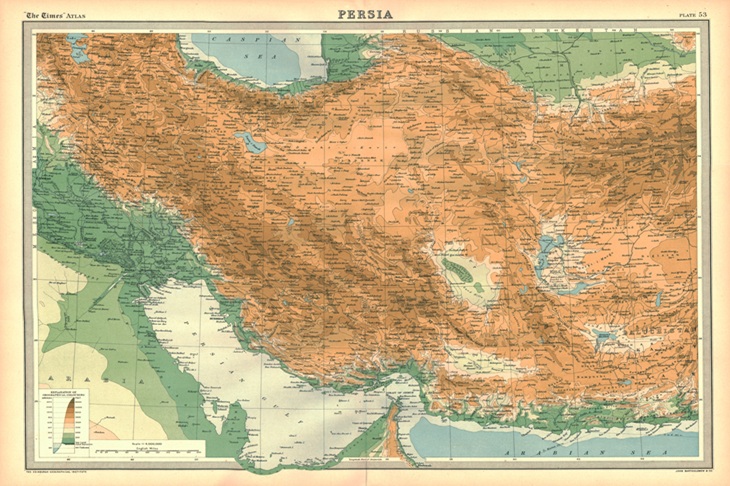
The geography of the Strait of Hormuz is not man-made; it is the result of a long process shaped by the continuous work of nature. This passage formed through tectonic transformations, where the Arabian Plate has been slowly and steadily pushing toward the Eurasian Plate. As a result of this prolonged collision, the Iranian plateau rose. From this pressure, folds emerged and mountain ranges such as the Zagros Mountains and the Alborz Mountains were formed, standing like stone walls that define the boundary of the plateau.
In the south, the land gradually subsided and seawater found its way in. What is now called the Persian Gulf is the result of this subsidence combined with rising sea levels in more recent geological periods. Water entered the lowest areas between Iran and the Arabian Peninsula and formed this body of water. Rivers such as the Tigris, Euphrates, and Karun have continuously altered this landscape by depositing sediments, but they were not its primary creators.
Within this broader setting, the Strait of Hormuz appears as a narrow knot in this vast structure; not by chance, but as a result of the balance between powerful tectonic forces and erosion over millions of years.
If viewed from above, the Iranian plateau appears as a large and unified elevation among surrounding lands, shaped by the complex history of the Earth rather than political boundaries. In this sense, what is called ‘Iran’ is, before anything else, a geological reality; a story of pressure, subsidence, folding, and time.
The origin of the name ‘Hormuz’ must be sought in language and ancient belief systems, where words reflected ideas about creation and existence. ‘Hormuz’ or ‘Hormozd’ is a transformed form of the name Ahura Mazda, the supreme creator in Zoroastrianism. Over time, the name evolved from ‘Ahura Mazda’ to ‘Ormazd’, then ‘Hormozd’ and finally ‘Hormuz’.
In this tradition, Ahura Mazda is not merely a god, but the source of order and wisdom. He is the creator of existence, the judge between good and evil, and the establisher of ‘Asha’, the order upon which the world is structured. He is the creator of light and the foundation of cosmic intelligence, from whose thought everything has come into being and through whose wisdom everything finds meaning.
For this reason, ‘Hormuz’ is not just a geographical name; it echoes the deepest layers of Iranian thought and reflects a connection between land and meaning. The strait seen on maps today carries within its name a memory of creation, order, and a presence that sets the world in motion.
Today, the Strait of Hormuz is the most important oil transit chokepoint in the world. According to recent data, around 20 to 21 million barrels of oil and condensates pass through it daily, accounting for about 20 per cent of global oil consumption and nearly one-third of the world’s seaborne oil trade.
A significant portion of the world’s proven oil and gas reserves is located in the Persian Gulf region. Countries such as Iran, Saudi Arabia, the United Arab Emirates, Kuwait, Iraq, and Qatar export most of their energy through this strait to global markets. The main destinations for these exports are Asian countries, particularly China, India, Japan, and South Korea. Japan, for example, has historically sourced about 70 to 80 per cent of its crude oil imports through the Persian Gulf and via the Strait of Hormuz.
Now, turning to the legal evolution of the Strait of Hormuz, from the 1959 law to UNCLOS.
Starting point: the 1959 law and Western reaction
In April 1959, Iran passed a law through its parliament increasing its territorial sea from 6 to 12 nautical miles. This move was in line with a broader global trend at the time, although no unified international standard yet existed. The United States and the United Kingdom objected, arguing that it conflicted with prevailing practice, where many states still maintained limits between 3 and 6 nautical miles. Iran responded that its decision reflected regional developments and stated that it would be open to reconsideration if a widely accepted international rule emerged.
Completion of the legal setting with Oman’s action in 1972 . In July 1972, Oman issued a similar decree extending its territorial sea to 12 nautical miles. As a result, given the approximate 33 nautical mile width of the strait at its narrowest point, the entire strait came to lie within the territorial waters of Iran and Oman, leaving no corridor of high seas in between. While this was geographically significant, it did not by itself determine the legal regime governing passage.
Legal transformation with the 1982 Law of the Sea Convention
With the adoption of the United Nations Convention on the Law of the Sea in 1982, a new legal framework was established for straits used in international navigation. Under this convention, straits like Hormuz, which connect two parts of the high seas or exclusive economic zones, are subject to the regime of ‘transit passage’. This regime allows ships and aircraft to pass continuously and expeditiously without prior authorisation from coastal states, and it is broader than ‘innocent passage’.
Iran’s position and continuing legal dispute Iran signed the 1982 convention but has not ratified it and issued an interpretative declaration at the time of signing. In its position, Iran maintains that passage through the Strait of Hormuz should be governed by ‘innocent passage’ and that foreign warships must obtain prior authorisation. It also offers a more limited interpretation of the applicability of transit passage.
However, a significant portion of the international community, including major maritime powers, considers transit passage to be not only based on the convention but also part of customary international law, and therefore applicable to the Strait of Hormuz. As a result, the legal status of the strait remains subject to differing interpretations.
In conclusion, I believe that the Strait of Hormuz cannot be understood merely as a geographic passage or an energy route. What converges at this point are three deep layers of reality: land, meaning, and power. From the collision of tectonic plates and the formation of the Iranian plateau to the accumulation of thousands of years of thought reflected in a name linked to Ahura Mazda, and to its present role in global economics and international law, the Strait of Hormuz is more than a place; it is a deep and ancient narrative.
This narrative shows that geography is not merely a backdrop to politics; it actively shapes legal and geopolitical realities. Just as natural forces determined the form of the strait, international law has attempted to establish an order for passage through it, an order that remains contested among different interpretations and interests.
In this sense, the Strait of Hormuz is neither fully under the control of states nor entirely beyond global rules and philosophical meaning. It stands at a point where nature, history, myth, and law coexist. Perhaps that is why this strait, more than just a route, has become one of the few places in the world where regional and global destinies are visibly intertwined.
By Leila Naseri: Author | Composer | Social Cultural Activist