‘Russian troop movements near Ukraine border prompt concern in US, Europe’ ran the headline in the Washington Times on 30 October 2021, exactly five years ago today. Below came the shocking revelation that as many as 90,000 troops had massed close to the border with Ukraine, together with a substantial build-up of tanks and artillery. The article quoted Russian expert Michael Kofman, who expressed what the world was now wondering:
The point is: It is not a drill. It doesn’t appear to be a training exercise. Something is happening. What is it?
The build-up came towards the end of a year of heightened tensions between Russia and the West. In the spring, there had been a similar massing of Russian troops close to Ukraine, before Russian defence minister Sergei Shoigu withdrew (or at least appeared to withdraw) the troops and weaponry in late April. The same month, in his state of the nation address, Vladimir Putin ominously warned the West against crossing a ‘red line’ with Russia and of the ‘asymmetrical, rapid and harsh’ response that would follow.
Five years on, the Ukrainian war has been a great revealer of people and players
In summer came the Belarusian migrant crisis, reportedly engineered by the country’s president Aleksandr Lukashenko. Thousands of Middle Eastern migrants were flown into the country, then allegedly encouraged to break through illegally into the EU (a provocation, Polish prime minister Mateusz Morawiecki assured us, which had ‘its mastermind in Moscow’).
‘I think you have to step back and look at this past year holistically,’ said Kofman, ‘and if you do, you will know that the Russian tone and messaging on Ukraine has changed dramatically.’
Amidst a host of eerie aerial photographs of the build-up – pictures strangely like circuit boards – the White House reacted fast. On 2 November, the White House dispatched CIA director William Burns to the Kremlin to discover Putin’s intentions. The following week, US Secretary of State Antony Blinken assured Ukrainian foreign minister Dmytro Kuleba that the US commitment to Ukraine’s security was ‘ironclad’. European Commission president Ursula von der Leyen backed him up: ‘We fully support the territorial integrity of Ukraine.’
Along with this came a flurry of denials from Moscow. ‘The movement of our military equipment and army units… is exclusively our business,’ flannelled Kremlin spokesman Dmitri Peskov. ‘Russia has never threatened anyone.’ Sergei Naryshkin, head of Russia’s foreign intelligence agency, backed him up: ‘I need to reassure everyone. Nothing like this is going to happen.’ Predictions of an invasion were, Naryshkin claimed, simply a case of ‘malicious propaganda by the US State Department’.
But the White House remained unconvinced. In December, reports said President Joe Biden had warned Putin of ‘economic consequences like none he’s ever seen or ever have been seen’ if he chose to invade Russia’s neighbour.
Who, we wondered, had got it right? There was no shortage of Cassandras in the Western media but other commentators, who thought the mooted invasion a myth, had persuasive arguments. Russia specialist Jeff Hawn, now a postdoctoral fellow at LSE, spoke dismissively of ‘increased chatter in the Western press about Russian military moves’. Was the Kremlin really about to launch a full-scale attack? ‘The answer, based on the empirical evidence, seems to be a resounding no.’ An invasion, Hawn said, would ‘permanently alienate Russia from Europe… tie down large quantities of resources that Russia cannot afford to spend’ and ‘would only be to Russia’s detriment’.
In a similar article, ‘Why Russia won’t invade Ukraine,’ US journalist Loren Thompson cited several reasons no invasion would go ahead. Among them were Putin’s instinct for ‘risk aversion’, the danger of ‘galvanising Nato’, fear in Moscow of ‘domestic opposition’ and the near certainty of punishing sanctions.
All this seemed logical. Yet we didn’t know at the time that Putin’s instinct for operating within limits was now trumped by historical obsessions. We didn’t foresee that Russia would find numerous means of sanctions-busting or that the country’s domestic opposition, once war broke out, would be silenced by punitive jail sentences or, in the case of Alexei Navalny, murder in a Siberian prison camp. We were unprepared for the fickleness of world sympathies when, in the Middle East, new, more slaking sources of outrage could be found. Nor can the White House have imagined, when it made those ‘ironclad’ guarantees, that the iron would have to last the better part of five years before showing metal fatigue.
Yet the most catastrophic change to Ukraine’s fortunes has surely been the re-election of Donald Trump as US president. ‘I know I speak for everyone here tonight when I say we are praying for the proud people of Ukraine,’ he said in a speech in South Carolina in March 2022:
They are going through hell. They are fighters, and God bless them all. Make no mistake, however, that Russia would not have dared to annex one inch of territory if I was in the White House.
Taking these words at face value, who could have guessed that among Trump’s first actions upon taking office in 2025 would be a genial 90-minute telephone conversation with Putin, warmly reflecting on the ‘great history of our nations’ and proposing a friendly visit to each other’s countries? That he would simultaneously smear Volodymyr Zelensky as a ‘dictator’ and accuse Ukraine of starting the war, or would openly express Ukraine’s plight in terms of opportunities for US mineral-mining?
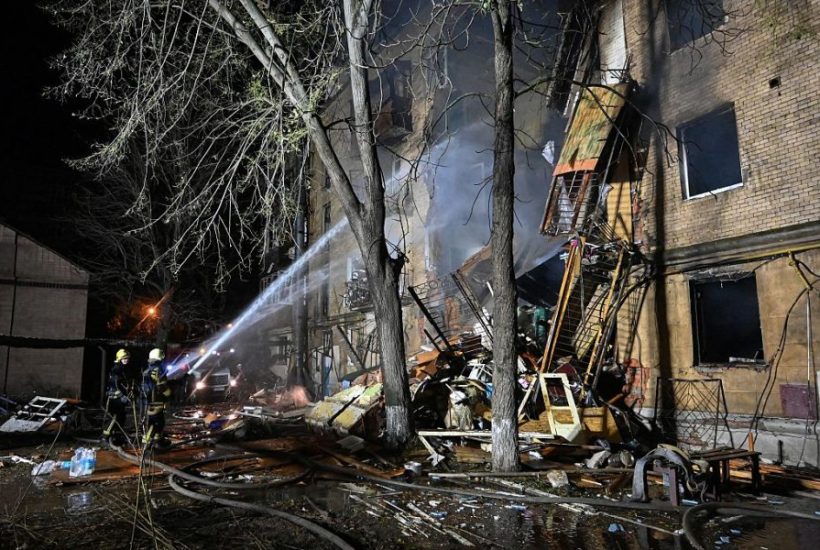
Eighteen months on, the numbing sense of unreality hasn’t let up. Trump’s cynical pre-midterm deal with Putin over diesel supplies has been followed by demands that Zelensky must step down imminently and his assertion that Russia, amidst a stepped-up bombing campaign against civilians, is ‘fine on Ukraine, they haven’t been doing much.’ In a moment to make Luis Buñuel blush, US envoy Steve Witkoff – the week a drone strike killed a one-year-old baby and her mother in the Kharkiv region – was recorded simpering to Putin’s face: ‘You are a humanitarian…sir, and I salute that.’ Ill-prepared as we were for the invasion of Ukraine – or that in late 2026 it would still be up and running – we expected the White House’s total collapse of moral authority and dignity on the world stage even less.
Five years on, the Ukrainian war has been a great revealer of people and players. It has shown us Zelensky’s bloody-minded stamina and Putin’s unbounded ruthlessness, not least with his own soldiers, of whom – likely a fraction of the real figure – at least 280,000 are now confirmed dead. It has stripped bare Trump’s vaunting self-interest and his glaring absence of integrity or good faith. It has exposed the disunity and flaky ‘allegiance’ of so many European governments: dispensers of hugs and blandishments but unable to walk the walk.
‘Will Putin Set Europe Ablaze?’ screamed one headline in November 2021. As the five-year anniversary of the war’s outbreak approaches, it’s still too early to say. But it begs the inevitable question – how will Ukraine look, how will Europe look, in another five years’ time?