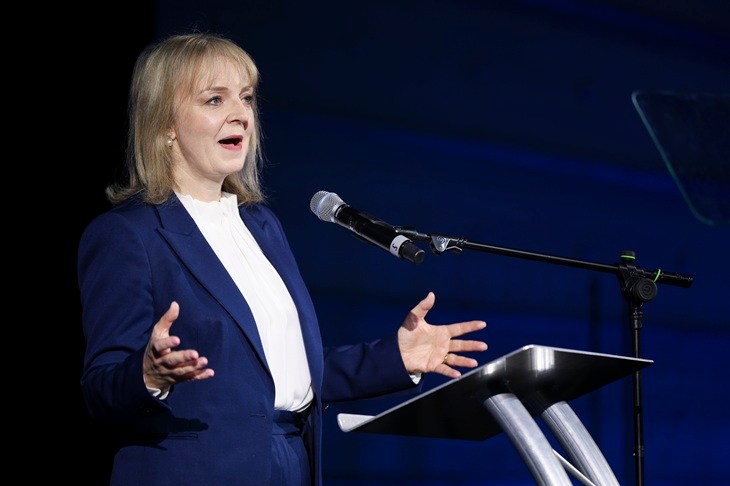
Every good heist film needs a villain who is not the crew. In Bank Job, published this week to coincide with the Burnham government’s first Budget, Liz Truss has found hers. The subtitle does the work: How the Bank of England broke the bond market and brought down the government. At roughly a hundred pages, it is a short book about a short premiership. On Budget Day itself she dismissed the package as a ‘complete nothing burger’ and told the press that Westminster’s biggest secret is how little power its MPs hold. Bank Job is the long version of that argument.
Australians should read it carefully. Truss led the UK-Australia free trade negotiations as Trade Secretary and arrived at the Foreign Office the week Aukus was unveiled. She retains admirers on the Australian right, some of whom think the British establishment simply refused to let a conservative govern. The book deserves an argument, not a sneer.
In The Italian Job, Michael Caine’s Charlie Croker scolds an overenthusiastic explosives man: ‘You were only supposed to blow the bloody doors off.’ It remains the best one-line review of the Mini-Budget. Kwasi Kwarteng’s statement on September 23, 2022, was meant to blow open the doors to growth. It removed the building instead: around £45 billion of unfunded tax cuts, no Office for Budget Responsibility forecast, an energy price guarantee of open-ended cost, all a fortnight after the Treasury’s permanent secretary was sacked.
Sterling hit a record low of US$1.0327 the following Monday. According to the Financial Conduct Authority, the 30-year gilt yield rose by 160 basis points in four days, having begun the year at around 1.2 per cent.
The case for the defence
Truss is not entirely wrong. British defined benefit pension schemes had hedged through leveraged liability-driven investment strategies (LDIs), so a sharp rise in yields triggered collateral calls, forced gilt sales and still higher yields. The Bank later told Parliament that earlier assessments had found schemes able to meet margin calls from a rise of up to 100 basis points. The market delivered 160 over four days, including 67 between the morning and evening of September 27.
Regulators had planned for a bad day, not the worst one, and every scheme needed cash at the same moment. That failure belongs partly to them. The Bank’s Financial Policy Committee later conceded that LDI resilience had been insufficient and now expects buffers able to absorb around 250 basis points. The doors had been sized for a smaller charge.
Truss can also point to timing. The Bank confirmed active gilt sales the day before the Mini-Budget, and the Governor later told pension funds they had three days to get their house in order. These are fair charges. They describe a Bank that made a bad week worse.
The case for the prosecution
They do not describe a Bank that caused it. Strain in any system travels to its weakest joint, and in September 2022 that joint was LDI. But the push came from Downing Street. Gilt yields jumped on the Friday of the statement itself, and the move was distinctly British. The City had a phrase for the difference, the ‘moron premium’, and it was not aimed at the Bank.
When the Bank announced emergency purchases of long-dated gilts on September 28, its own account records that 30-year yields fell by more than 100 basis points that day. Arsonists rarely put out their own fires within the hour.
Truss’s own conduct concedes the point. On October 14, 2022, she sacked Kwasi Kwarteng, her close ally and fellow author of Britannia Unchained, after just 38 days as Chancellor. The same day she abandoned her freeze on corporation tax, and his successor, Jeremy Hunt, reversed most of what remained within days. A Prime Minister who truly believed the Bank was the culprit would not have thrown her own Chancellor under the bus.
Should the Bank have kept buying? Its support was always meant to be temporary, and for good reason. With consumer price inflation running at around 10 per cent, an open-ended commitment would have meant printing money to finance unfunded tax cuts in the middle of an inflation shock. No inflation targeting central bank would do that, the Reserve Bank of Australia included.
What Australia should take from it
We have our own bond market scar. In 2020 the RBA set a target of 0.1 per cent for the April 2024 Commonwealth bond. In late October 2021, after a strong inflation print, traders pushed that yield as high as 0.78 per cent and the Bank declined to defend its line, abandoning the target on November 2. In 2021 the market disbelieved a central bank’s promise; in 2022 it disbelieved a Treasury’s arithmetic. Bond markets do not care whose numbers are implausible.
Our plumbing differs too. Superannuation is overwhelmingly defined contribution, so the leveraged pension hedges that blew up in London barely exist here. Our exposure sits in currency hedges. When the Australian dollar fell 15 per cent in early March 2020, super funds paid more than $17 billion in margin to their counterparties, and the RBA expects hedging books of around $500 billion to grow substantially. An Australian Treasurer who sent the dollar into freefall would discover where our weakest joint lies. The doors are different. The explosive would be the same.
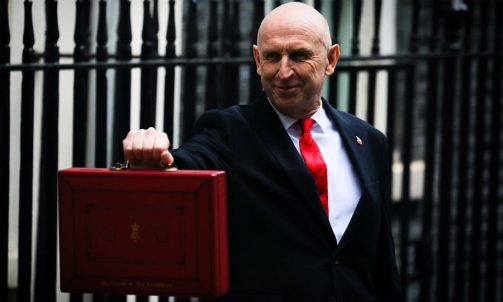
Nor is Truss wrong about the disease. This week the Institute for Fiscal Studies warned that, after Chancellor John Healey’s Budget, a typical British family’s disposable income will rise by just 2 per cent across the 2020s, the worst decade for household income growth since records began in the 1950s. ‘We need a stronger economy,’ said its director, Helen Miller, while the institute dismissed the Budget’s measures as ‘unhelpful fiddling’. Britain has now tried the gamble and the shrug. Neither looks likely to buy growth.
The lesson for the Australian right is that the problem in 2022 was not tax cuts; it was sequencing and credibility. Australia wrote the referee into law. Under the Charter of Budget Honesty, Treasury and Finance must publish their own fiscal outlook within ten days of an election being called, and ministers must declare every decision with material fiscal implications. An Australian Treasurer can still gamble, but the arithmetic arrives under officials’ signatures before voters decide. Truss’s problem was never that officials held too much power; it was that she would not let them check her sums.
Fiscal credibility takes years to build and days to spend. Truss spent hers 17 days into her premiership, and the market collected.
The Italian Job ends with the crew’s bus teetering over an Alpine drop, the gold sliding towards the back. Croker, inching towards it, announces, ‘Hang on a minute, lads. I’ve got a great idea.’ The credits roll before we hear it. Bank Job is that idea, four years late. It still involves pushing the gold out of the back door. Britain has tried that before: between 1999 and 2002, Gordon Brown sold about half the nation’s gold near the bottom of the market. This time there is less gold left to push.