The European continent, at least the Western part, lunges further into disarray every time you check the TV news.
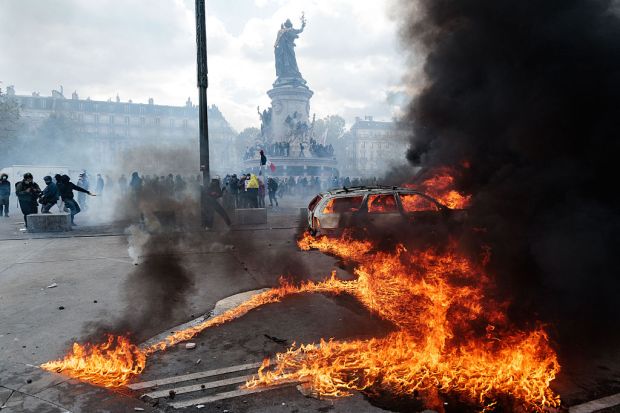
If it is not a beheading, a rape, it is looting in broad daylight.
Gloom abounds and this is not helped by Harry and Meghan turning up in the UK uninvited. The French, having a romantic attachment to revolution, are averse to pointing out the obvious. So vicious thuggery and looting is excused as ‘protest’. Any national recognition of failure is an insult to the revolutionary spirit. You need to read a Marcel Proust novel of 800 pages to realise that the man is describing a cake.
Sartre wrote in Being and Nothingness that ‘man is condemned to be free’. Or condemned to live in Paris. The French have a nihilistic approach to life, visible in the bizarre spectacle of white women trying to empathise with wanna be gangsters stealing from their shops. The West is the victim of a sordid Faustian pact; the liberals selling their souls for ‘virtue’, whilst all around them burns.
Edmund Burke lamented the destruction of the French Revolution:
‘The age of chivalry is gone. That of sophisters, economists, and calculators has succeeded.’
This was the age of revolution. The endless arc of its apparent historical inevitability saw it being the dominant theme of the 19th and 20th centuries, so much so that conceptions of equality became ingrained into popular discourse. The soundbites of the liberal left became chiselled into stone, like commandments. However, equality and democracy become so detached from their original meaning that they become irrelevant. Ideas of ‘democracy’ in Ancient Greece went hand in hand with responsibility and community. Malcontents were banished. Of course, the rioters in Marseille or Paris are not the ‘sans culottes’ without cake. They have trousers and cake and mobile phones. Robespierre, to them, could be a footballer or a gangster rapper.
Germany, meanwhile, in an attempt to appease the guilt of the Third Reich, followed a self-destructive policy of ‘immigration sans logique’. Yet the Germans have a very different cultural history than the French. Built on the conception of a strong state, discipline, and hard work, the politics of the left sits uneasy with notions of ‘realpolitik’. Hence the growing popularity of the AfD. Notions of community, of tradition, and responsibility sit ill at ease with a multicultural state quickly becoming rootless and violent.
Britain has become a victim of the liberal guilt trip. Rather than celebrating the excellence of success, hard work, and entrepreneurship, the state employs apparatchiks based on gender and race. Quelle surprise that in Britain we have an ever-expanding class of civil servants whilst taxing and regulating anyone who works or produces wealth. The universities and institutions are awash with DEI hires. The result in Britain is catastrophic: a young population devoid of skills but full of revolutionary soundbites. We have a government drawn from the civil service and full of self-aggrandisement. A Cabinet of low-level clerks of the civil service; with the intellectual acuity of the lanyard class.
Alas, everywhere in Western Europe the gargantuan liberal state has killed itself. By a dependency social model of care, it has destroyed liberty and the creative spirit. There is a trade-off between democracy and liberty. The more liberal democracy grows, the less liberal becomes civil society. Equality needs policing and laws and ‘safeguarding’. The state needs to expand ‘democracy’ but through positive discrimination and bias. Everything from the arts to government is funnelled through this myopic lens of the state. Literature, debate, education, become locked in the liberal panopticon of virtue. For the French, it is more important to be virtue-laden than honest. The plague has spread to Britain. The social contract between the government and the governed has collapsed. The state, having set itself up as the solution for everything, cannot now hold everyone’s hand, provide them with free houses and welfare. The post second world war social contract between labour and capital is in its denouement. The liberal governments of Europe sold their peoples a lie that if you vote for us, we will look after you…
Hence the current impasse. Yet we have now an even larger problem. The growth of the state has gone hand in hand with a dissolution of liberty, free speech, and the increasing authoritarian state apparatus. Whilst Britain is framed in liberal catchphrases ‘liberal democracy’, ‘multi-cultural’, ‘equality’, they are merely ephemeral spin which dupes a large percentage of the population. Beneath the verbiage here is a frightening statistic, from the government’s own statistics (so it will be even worse). In the previous 10 years London recorded approximately 8.48 million crimes, compared with approximately 267,000 in Singapore. Britain’s authoritarian hate speech laws allow minuscule Facebook remarks to warrant arrest. The police and judiciary have, in my opinion, become politicised.
It is not just card-carrying members of ‘the far right’ who have noticed the transition of judicial influence over to the political sphere. It is the judges themselves. Britain’s constitutional balance has shifted since 1998, with judicial review, the Human Rights Act and proportionality increasingly drawing judges into political and policy questions. They can delay or dilute decisions made by elected governments, creating institutional paralysis. Judicial review is the procedure by which the courts examine whether a public body has acted lawfully. It reviews the legality of the decision-making process—not ordinarily whether the court thinks the decision itself was correct. Judicial review begins as supervision of legal limits, but becomes controversial when proportionality and rights adjudication require judges to evaluate the justification and social consequences of government policy. Through judicial meddling, the courts can now act as a brake on government legislation. This is hugely undemocratic, going back to Dicey’s strict definition of parliamentary sovereignty: Parliament is sovereign when it comes to law-making.
Robert Jenrick’s recent LinkedIn post alleged that more than 30 immigration judges had connections with organisations supporting liberal immigration policies. He argues that this creates concerns about judicial impartiality and undue influence on government. Therefore, we have several branches of ‘independent’ institutions, from the police to the judiciary, schools, universities, the civil service, that can veto an incoming government. The bias is inherent in the attempt to prevent dissident voices, from Tommy Robinson to the pensioner sending an ‘offensive’ Facebook post. Judicial decisions have become separated from justice and appear more and more along race lines. There is nothing new here; the racialisation of criminal justice goes back to the setting up of the Sentencing Council (unelected) by the Gordon Brown government. Baroness Fox, in her foreword to the 2025 Civitas expose, outlines the crass two-tier legal system in the UK:
The Sentencing Council – an unelected quango set up in the Gordon Brown era – published the revised Imposition of community and custodial sentences sentencing guideline, which was due to come into force on 1 April. The revised guideline states: ‘When considering a community or custodial sentence, the court must request and consider a pre-sentence report (PSR) before forming an opinion of the sentence’, and that a PSR ‘will normally be considered necessary if the offender belongs to one (or more) of the following cohorts’, which includes those ‘from an ethnic minority, cultural minority, and/or faith minority community’. Justifying this change, the Sentencing Council said the quiet bit out loud, admitting its aim was to help address racial and other disparities in outcomes in the criminal justice system. In other words, it moved from its dispassionate, impartial role of sentencing advice, based on judicial fairness, to a politicised attempt at manipulating sentencing outcomes to fix its perception of ‘institutional racism’.
In the US, constitutional history allowed for The Second Amendment. This was conceived for the eventuality of the ’social contract’ breaking down; an authoritarian government abusing its limited powers. It allowed for the citizens, as the founders of the political community, to intervene with arms. Britain has never possessed an exact equivalent of the American Second Amendment, but English constitutional history contains a recognisable ancestor. Medieval laws such as the Assize of Arms 1181 and the Statute of Winchester 1285 required subjects of appropriate wealth and status to possess weapons for the defence of the realm. This was principally a public obligation connected with the militia, rather than a modern individual right to possess weapons for personal protection.
During the 19th and 20th centuries, Britain moved steadily from a qualified right towards licensed possession. The Gun Licence Act 1870 introduced a revenue-based licensing requirement, while the Pistols Act 1903 regulated the sale and possession of handguns. The decisive change came with the Firearms Act 1920, which required a police certificate for many firearms and demanded that an applicant demonstrate a legitimate reason for possession. The Firearms Act 1968 consolidated the licensing system that remains the basis of British law. After the Hungerford killings, the Firearms (Amendment) Act 1988 prohibited most semi-automatic and pump-action rifles; following Dunblane, the 1997 Acts effectively prohibited private handgun ownership.
Parliamentary sovereignty means that a new Parliament could enact a Second Amendment Bill for the UK, under a Reform or Restore government, such is the breakdown between government and the indigenous civil society. There needs to be a powerful buffer to the errant Police force of the UK. They now act immune to consequences with the biased system rubber-stamped by Labour. Structural reforms are needed across the board. Britain is in a dangerous social and fiscal morass. This stems from deindustrialisation, bizarre green policies, and out-of-control spending on immigration infrastructure. Fiscal policy, managed by the incompetent Treasury has discouraged productive public investment. Since 2010, debt as a proportion of GDP had almost doubled while the public sector’s net worth had declined. Successive chancellors protected arbitrary debt targets by cutting investment and research spending, the very expenditure most likely to increase long-term economic growth. The fiscal framework consequently prioritised the appearance of controlling debt over strengthening the country’s productive capacity. Public expenditure under Labour is ‘unproductive’. It goes on quangos and civil servants and illegal immigration. Investment to increase GDP must be productive, encourage SME’s and control wasted taxpayers money.
Yet the only way we will get there is to take away the left’s monopoly on the institutions. And that means a Second Amendment. John Locke had anticipated the terror of democracy and the need for a counter-balance:
‘Whenever the legislators endeavour…to reduce them to slavery under arbitrary power, they put themselves into a state of war with the people.’