What does the rise and fall of Russell Brand say about our culture, especially or moral and religious culture? A few different things, I suggest.
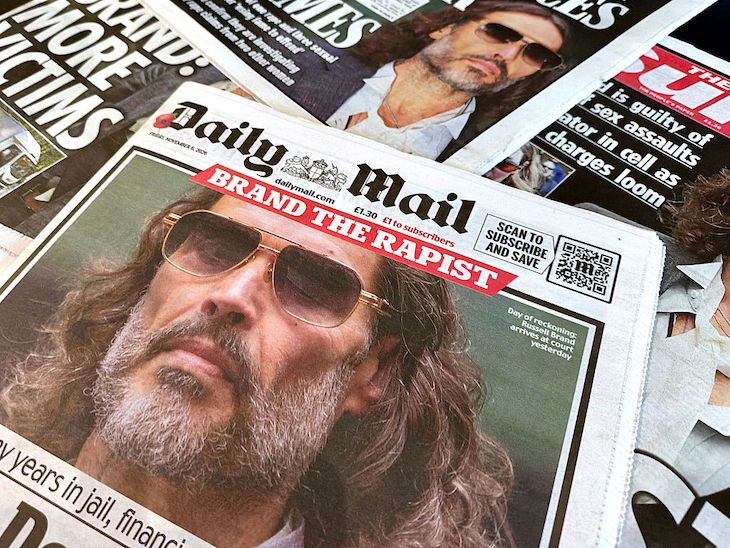
First, it highlights our deep confusion about sex, and our fear of thinking about it in any serious sense. Brand, who will be sentenced today for raping a fan at his house in 2009 and three sexual assaults, was a test case: what do we think of an outright sexual hedonist? The liberal orthodoxy is that there is absolutely nothing wrong with such an approach to sex, and maybe something good about its honesty. Only Mary Whitehouse-type prudes seek to scorn such self-expression.
In relation to sex, it seems that we are scared. We are scared of sounding old-fashioned, moralistic. We are scared of saying what we think
Almost no voices in the media said any different, for the fifteen years or so of his pomp. In real life, lots of people in the media are wary of sexual promiscuity, indeed most are. Yet almost no one dared to articulate the mainstream view, that sex shouldn’t be treated flippantly and hedonistically. Odd that a minority view – sex is just fun – was allowed to rule the roost, so to speak.
In relation to sex, it seems that we are scared. We are scared of sounding old-fashioned, moralistic. We are scared of saying what we think. We tell ourselves that there is a lot of frankness about sex in the culture, because the sex-positive people are certainly frank. But one-sided frankness isn’t enough. Mainstream opinion has to learn to pipe up.
Brand’s rise and fall also tells us a couple of things about religion. He gradually claimed to be a man of spiritual insight. It would be easy to react to this claim with angry scorn, but I think a that a bit of nuance is needed. We should admit that his message did, for a while, resonate; it tapped in to something. In his book of 2014, Revolution, he offered a hippie-type message, of utopian possibility, love and peace, with some echoes of English Romanticism and radical Christianity. He insisted that our political and environmental problems can only be addressed if we are religious in a new way, and discover a new utopian hope. We need a spiritual revolution.
Empty humbug, you might say, and I would half-agree. But the point is that no one else was reviving this tradition in an engaging way. So Brand highlights the weakness of our religious culture, in a wide sense (including the semi-Christian radical tradition). I know, this is hardly news. But he sheds new light on it. Christians, and post-Christians, failed to speak of the central Christian theme of hope for a better future; it fell to this dubious man to dust it down, give it a whirl.
What about his Christian conversion of two years ago? He was baptised in the Thames by Bear Grylls, who has semi-apologised for sharing a watery platform with him: Brand’s faith ‘seemed genuine to me at the time,’ he said on X. It is not good form to question the authenticity of another Christian’s faith, but I think I can be forgiven for pointing out that Brand was quick to seek a huge new American fan-base on the basis of his piety, and also that he was trying to build a new image as the rape allegations closed in.
Maybe historians will see Brand as the last figure of the long 1960s. As it happened, I channel-hopped after watching the news about his conviction, and landed on a Pierce Brosnan Bond film (the first Bond film was released in 1962). A lady doctor had just given our hero a check-up and was now allowing him to undress her. Good clean entertainment surely? Well, maybe not.