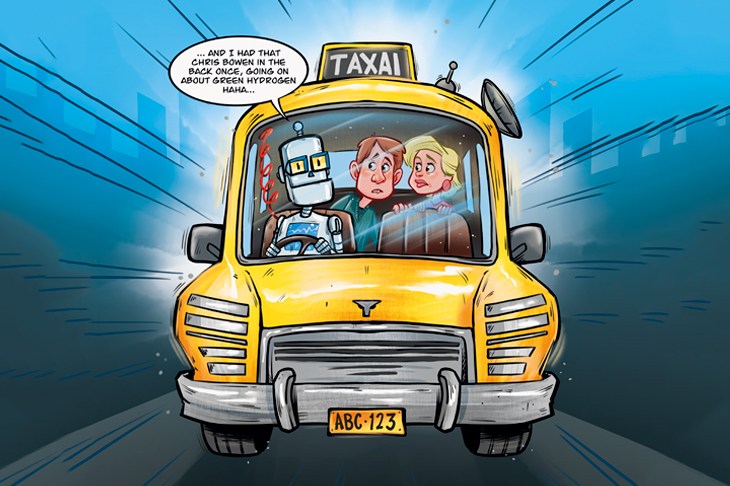
My Uber driver last week was an electrical engineer. He drives part-time, between contracts. He was good company, knew his trade and had no illusions. He told me, flatly, that a robot will take this job from him. He was not complaining. He was forecasting.
He is right. The only questions are when, and whether our governments will let it happen or sell the right to stop it. Australia has run this experiment before. We should remember how it ended.
In America the robot is no longer a demonstration. Waymo, owned by Google’s parent, now carries paying passengers in fourteen American cities, from San Francisco to Miami, with London and Munich next, and sells more than half a million rides a week. Its cars have driven more than 200 million kilometres with nobody behind the wheel.
Here is the striking part. Riders pay more for it, not less. Independent pricing studies in San Francisco found Waymo charging around ten US dollars above a comparable Uber trip. The waits were longer too. Riders paid the premium anyway, in growing numbers, for two years and counting.
Why pay extra to remove the driver? Novelty, at first. A driverless car is a fairground ride the first time. But novelty does not survive two years of daily commuting. Something else is being bought. That something is safety, and peace of mind. On Waymo’s published record, audited in peer-reviewed studies with the reinsurer Swiss Re, the robot has about 90 per cent fewer crashes involving serious injury than human drivers on the same roads, and about 80 per cent fewer crashes causing any injury at all.
The robot is never drunk. It is never tired, never angry, never texting. It will not assault a passenger. In America, on the New York Times’ count, Uber fielded a report of sexual assault or misconduct roughly every eight minutes for five years. It will not harass the woman travelling alone at midnight, and women, tellingly, are among its keenest customers. It does not call in sick, take a break, or knock off at shift change. It works every hour of every day. The premium is the market’s verdict that the machine is already the better driver.
Now look at the economics underneath, because that is where the earthquake is. Uber owns no cars and employs no drivers. The driver supplies the car, the fuel and the labour. Uber supplies an app and keeps a cut. My own research on New York’s complete trip records shows that cut rising from about a fifth of the fare a decade ago to roughly a third today. In Manhattan it reached 37 cents in every dollar. The driver, in effect, rents his job by the minute.
The robot abolishes the job, and the wage with it. What remains is a fleet of capital and some software. Whoever owns the fleet then holds the whip hand. Waymo has already ended Uber’s exclusive right to offer its cars in Austin and Atlanta. It is building its own app and its own customer base. Uber risks becoming a shopfront for other people’s robots. Shopfronts do not command a third of the fare for long. The dominant platform in Australia should study that sentence carefully.
Australia has seen this movie. For decades our governments rationed taxi plates. Scarcity made the plates valuable. A Sydney licence changed hands for as much as $400,000. The plate was a government-manufactured asset, and every passenger paid for it in dearer fares and longer waits. Then Uber arrived, the scarcity dissolved, and plate values collapsed.
What did governments do? They taxed the passengers a second time. New South Wales put a levy on every taxi and rideshare trip, a dollar at first and then $1.20, to fund $905 million in compensation for plate owners. The levy runs to 2030. Victoria ran its own levy and its own payouts. Uber itself paid $272 million to settle a class action brought by the taxi industry. The riders who had paid for the cartel through the fare were then made to pay for its funeral. Remember that trick. It is about to be attempted again.
The same rent has quietly re-formed inside the platform. Uber’s commission pool is the medallion reborn, booked in the company’s share price rather than on a licence plate. History offers that capitalisation exactly two endings. If the robotaxi enters, the value goes the way the plate’s went, written down, with the rent passing to the newcomer. If the robot does not enter, it will be because someone paid to keep it out.
The purchase is already being prepared, politely. Expect submissions about safety, about jobs, about a level playing field. Expect calls for caps on robot numbers, for a robo-licence, for a new levy to compensate the displaced. The petitioners will be the incumbents. The taxi lobby will be back for an encore, and in time the platform will join it. Waymo is already knocking. Its executives have met state and federal officials, the NSW Premier wants a Sydney trial, and ministers have agreed to conditional deployment from 2027. The rule for them is simple. No special certificates. Tens of thousands of Ubers went on the road through ordinary registration, and Waymo has proved itself over 200 million driverless kilometres. Register the car. Never ration the number. Sell no exclusions, and compensate nobody for the loss of a privilege.
My engineer will be fine. Australia is short of electrical engineers, and he knows it. The full-time driver deserves honesty rather than false comfort. This work is going, just as the plate’s value went. The gains go to passengers. Rides that are far safer from the first day, above all for women travelling at night. Fares that fall as the fleets scale and the robots compete, first with Uber and then with each other.
I wrote my first study of this industry in 1979, on the Canberra taxi cartel. It was called On Buying a Job.
Half a century later the lesson has not changed. The quota never served the public. Competition did. When the robot knocks, let it in. And this time, make nobody buy the door.
Got something to add? Join the discussion and comment below.
Peter Swan AO is Emeritus Professor of Finance at the UNSW-Sydney Business School.
You might disagree with half of it, but you’ll enjoy reading all of it. Try your first month for free, then just $2 a week for the remainder of your first year.