When British and Ottoman forces defeated the remnants of Napoleon’s army in Egypt, General Menou, the Frenchman in charge of Alexandria, was ordered to surrender his personal collection of looted antiquities. ‘Never has the world been so pillaged!’ he moaned unironically. The item which provoked such self-pity was the Rosetta Stone, whose extraordinary value Menou had identified – and publicised in an academic article – two years earlier. When two British officers were sent to collect the stone, Menou challenged one of them to a duel, though he seems to have been talked out of this. The stone was strapped to an artillery cart and began its journey to London, where it resides today as one of the star attractions of the British Museum.
As any fule kno, the importance of the Rosetta Stone is that it contains the same proclamation written out in three different scripts: Egyptian hieroglyphs, Demotic, and the Greek alphabet. For early-19th-century scholars trying to figure out how to read Demotic or hieroglyphs, this was an immeasurable help. Now at least they knew what the signs were supposed to mean. Within a couple of decades, both scripts had been rendered intelligible thanks to the efforts of a network of frenemy Egyptologists.
Decipherment is something different from translation. It precedes it, establishing the rules by which translation can occur. In Daniel Harbour’s concise definition, it is ‘the salvage of lost languages from unknown scripts’. We should distinguish also between a language and a script. Many languages use the same Roman letters as English to represent roughly the same sounds. Show me a piece of Dutch or Portuguese, or let’s say Hungarian or Estonian, and I expect I’ll be able to read it out loud. More or less. But I’ll have absolutely no idea what it means. Harbour again: ‘Decipherers have often made progress on scripts long before they knew which language they were looking at.’
The Book of Lost Languages gives us a history of the discipline of decipherment, from Jean-Jacques Barthélemy’s cracking of the Palmyrene alphabet in 1754 to the bleeding edge of the present. Harbour mentions in passing that Proto-Elamite was cracked during the period in which he was writing his book. The idea of cracking, as in breaking a code or solving a puzzle, applies to decipherment in a way that it doesn’t to translation. Barthélemy’s insight into Palmyrene hit him in a single night; Jean-François Champollion, when the key to Egyptian hieroglyphs occurred to him, is said to have fainted. Harbour treats us to regular and well-annotated puzzles so that we can try for ourselves to follow incrementally the steps that will bring the system of Akkadian or Hittite or Linear B into the light.
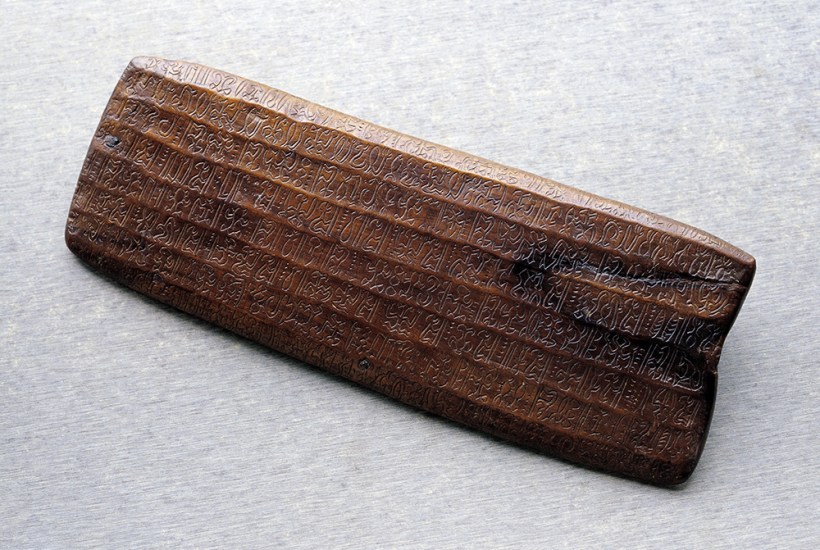
In the later chapters we come to the still undeciphered rongorongo script of Easter Island and to Andean khipus. The latter are complex knotted threads, almost like a rope curtain, and represent – potentially – a script that works by tactility rather than by the relationship of sounds to visual symbols. What’s at stake in decipherment, then, is not just the ability to understand the documents left behind by long-vanished civilisations. In terms of the bigger picture, decipherment might lead us to a broader conception of what writing – mankind’s most significant invention – actually is.
The traditional view is that writing was invented independently four times: in Mesopotamia, Egypt, China and Mesoamerica. It is possible, however, that the Easter Island’s rongorongo might represent a fifth moment of invention. In 1770, a Spanish ship landed on the island and local dignitaries were made to sign a ‘deed of cession’. The as-yet-unanswered question is whether this was the first time islanders had seen writing, with rongorongo developing out of their impression of it, or whether the script predates the Spanish landing. Carbon dating of documents found on the island is inconclusive. If rongorongo turned out to be a sui generis writing system, it would challenge our understanding of why writing emerges. Generally, it is assumed that writing becomes a necessity when societies reach some level of complexity: at a certain size, the need for bureaucracy arises, and for a lasting witness – to events or transactions – that goes beyond word of mouth. But the socioeconomic complexity argument doesn’t hold with the Easter Islanders. What might that tell us, fundamentally, about what writing is for?
Harbour is the real thing – a theoretical linguist fluent in more languages than you can shake a wedge-shaped reed at. But The Book of Lost Languages is accessibly done, its focus as much on the lives of the decipherers who have come before him – their travels and spats and eccentricities – as it is on the technicalities of early Chinese or Anatolian hieroglyphs. At heart, it is a book about writing – and what it is about this extraordinary global invention that is essentially human. Right now that feels like a very welcome thing.
Got something to add? Join the discussion and comment below.
You might disagree with half of it, but you’ll enjoy reading all of it. Try your first month for free, then just $2 a week for the remainder of your first year.