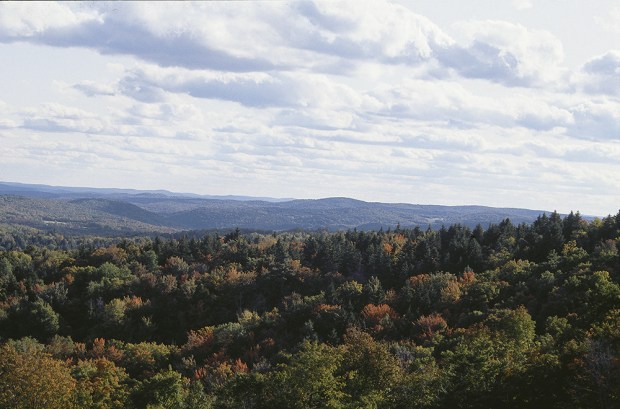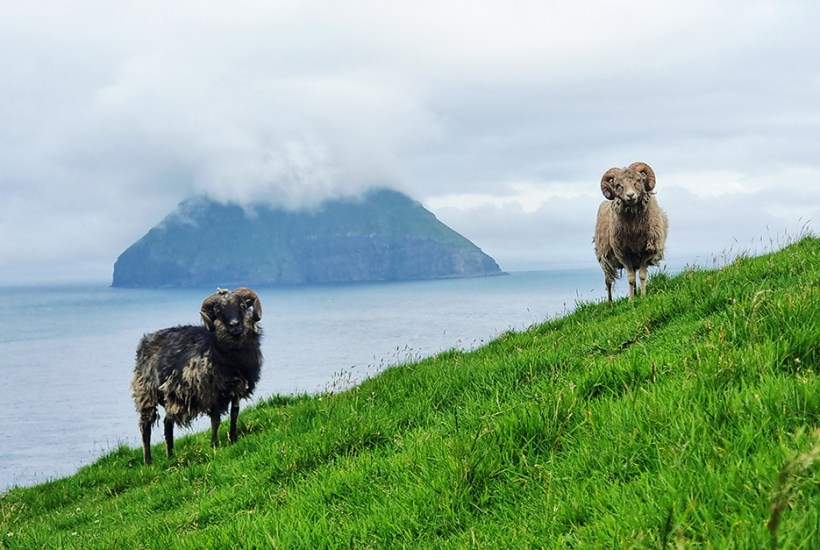
Tim Ecott has always been drawn to islands, and the seas that surround them: ‘I once ran away from England to live in the Seychelles so that I could scuba dive obsessively in the Indian Ocean,’ he writes at the beginning of Eva and the Island. ‘The tropical humidity and seductive blue water drew me into its spell.’ Gradually his love for what he calls ‘the torrid zone’ faded, and he found himself attracted to ‘the higher latitudes’. He decided to spend time on all the inhabited islands in the Faroes, including the smallest, Stora Dimun, ‘a frayed and crumbling chunk of basalt’ covering ‘just over one square mile’, which has ‘the qualities of a secret kingdom’.
What better way to spend an evening in good company than eating sheep’s heads and singing?
Stora Dimun used to be home to 35 people, but today there are only two human inhabitants – a woman called Eva, whose family have farmed the island for eight generations, and her husband, Jogvan Jon. Even their two children, Dogg and Sproti, have left. Not surprisingly, other Faroese islanders regard it with suspicion: ‘Naughty children were warned “Behave yourself, or you will be sent to Dimun,”’ according to Ecott. ‘Not everyone will feel at home here,’ Jogvan Jon says, ‘but for those that understand it, there’s nowhere like it.’ Ecott agrees: ‘I have met magic here, if not wizards.’ He doesn’t say exactly what he means by magic, and perhaps he can’t: doing so would be at odds with what drew him there in the first place.
Eva and the Island is not a memoir of fleeing to the north, like The Outrun, Amy Liptrot’s account of escaping addiction by returning to her childhood home in the Orkneys. Stora Dimun is not a destination on a personal journey of discovery, or a refuge. It is the kind of place that renders such ideas irrelevant. Ecott relishes the sense that ‘the razor-thin boundary between life and eternity is visible from the kitchen window’, and seeks to emulate the characteristic of the Faroese, who value ‘understatement, modesty and a relatively low-key attitude to expressing emotions in public’. Vanity is discouraged. The Nordic precept of janteloven (the Law of Jante) ‘enforces humility, and a lack of ego’. Self-abnegation, rather than self-fulfilment, seems to be the goal – though even an ‘unemotional Englishman’ like Ecott cannot help standing out in such an environment.
This is partly due to his ineptitude: when he is required to wring the neck of a fulmar, he pulls so hard that he takes its head off, resulting in a ‘small vertical fountain of blood spraying over my hands’. He also plays up to the comic stereotype of the Englishman abroad. His expensive walking boots and rain gear are not only garish but dangerous – if you trip or slip on the slopes, the locally made woollen clothes might slow you down, but waterproof nylon will speed your descent to the cliffs.
Yet Ecott devotes himself so patiently and wholeheartedly to the Faroes that he begins to feel like he belongs. Walking back to his hotel in the capital, Torshavn, one snowy night after the annual Sheep’s Head Banquet, he has a distinctly Faroese epiphany, induced by ‘the wintery beauty of the tiny capital, amplified by a full stomach and, possibly, the afterglow of a glass or two of schnapps. It wasn’t possible to imagine a better way to spend an evening in good company than eating sheep’s heads and singing.’ Later, he arrives on Stora Dimun by helicopter as a storm descends. He knows he won’t be able to leave. But the thought doesn’t scare him: ‘Dimun feels like the safest place in the world.’
Again, he doesn’t say why, but by this point it doesn’t matter: Ecott wanted to immerse himself in the rhythms and textures of life on the island, and having done so, he wants to make the reader do the same. He describes the ‘small chores’ of daily life – ‘cutting turnips, fetching silage, sweeping the byres clean of dung and spoiled hay’ – and the more demanding tasks of raising and slaughtering the animals. Otherwise, his attention is devoted to the seabirds that are the true owners of the island. Many are described in stand-alone chapters, illustrated by Ecott’s wife, Jessica. He is fascinated by the ‘piratical’ skuas, who are powerful enough to chase sheep away. But he feels the greatest affinity with the less obtrusive birds – the ‘tiny flying shadows’ of the petrels, or the rock pipits, the commonest resident bird. These look as if they are ‘using their wings to hop through the air’, and land near him when he sits on the high plateau – ‘tiny spirits dancing on the edge of the abyss’.
Got something to add? Join the discussion and comment below.
You might disagree with half of it, but you’ll enjoy reading all of it. Try your first month for free, then just $2 a week for the remainder of your first year.