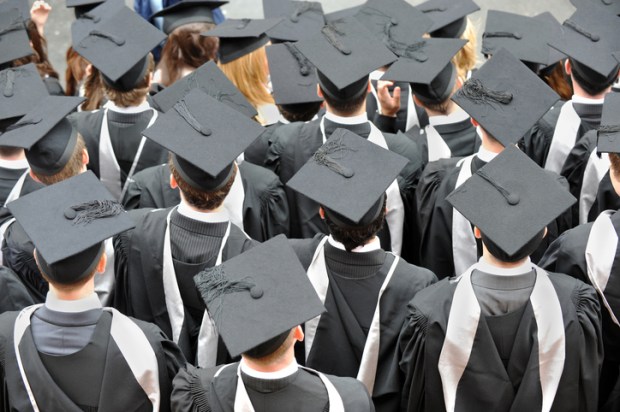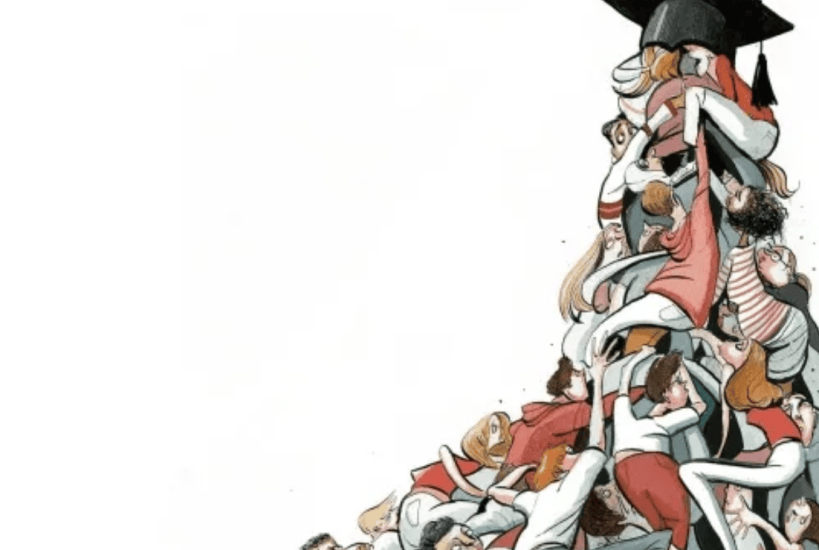
American higher education is in retreat. It’s shrinking. The for-sale signs have gone up. It’s time for “inventory reduction.” Forty-nine colleges have closed since 2020. Forty others have merged with neighbors. The Huron Consulting Group says that 400 colleges are at risk of closing in the next decade. The prospect of insolvency has now moved beyond small colleges. Larger ones are closing programs and laying off faculty.
Not counting community colleges, trade schools, online-only outfits and clandestine thinkatoriums, some 2,700 four-year institutions are currently authorized to hand out college degrees in the US. That compares with 4,150 licensed hot dog stands in New York City alone and 267,000 licensed massage parlors across the country.
The market for hot dogs and massages is holding steady. The market for college degrees? Not so much. It is the old story of more supply than demand: too few students for too many seats. People who build things imagine customers will keep coming forever, until they don’t. In the 1930s, 16 major railroads folded and in the 1970s, 23 more ground to a halt. All was not lost. Americans ended up with some excellent bike paths.
At the top of the list of higher education’s woes is a demographic cliff. During the 2008 recession, young couples became baby-averse. The birthrate plunged and stayed low. Those children who were never conceived would now be freshmen, and the system built to educate them finds itself like a large bus carrying a handful of passengers.
The cost of running the bus doesn’t decline in sync with the loss of riders. Fixed expenses don’t like falling revenues. Moreover, the dearth of children will continue for at least 15 more years. Colleges can’t wait it out. Higher education knew this was coming and tried to offset it by recruiting more students from abroad and cajoling more Americans unsuited to college to enroll anyway. The ditching of SATs at 90 percent of the institutions marked the advent of the enrollment-at-any-cost era. The gains were marginal and the cost to academic reputation was large.
There are other reasons why college enrollment is in crisis. For one thing, Americans of all political persuasions no longer trust colleges and universities as institutions. The latest Gallup Poll shows that 77 percent of Republicans and 50 percent of Democrats distrust American higher education – a figure that continues to grow.
The distrust comes from the cratering value of the education they provide. Most colleges have become sandboxes for indolent students. The teachers pretend to teach, the students pretend to learn and everybody gets an A. It isn’t all the teachers’ fault. They have to deal with students who have been haphazardly recruited and often subjected to 12 years of “Social Emotional Leaning.” The majority are “book virgins” who have reached college without ever reading an entire work cover to cover. They aren’t going to start with The Republic.
But as teaching standards have fallen, tuition and expenses have surged. Americans now carry a total of $1.863 trillion in student-loan debt. That’s the second largest sum of consumer debt, behind home mortgages. A house, however, has intrinsic value. A college degree is worth only what the graduate can make of it. Student-loan debt impedes graduates who want to get married or change jobs. It cannot be defaulted on. It can linger even into one’s retirement years.
Then there’s the matter of waste and bloat. More than half the salaried employees of colleges and universities are now in “student services” rather than education. What students get for their tuition dollar is a full range of counseling, stroking, reassurance and diversion from the actual acquisition of knowledge and skills.
The teachers pretend to teach, the students pretend to learn and everybody gets an A
If the students can’t be relied on to read more than a page or two per week, what can a professor do? He, or more likely she, can profess. Teaching students about racism, sexism, colonialism and the myriad forms of injustice embedded in “late-stage capitalism” is one approach. The list of the top 20 most-assigned college texts incudes The Communist Manifesto and Edward Said’s Orientalism, but the real story is not what books are assigned, but what the professors communicate in class. Wokeness isn’t in the syllabus; it’s in the air.
Gender dynamics also play a role. More than 60 percent of undergraduate students are women. Men increasingly turn away from college as something that doesn’t meet their educational and career goals. They are also turned off by the high degree of bias against men in both the curriculum and campus culture.
Besides, only 17.8 percent of posted jobs even require a bachelor’s degree or higher. More than half list no educational requirements at all. Indeed, with all the debt and opportunity cost now involved, a college degree can be an impediment to the start of a promising career, not counting hot dog provider or masseuse.
AI threatens the entire edifice. Artificial intelligence has made it child’s play to avoid reading assigned texts or writing essays on assigned topics. Many faculty members have capitulated, seeing no way to resist the tide. Some have enthusiastically embraced it as a new way of learning. AI has also dented the proposition that a college degree is an all-purpose, adaptable credential for employment. Some employers still think a college degree testifies to useful knowledge and skills, but they will soon learn better.
This is no reason to despair. These institutions have been making themselves obsolete for a long time. Better not to get in their way.