Secret Harbour was Labor’s not-so-secret nightmare: a seat it had held since 1989 fell in a landslide to One Nation, which had polled just 8.5 per cent there at the previous election.
Pollsters said voters felt taken for granted and were worried about the housing shortage, high migration and the high cost of living, but the Prime Minister wasn’t having a bar of it.
Albanese is a man who can’t even admit to falling off a stage, so he was hardly going to admit that Labor’s migration surge had created a housing crisis, that his budget had smashed the property market, or that his economic and energy policies had driven household costs through the roof.
Addressing the Queensland State Labor Conference in Brisbane the next day, he fumed that, ‘Across the world hard-right populists are on the march, peddling politics that is dangerous, divisive, and downright dishonest’.
Dangerously divisive? Dishonest? Bold claims from a PM who tried to divide Australians by race, and broke an election promise he’d made more than 50 times not to hike housing taxes.
Albanese ran through his attack lines on One Nation: it thinks people working from home are ‘bludging’, that ‘Australia should become a monoculture’, and that One Nation couldn’t govern in coalition with the LNP, and couldn’t govern without the LNP, so they would be a ‘coalition of chaos’.
Except there was no chaotic coalition in Secret Harbour, just neat electoral arithmetic: One Nation took 40 per cent of the primary vote, stripped Labor of almost half its voters and reached 57 per cent two-party-preferred with Coalition preferences.
Albanese put it down to misinformation: ‘They’ll say anything and do anything to win votes. Bend any facts. Peddle misinformation and disinformation. Turn Australian against Australian.’
Assistant Minister for Productivity Andrew Leigh blames ‘the algorithms’ that are ‘weaponising anger, outrage’, and said, ‘I think that’s been one of the factors in the rise of right-wing populists around the world’.
Labor, however, hasn’t been idly waiting to be smashed by the orange tsunami. Albanese and his trusty ministers have set their sights on banning ‘misinformation’.
He told the delegates in Brisbane that Labor had ‘led the world in standing up to the big tech companies by addressing the harm being done to children’.
Never mind that his prohibition on under-16 accounts led to a drop of less than five per cent. Hardly something to boast about, you’d think, but boast he did.
Labor’s digital policies were ‘designed to shape the globe’ and their ‘policy significance’ was ‘profound’ because they showed that ‘middle-sized countries can stand up to the power of the tech world’.
Indeed, ‘it was possible to make this awesome new technology work for us,’ he enthused, ‘but only if we have the guts to develop a strategy for making it address the needs of our economy, our community, and our people’. By the end of the week, the Department of Climate Change launched a cross-agency working group to fight ‘climate misinformation’.
A fortnight earlier, the head of the Climate Change Authority, Matt Kean, released an ‘insights’ paper that warned that climate misinformation had shifted from straightforward denial to seeking ‘to delay or disrupt climate and energy action’ through the spread of ‘information disorder’.
It sounds like a psychological diagnosis. Symptoms include questioning whether your electricity bills have fallen by $275, or wondering whether renewables really are cheaper. Severe cases involve ‘malinformation’: inconvenient truths about the astonishing cheapness of Malcolm Turnbull’s Snowy 2.0.
Malinformation, of course, has nothing to do with Malcolm; it is ‘true information’ which is deployed to fuel malign narratives about impending blackouts and whether Australia’s sacrifices do anything other than enrich rent seekers.
In the face of these dangerous truth tellers, the Authority would develop a ‘whole-of-government rapid-response approach to climate and energy misinformation’. And climate is only the prototype. The Authority said climate misinformation was ‘part of a broader challenge around information integrity that affects many policy areas’.
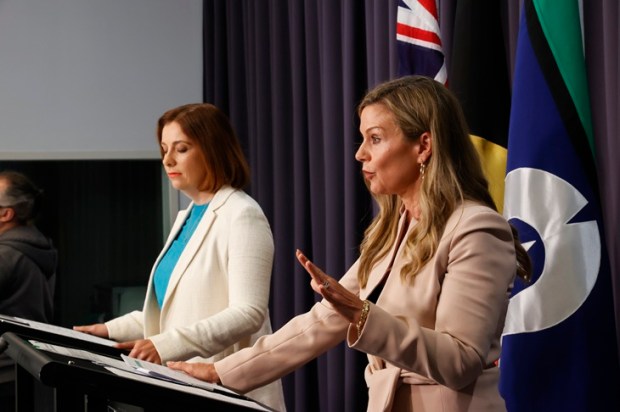
Right on cue this week, Communications Minister Anika Wells unveiled the Digital Duty of Care; a regulatory system designed to require online platforms to prevent ‘harm’ online. And what could be more harmful than a political opponent who wins Labor seats by spreading truthful information about the cost of living and the climate apocalypse?
Wells says that for Australian adults, the bill only bans illegal content – terrorism, paedophilia, who could object?
Albanese reminded media at the press conference that national security agencies were concerned about ‘bad faith actors pushing material in order to undermine social cohesion’.
The good news, according to Albanese, is that people over 16 will get ‘My Feed, My Way’ — the revolutionary freedom to choose a chronological feed, an innovation already available on X, along with the even more radical option of turning the thing off.
As Leigh sees it, it gives Australians the right to opt out of the ‘angertainment’ that has the unfortunate habit of persuading too many of them to vote One Nation.
For children, however, lawful content may also be deemed harmful in areas including women and gender equality — which raises the obvious question of who gets to decide which contested claims children are permitted to hear. The parents, or the drag queen storyteller?
And the Minister could declare a new ‘serious lawful harm’ not just for children but for adults, without putting the amended legislation before Parliament. And unless Parliament disallows it, it takes effect.
So, if Ms Wells declares climate misinformation a serious harm, or misgendering trans people, or laughing at hard right memes, social media platforms would have a legal duty to prevent or minimise exposure to them.
Get it wrong, and the penalty can exceed $100 million. No platform lawyer needs an algorithm to work out which direction to err.
Wells was candid about the threat. She says, ‘The power of online is so strong, the power of the algorithm is so strong, that it is overwhelming our public institutions and the decline of trust is problematic for everybody’.
Or at least for Wells. She said a woman came to talk to her about her various grievances, and Wells said to her: ‘I’m a member of the Cabinet; that’s not true… that’s a scare campaign from online.’ She looked the woman straight in the eye, and the woman didn’t believe her.
For Labor, this is evidence that the algorithms are broken. A more likely possibility is that trust has been broken. And Secret Harbour suggests the voters have already worked that out.
Got something to add? Join the discussion and comment below.
You might disagree with half of it, but you’ll enjoy reading all of it. Try your first month for free, then just $2 a week for the remainder of your first year.