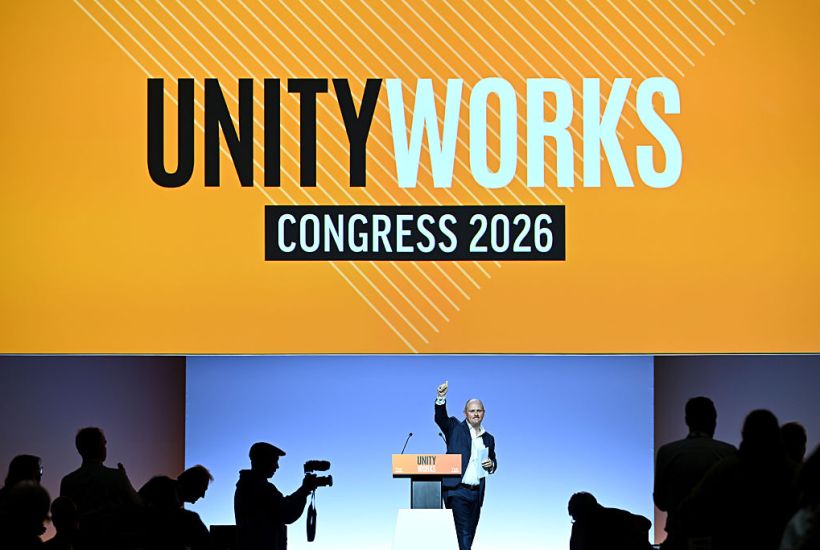
Home Secretary Shabana Mahmood’s changes to Indefinite Leave to Remain status, first announced almost a year ago, are still to be implemented, and have been facing increasing opposition from within the parliamentary Labour party and the wider left. The latest challenge is from the Trades Union Congress (TUC), where delegates have voted to exempt any workers already in the UK from changes which would see them wait 15 years for settlement, rather than five years.
The country’s largest union, Unison, proposed the motion, stating they were ‘alarmed at the sweeping attacks on migrants workers which render them second-class citizens’, while Unison’s head, Andrea Egan said ‘these are workers that have come from overseas to support a social care system, a health system that was absolutely buckling under stress. They answered that call on a contract with the government… work for five years and you’ll get the right to remain. To change that half-way through is breaking the contract with those workers’. The motion was seconded by the Society of Radiographers who claimed that NHS radiographer staffing numbers had fallen 12 per cent between January and March this year because of the proposed changes to ILR.
The Royal College of Nursing has also described the proposals as a ‘betrayal’ of migrant staff working in the care sector. The nurses’ union said that they are ‘calling on the UK Government to value migrant nursing staff and protect the social care sector by providing immediate eligibility for ILR across all roles and health settings’.
It’s bizarre that unions, whose purpose is supposedly to improve pay and conditions for their members, are advocating for policies which will do the opposite
All of this is so wrong-headed, it’s hard to know where to begin. It’s bizarre that unions, whose purpose is supposedly to improve pay and conditions for their members, are advocating for policies which will do the opposite. Without the ability to import endless cheap foreign workers, the NHS would have to make jobs more appealing, with better pay or better conditions. It is baffling that the Radiographers’ union and the Royal College of Nursing are trying to suppress their members’ wages.
The statement that migrant workers might be made into ‘second-class citizens’ by these changes is even more confused. Obviously migrant workers, who are not even citizens, have different legal status and rights than British nationals. That’s the case now. A Boriswaver here on a health and care visa can’t claim benefits or expect to be housed at taxpayers’ expense (until they are granted ILR). They can’t vote (unless, as many are, they’re a Commonwealth citizen). And their visas can be cancelled if it is no longer in the interests of the British people that they remain here. None of this is shocking, or controversial. It is the norm across most of the world.
As for the RCN’s demand that those working in ‘all roles and health settings’ be made immediately eligible for ILR, on the basis that this would ‘protect the social care sector’, it is impossible to understand how granting a status which allows workers to leave the sector will ‘protect’ it.
The final claim is that these workers came ‘to support a social care system’. Perhaps that’s true. Or perhaps they came for better pay than they could get back home and the opportunity, after five years, to be entitled to a lifetime of benefits at the expense of British taxpayers. In truth, their motives are irrelevant. What does matter is that the care worker visa route was itself a disaster.
I recently co-authored a research paper for Cambridge Circus Research in which we explored exactly what went wrong with the Boris-era attempt to ‘support’ our social care system. What we discovered was absolutely shocking. The system seemed almost designed to facilitate fraud. There was minimal oversight and organisations granted the right to sponsor care workers did not even have to be registered with the care sector regulator, the Care Quality Commission. Indeed, ‘between July 2022 and December 2024, the government… revoked more than 470 sponsor licences in the care sector to clampdown on abuse and exploitation. More than 39,000 workers [were] associated with these sponsors since October 2020’.
There was no cap on numbers sponsored via the route, so despite the Home Office expecting only 6,000 to 40,000 applications per year, 132,452 were made in the 12 months to October 2023. Despite the low average salaries of care workers (around £23,000 a year), dependants were allowed to flow in along with them, with every arrival exempt from the NHS surcharge other migrants are required to pay. No wonder then that the care route is strongly fiscally negative, with the Migration Advisory Committee estimating that the average care worker will cost taxpayers £36,000 over their lifetime.
Given that this was a disastrous policy whose costs will be ruinous, it is absolutely critical that the ILR reforms are implemented. The idea that we shouldn’t do this because of confused unions, or some vague sense of embarrassment at telling people ‘no’, is ridiculous. At some point these Boriswavers will be sent home, and it would be far kinder to do it sooner rather than later. Delaying the difficult decision is not kind. As Brigadier General James Neill said at Cawnpore, sometimes ‘severity at the first is mercy in the end’. We must be severe.