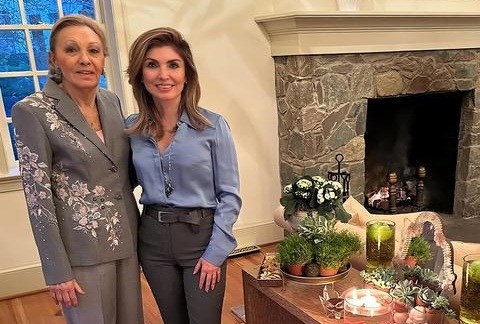
Throughout Iranian history, the term Shahbanu has never been merely a ceremonial title. In the cultural understanding of Iranians, the Shahbanu can represent wisdom, culture, the mother of the nation, social responsibility, and the connection between tradition and the future. Particularly within a constitutional monarchy, the role of the Queen can extend far beyond participation in official ceremonies, encompassing culture, education, the arts, social affairs, and the welfare of the people.
If a monarch were to ascend to the throne while still a child, a constitutional system could provide for a regency to govern during the monarch’s minority. Therefore, a Shahbanu who is legally and politically designated for such a responsibility could, as Regent, play an important role in maintaining stability and passing experience and political wisdom on to the next generation. This does not mean that the Shahbanu automatically becomes the Shah. Rather, until the young monarch reaches the constitutionally determined age of majority, she could assume specific responsibilities within the framework of the constitution.
Iranian history also provides examples of strong and wise women who stood alongside the institution of monarchy, women whose roles extended beyond the royal court. In contemporary Iranian history, one of the most prominent examples is Shahbanu Farah Pahlavi.
Shahbanu Farah Pahlavi defined much of her public role through culture, the arts, education, and social service. During her years of public activity, numerous cultural and artistic institutions were established or expanded, including the Tehran Museum of Contemporary Art, the Carpet Museum, the Reza Abbasi Museum, the Glassware and Ceramic Museum, and other cultural centres. The Encyclopaedia Iranica also identifies the establishment of the Negarestan Museum in 1975 as part of the broader development of museums pursued during that period with the initiative and support of Shahbanu Farah.
Her contribution was not limited to museums. She supported institutions and initiatives concerned with children, mothers and infants, people affected by leprosy, burn victims, and cancer prevention and treatment. She also supported the Shiraz Arts Festival and a range of other cultural and artistic programs that were established or developed during that period.
The Shiraz Arts Festival, held from 1967 to 1977, was a clear example of her international cultural vision. The festival brought together music, theatre, dance, traditional arts, and contemporary artistic forms, creating a platform for dialogue between Iranian culture and artistic movements from around the world.
Perhaps one of the most significant aspects of Shahbanu Farah’s cultural legacy is that many of the institutions, buildings, artistic collections, and cultural initiatives associated with her work continue to exist in Iran today. Cultural heritage cannot simply be erased by a change of government. Buildings, books, museums, works of art, and generations of people who received cultural and artistic education can continue to carry that legacy forward for decades.
Today, the concept of the Shahbanu can also acquire a different meaning in exile. Shahbanu Yasmin Pahlavi, the wife of Reza Shah II, lives outside Iran, yet her social and humanitarian activities can be understood as part of the same broader conception of the role of a woman within a royal family: a role that is not limited to titles and ceremonies, but can focus on people, families, children, and the future of society.
Her visits to refugee communities and camps, and her attention to the circumstances of people who have been separated from their homes and countries because of war, repression, or political instability, demonstrate that a sense of social responsibility can continue even beyond Iran’s borders.
At the same time, looking toward Iran’s future cannot simply be reduced to the restoration of a title or the return of a particular family. If Iran were one day to adopt a constitutional monarchy, its true value should be measured by the rule of law, civil liberties, the separation of religious institutions from government, equal rights for all citizens, and respect for the people’s right to determine their own political future. Within such a framework, the Shahbanu could have a cultural and social role that complements the constitutional position of the monarch rather than replacing the will of the people.
Shahbanu Farah Pahlavi represents a historical example of this potential, while the social activities of the Pahlavi family today, including the humanitarian work of Shahbanu Yasmin, can serve as a reminder that the concept of service to Iran does not necessarily depend upon being physically present within the country.
For a free Iran, the future is more important than the past. Yet the future cannot be built without understanding and preserving the cultural and human heritage of the past. Perhaps one of the most important responsibilities of a Shahbanu in a free Iran would be precisely this: to protect culture, support people, and connect Iran’s heritage with future generations, a responsibility that Shahbanu Farah and Shahbanu Yasmin have, in their own ways, faithfully carried forward to this day.
By Leila Naseri: Author | Composer | Social Cultural Activist