There were two butcher’s pork pies in my bag that also contained a copy of Lewis Bassett’s The Full English. As I began reading this investigation into the story of English food, having those pies on my person felt particularly in keeping with the English culinary tradition. By the time I’d finished the book, I was not so sure.
Bassett sets out on well-trodden ground to ask: what is English food? He focuses on a clutch of dishes or products which have long been seen as important to, or turning points within, English food culture: bread, haute cuisine, curry, fish and chips, roast beef, sausage rolls, olive oil. So far so conventional – but that’s rather the point. His contention is that much of our received wisdom about English food is reductive or simply wrong. We think we know the story of English food, of what makes it distinctively English, but: ‘There is clearly a lot of romanticising at work when we talk about tradition.’
He begins punchily and surprisingly in the present day, with the hot topic of ultra-processed foods (UPFs) – ones that have undergone industrial processes to significantly change their natural state to make them more-ish. Much of the discourse around these foods’ success relates to their irresistibility, reducing our dietary preferences to a simple matter of biology: ‘Scientists like to imagine that when you sweep away the thin shell of human culture you will find in each of us a naked, evolutionary desire to eat Doritos.’
But this scientific focus is blinkered: UPFs constitute 57 per cent of the British diet, compared with 14 per cent of the French and 13 per cent of the Italian. If every human being wants to eat Doritos, why are we eating so many more of them? This English reliance on processed food is not new. In 1900, nowhere in the world ate as much factory-made white bread, sugar and margarine as England. But why? Our diets are as much a product of social history as they are biological imperative. And it is from this sociological vantage point that Bassett explores national food culture and unpacks the stories we tell ourselves.
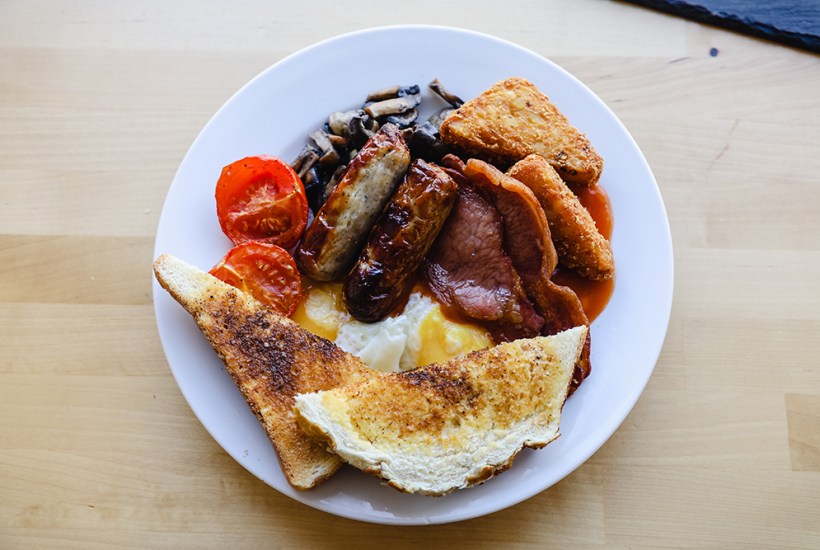
Our baking heritage is not, as today’s artisan bakeries may have us believe, the soaring sourdough loaves that use natural leaven – tangy, with thick, glassy, chewy crusts and hole-ridden crumb. Before the invention of commercial yeast, English bakers used beer barm as the raising agent. Our image of England as a proud fishing nation is also warped: by the time of the Leave campaign, fishing accounted for 0.4 per cent of Britain’s GDP – ‘less than the contribution to GDP by sales of sit-down lawnmowers or Peppa Pig merchandise’. The full English breakfast itself is not working-class in origin, fuelling days of manual labour, but aristocratic.
Bassett’s investigation goes deeper than upending culinary origin stories – and to more interesting places. At the heart of his book is the question: why is our idea of English food built on self-mythologising? His overall thesis is that our misunderstanding of English food is due to ‘England’s peculiar experience of modernity’, caused by a perfect storm of urbanisation, empire, industry and war.
Bassett is a man of two halves: as well as holding a PhD in sociology, he has worked in professional kitchens since the age of 16. At one point an academic career beckoned, but he remains ‘drawn to the kind of careful, physical work that is done with human hands’. As a result, The Full English is an irrepressible ode to craft as much as a historical analysis or a cultural reckoning.
In pursuit of understanding our mythologies, Basset places himself in the belly of various beasts, spending time with producers and suppliers: in the kitchens of Quince, an artisan bakery in Islington; in an unnamed high-end French-style restaurant in central London; at the River Café on the bank of the Thames; and on a whelk-fishing boat in Eastbourne.
This is gorgeously immersive. Bassett is a great storyteller as he describes making ‘parrot green pistachio frangipane’, sorting 10kg of Grade A black Périgord truffles that smelled ‘faintly of fresh tarmac’ (if fresh tarmac could be said to have an appealing smell), forming croustade pastry shells with ‘a hot brass rod that is dipped into batter, then into boiling oil’, and picking through crab meat with a UV torch and latex gloves to check for missed shell.
The scope of the book is ambitious, taking in everything from Jamie Oliver’s naive optimism of the early Noughties to what men who drink Huel are really trying to satisfy. Bassett’s urge to be accurate and completist can occasionally confuse timelines – but perhaps this speaks to the lack of a true, coherent narrative in our food culture. He thinks deeply and carefully about Englishness, and grapples brilliantly with tradition, class, social mobility, fashion and mythmaking. It’s a hugely enjoyable and original thesis, as well as a charmingly told story.
Got something to add? Join the discussion and comment below.
You might disagree with half of it, but you’ll enjoy reading all of it. Try your first month for free, then just $2 a week for the remainder of your first year.