‘Bog’ is an unlovely word, and the expressions in the bog lexicon – ‘bogged down’, ‘bog standard’, ‘bog off’ – are pretty unappealing too. When Roald Dahl created Bruce Bogtrotter in Matilda he invited us to envisage an obese, unattractive boy.
But when Merritt R. Turetsky, aged 20, encountered her first bog, it ‘pulled me in, and I have never looked back’. Three decades on, she is never happier than when landing on a bog in a helicopter or float-plane, heading out across trembling sphagnum in her chest waders, lying on her stomach with her ‘face pressed close to the bog surface’, or ‘getting down and dirty with the peat’. In dedicating this book to her three daughters, her deepest wish is that they each find passions to run through their veins, ‘like bog waters course through mine’.
It’s not just that Turetsky finds beauty in dank, soggy places – though she does – but that bogs enable her to ‘blend [her] passion for the natural world with a career relevant to environmental policy’. This is one of those books – the cover mimics Merlin Sheldrake’s Entangled – that takes what might seem a byway of nature and demonstrates how it can change not just lives, but your life. By ‘reconnecting’ with bogs, Turetsky suggests, you might improve your mental health.
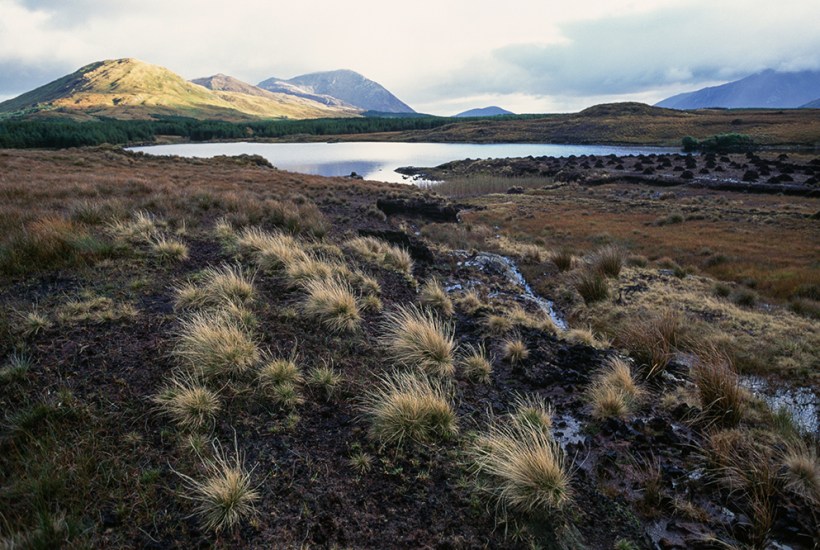
Travelling from Alaska to Canada, Vietnam and Borneo, she explains how, when the Ice Age retreated, it left behind the ‘raw, wet canvas’ that slowly emerged as bog and peat. She shows how the places where she spends her working life – relentlessly assaulted by pesky biting insects – are filled with dazzling biodiversity and unlikely life forms, from acid-flinging mosses to amphibian-eating plants.
Most importantly, she explains how bogs can be our allies in the fight against global warming. For thousands of years they have locked away carbon, especially in cold regions underlain by permafrost – and, in so doing, have helped cool the planet. But, as the climate changes, this role is being reversed. Bogs are now releasing carbon, often as methane, nudging the planet towards warming. Turetsky’s chief aim in writing this book is to sound a wake-up call to those outside the ‘peat community’ to learn to understand, then love, one of the Earth’s most extraordinary, overlooked ecosystems and to protect it.
I am not a scientist, and sentences such as ‘The acidity created by sphagnum inhibits many decomposer microbes by disrupting their enzyme and cell functions’ leave me cold. But I loved some of the stories: Eddie Fogarty discovering the Faddan More Psalter as he drove his mechanical digger through an Irish bog one July afternoon in 2006; sphagnum moss from bogs being used to make hundreds of thousands of surgical dressings during the first world war; bogs creating sanctuary for indigenous communities in early America, and so saving them from slavery; and the Rung Sac providing cover for the Viet Cong during the Vietnam War. In the 1960s, at the height of the Troubles, members of the IRA relied on the remoteness of the bogs in Northern Ireland to evade British security forces. Bogs enabled them to move undetected across rural borders and conceal weapons. They also helped them to dispose of the bodies of their victims – the Disappeared – who were sucked down into deep, wet peat.
But I struggled with the book’s repetitiveness. A number of ideas – that bogs are ‘keepers of memories’, that they stand on the boundary between life and death (I lost count of the number of times Turetsky used the voguish but worn-out word ‘liminal’), that bogs are ‘humble’ – seemed to come round every few pages as if on a loop. Most of all, the notion that bogs are ‘unique story-tellers’, ‘have stories’, ‘silently tell stories’, ‘tell powerful stories’, was repeated so often that by the time I reached the central question – ‘Are you ready to advocate for bogs?’ – I was zoning out.
I wanted less repetition and more literature. If we are to learn to love bogs we need enchantment. To be fair, Turetsky mentions The Hound of the Baskervilles, Wuthering Heights and – briefly and blandly – Seamus Heaney’s ‘The Tollund Man’. But why not explore Heaney’s fascination with bogs as metaphors for the layers of the human psyche?
My own favourite bog tale comes from George Mackay Brown and is the true story of a young Orkney woman, Betty Corrigall, who took her own life when she fell pregnant outside marriage in the 1770s. Refused a kirk funeral, she was buried in a peat bog high on the moors on the island of Hoy. The peat moss kept her uncorrupted. Soldiers digging drains in the second world war came across her body and ‘looked with wonderment into a face that had lingered sweet and beautiful from, it seemed, the first springs of time’.
Got something to add? Join the discussion and comment below.
You might disagree with half of it, but you’ll enjoy reading all of it. Try your first month for free, then just $2 a week for the remainder of your first year.