There are defeats in tennis that live in statistics, and then there are defeats that live in memory.
Novak Djokovic’s first‑round exit at the 2026 US Open will never be remembered as a scoreline. It will be remembered as a night when one of the greatest athletes of the modern era stood on the edge of his own physical limits and, for the first time in two decades, could not push past them. It was not a loss to Mariano Navone, the Argentine who played with admirable discipline and courage. In my opinion, it was a loss to something far more intimate, far more frightening, and far more human: his own body.
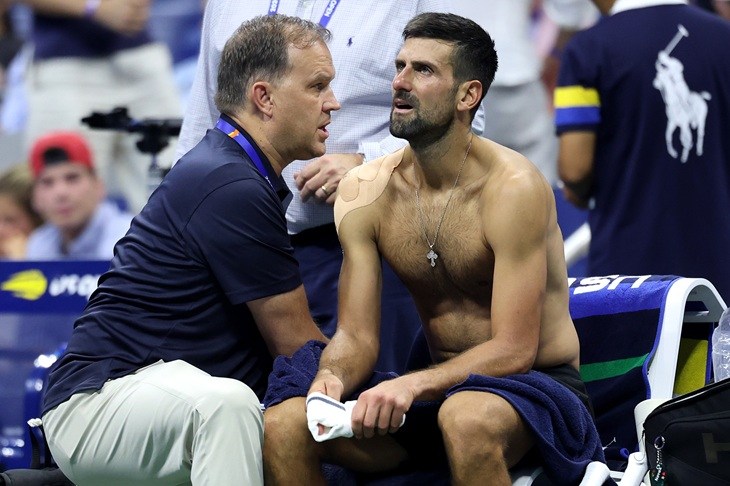
From the opening games, it was clear that something was wrong. Djokovic, usually a master of early‑match control, looked unsettled. His breathing was heavy, his movement stiff, his eyes unfocused. Within minutes, he was bending over, resting his hands on his knees, fighting for air in the thick New York humidity. Then came the moment that stunned the stadium: Djokovic appeared to walk behind the advertising boards and vomit. It was not subtle. It was not something he could hide. It was the kind of raw physical collapse that strips away the myth of invincibility and leaves only the vulnerable truth of a human being in distress.
He tried to continue because that is what champions do. He wiped his face, steadied his hands, and returned to the baseline. But the body that had carried him through 24 Grand Slam titles, through countless five‑set epic battles, through the longest and most brutal matches of the modern era, was no longer responding. His legs cramped. His back seized. His balance faltered. At one point, he looked dazed, as if the world around him had tilted slightly off its axis. The crowd, usually loud and electric, grew quiet. They were watching something they had never seen before: Novak Djokovic fighting not an opponent, but his own physiology.
This was not an isolated incident. Weeks earlier, at the Cincinnati Masters, Djokovic lost to Thiago Agustín Tirante in the second round. He later admitted that he has been dealing with a recurring health condition throughout the season that is made worse by heat and humidity. It is a cruel irony for a player whose career has been defined by endurance, resilience, and the ability to outlast anyone across any surface. The man who once seemed engineered for survival is now undone by the very conditions he used to dominate.
The question that now hangs over Djokovic’s future is unavoidable: should he retire?
It is a question that feels almost sacrilegious when applied to a player of his stature. Djokovic is not merely a champion; he is a legend of the game, a true phenomenon. He has added several chapters to the history of tennis, and he has spent more weeks at world No. 1 than any player in history: 428 weeks, compared to 209 for Nadal and 310 for Federer. He has won more Grand Slam titles than any man to ever pick up a racket: 24, compared with 22 (Nadal) and 20 (Federer). He has beaten every rival of his era – Federer, Nadal, Murray – on every surface, in every stadium, under every imaginable pressure. His legacy is not just secure; it is monumental.
But retirement is not about legacy. Retirement is about capacity.
Djokovic is still ranked among the world’s top players, though his ranking has slipped since the US Open to number 12. He remains dangerous on any given day, capable of brilliance that younger players still struggle to match. His tennis IQ is undiminished. His technique is intact. His hunger, at least publicly, remains fierce. But the body that once obeyed him without question is now sending signals that cannot be ignored.
The comparison with other ageing tennis players is instructive, but not definitive. Stan Wawrinka continues to compete at 41. Gaël Monfils still dazzles crowds at 40. Doubles specialists like Jean‑Julien Rojer and Santiago González play well into their mid‑forties. Venus Williams, at 46, remains a symbol of longevity and stubborn grace. Serena Williams, though no longer a full‑time competitor, still steps onto the court at 44 with the aura of a legend.
Djokovic, at 39, is not unusually old by modern tennis standards. He is younger than some active professionals and younger than the oldest active male player, Aqeel Khan, who competes at 46. Age alone is not the issue. What separates Djokovic from these veterans is not the number of years he has lived, but the severity of the physical symptoms he is experiencing. Wawrinka and Monfils show normal ageing decline. Djokovic shows acute physiological collapse.
And yet, it is impossible to ignore the emotional dimension of Djokovic’s struggle. When he sat on his bench during the fifth set of his US Open match, tears streamed down his face. I did not see them as tears of frustration or disappointment. I saw them as the tears of a man who knows his body better than anyone else, and who felt it slipping away from him in that match. It was a moment of heartbreaking vulnerability from an athlete who has built his career on mental steel.
Should he retire? The honest answer is that he should not, at least not yet. Retirement should never be a reaction to a single night, no matter how painful. Djokovic deserves the chance to adapt and to decide his future on his own terms. He has earned that right through decades of excellence, discipline, and sacrifice. If his medical team can stabilise his condition, if he can learn to manage the triggers, he can continue to compete at a high level. He may not dominate as he once did, but he can still win, still inspire, still add chapters to a story that is already one of the greatest in sports history.
In my opinion, if the health condition persists, if the heat continues to break him down, if the vomiting and dizziness return, then retirement becomes not a choice but a necessity. No title, no ranking, no record is worth risking long‑term health. Djokovic has nothing left to prove. He has already achieved more than any player of his generation. He has already secured his place among the immortals.
And beyond tennis, Djokovic’s legacy extends into philanthropy. Through the Novak Djokovic Foundation, he has funded early childhood education programs, built schools across Serbia, and supported humanitarian initiatives around the world. His philanthropic work is not a footnote; it is a central part of who he is. He has used his fame not only to elevate himself, but to elevate others. In Serbia, he is not just an athlete; he is a symbol of possibility, a reminder that greatness can emerge from small places and humble beginnings.
If Djokovic retires, he will not disappear. He will continue to shape the world in ways that transcend sport. He will continue to inspire, to lead, to give. His legacy will grow, not shrink.
But for now, he stands at a crossroads. The US Open was not a defeat; it was a warning. It was a night when the body that carried him through a thousand battles finally said ‘enough’. Whether that warning becomes a turning point or a final chapter remains to be seen.
What is certain is this: Novak Djokovic has earned the right to decide his future without pressure, without panic, and without the noise of speculation. He has earned the right to listen to his body, to consult his doctors, to speak with his family, and to choose the path that honours both his greatness and his humanity.
Whatever he chooses, his legacy is already written, in records, in memories, in the hearts of millions. And no early exit, no collapse, no moment of weakness will ever erase it.