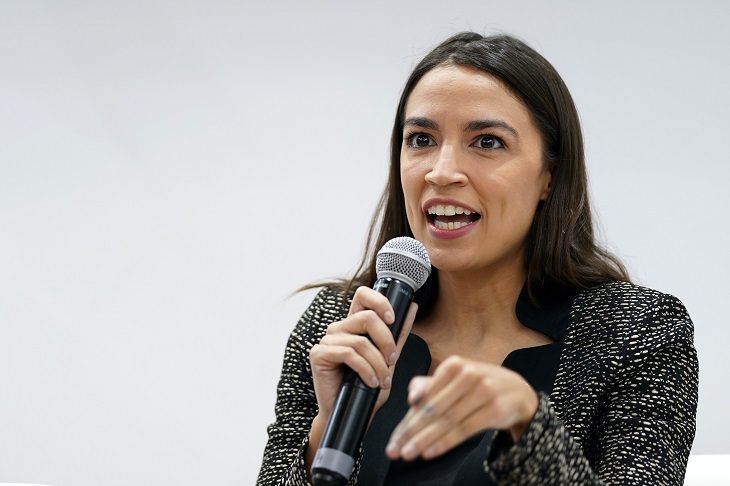
Democrat Alexandria Ocasio-Cortez, who often goes by AOC, recently took to the internet to share that she would be freezing her eggs.
Her 9.7 million Instagram followers are able to see her document multiple aspects of her journey each day, from her personal reasoning to the fertility injection itself. Far from being your average vlog, she makes clear that this is not just personal, but deeply political. Talking into the camera, she laments the broken medical system, the pressure women feel to do it all, and the policy-makers who ‘don’t understand women’s bodies’.
For the person scrolling on their phone, she may as well be talking to them directly. Yet this conversation is not strictly one-sided.
Followers can contribute to her AMA (ask me anything) sessions, asking questions that range from her thoughts on given policies to what the process itself is like. One woman asked: ‘How was your medication unpacking experience… I feel so overwhelmed and ill-prepared.’
In sharing what is the most emotionally charged aspect of many people’s lives, AOC becomes someone who not only shares your political frustrations, but also your personal struggles. People from across the political spectrum were highly invested. Conservative commentator Allie Beth Stuckey went so far as to make an hour-long video titled ‘AOC is selling a dangerous lie about fertility’, while Guardian journalist Moira Donegan labelled the act ‘an assertion of women’s freedom’.
If there’s anything indicative of the current state of politics, it’s this. Not because of what it says about the difficulties of working women or the average person’s relationship to the medical system, but because it reflects the parasocial nature of politics.
The term parasocial relationship was coined in the 1956 paper Mass Communication and Para-Social Interaction by researchers David Horton and Richard Wohl to describe the one-sided relationship many felt with TV characters.
They write: ‘Sometimes the actor – whether he is playing himself or performing in a fictional role – is seen engaged with others; but often he faces the spectator, uses the mode of direct address, talks as if he were conversing personally and privately.’
In her comments section and AMAs, Ocasio-Cortez allows followers to transcend the illusory conversations that TV characters are confined to. As followers hold out hope of interacting with her via a screen, she becomes not just a politician, but also a friend and peer.
The phenomenon of parasocial politics isn’t limited to AOC.
On TikTok, New York Mayor Zohran Mamdani addresses New Yorkers in different languages, or posts beautiful photos of events he’s been to. In curating this public image, he fosters audience affection in a way that a TV debate would not likely permit. On the other side of the political spectrum lies not just Donald Trump’s humorous videos, but also those of his family. His granddaughter Kai can look me in the eyes through her screen as she tells me of her makeup routine or college plans.
While this phenomenon is less true of Australian politicians, it nonetheless exists in the form of political influencers. Political commentators such as Abbie Chatfield and Hannah Ferguson oscillate between discussions of politics and updates on their personal lives. I can listen to Chatfield’s engaging It’s a Lot podcast before playing her boyfriend Adam Hyde’s music, or learn on an ABC podcast that Ferguson’s opposition to hookup culture is partly informed by personal experience. With the rise of online activism, even lifestyle influencers can comment on politics, awakening us to new issues or perspectives.
The power of parasocial relationships to impact our thinking should not be doubted.
Researchers have found that one’s parasocial connection with a given political influencer impacts not only how much they become interested in the topic at hand, but also the likelihood that they will participate in activism. We like to consider ourselves rational voters, guided by nothing but reason and certainly not parasocial affections. Yet as political scientists Christopher Achen and Larry M. Bartels argue in their book Democracy for Realists: Why Elections Do Not Produce Responsive Government, people often vote based on group loyalty and general impressions as opposed to policy.
Difficulty separating affection for AOC from support for her policies is not a sign of stupidity, but a reflection of one’s humanity.
In some senses, the parasocial landscape of politics is positive. It can provide opportunities to learn about topics people otherwise wouldn’t, particularly as politicians and influencers are incentivised to present information in an engaging manner. It can also expose the political as personal. Hearing that some women struggle to balance motherhood and career is abstract. Seeing a successful congresswoman personally wrestle with it transforms the problem into a concrete reality.
The risks, however, are numerous.
With politics increasingly dominating public discourse, there is pressure for influencers to comment lest they risk appearing out of touch. The online movement #Blockout2024 aimed to boycott celebrities and influencers who hadn’t spoken publicly about Gaza. As reported in an article for Al Jazeera, influencer Haley Bayley responded to such pressure by saying in a since-deleted video: ‘I am not informed enough to talk about it in a meaningful or educational way.’ Yet this too was met with backlash, with an X post with over two hundred thousand views saying: ‘Not informed enough on a gen0cide that’s been happening for 8 months??? … How ignorant and disgusting.’ While frustration over the reluctance of influencers to speak on global issues is understandable, this online environment risks contributing to a culture in which one must rush into having an opinion, privileging enthusiasm over the nuance that is often necessary.
Perhaps the parasocial bonds the media allows us to have with politicians and political influencers are also contributing to political division.
While the individualised nature of online written media can allow people to continuously confirm their beliefs without being challenged, watching a politician simulate FaceTime with you has the additional persuasive element of parasocial interaction. In some cases, this can be extreme. The recent report Misogyny, Online Radicalisation, and Youth Extremism in Australia, led by Dr Sarah Meger from the University of Melbourne, concluded that engagement with harmful male influencers is ‘among the strongest online predictors of both hostile gender attitudes and violent extremist attitudes’. While the report did not measure parasocial relationships, it is clear the boys held manfluencers in high regard, with one teacher saying, ‘Influencers are now seen as celebrities.’ What is also concerning is that loneliness and social isolation are associated with both parasocial involvement and susceptibility to extremist ideologies. In other words, extreme views and the illusion of a relationship may present a perfect combination for radicalising the most vulnerable members of society.
The loyalty people feel to their political tribe has been particularly intense in recent years. While one could blame the global rise in polarising political figures such as Trump or Italy’s Meloni, parasocial relationships may also play a role. In the lead-up to the elections, many people likely saw the faces of Trump and Harris more than they did their neighbours. That’s not to mention the political commentators who post daily to front-facing cameras. If an acquaintance were to speak ill of one of my friends, I would likely cut them off out of loyalty. If I subconsciously viewed Donald Trump as a friend, might this not similarly encourage greater hostility towards his opponents than if I viewed him as simply a politician? In the same manner, the faces and voices of Hanson and Albanese are hard to miss in the daily news. Tune into the ABC show Kitchen Cabinet, and you can even watch Albanese discuss his culinary tastes as he makes pasta. Even for those who dislike Hanson or Albanese, this doesn’t stop algorithms or the news from imposing them on you. Like the annoying colleague who fails to become more tolerable with time, this may only further intensify the parasocial dislike.
In Marshall McLuhan’s 1964 book Understanding Media: The Extensions of Man, he coined the now-famous term the medium is the message. Put simply, the medium through which the message is communicated can matter just as much as the content itself. Citing the example of how the railroad reorganised societies, he argues that technology has social implications that extend beyond its immediate use. In the same manner, AOC’s vlogs don’t just tell us about the problems with the medical system. They tell us that she is a human you can interact with, your subconscious mind unable to register the fact she doesn’t know you.
Open your phone or turn on the TV, and a version of this may occur with politicians every day. You may love them or hate them, watch the video or scroll.
Yet just as McLuhan’s essay brings to mind a man stepping off the train into a world freshly reorganised by the railway, the social effects of parasocial politics will be felt long after you turn off your phone.