Chekhov is tricky. He’s not someone we think of as uproarious but the playwright himself used sometimes to complain that Stanislavsky, or whoever it was, was neglecting his comedy. On top of this there’s the evidence of Michael Frayn’s Wild Honey – his adaptation of Platonov – which Ian McKellen said he didn’t realise was a comedy until the first-night audience roared at every word the author of Noises Off who spoke Russian had planted in his mouth. So you can at a pinch play a supreme masterpiece like Uncle Vanya for the gag lines if you want to but it will be a strange mutation. Joanna Murray-Smith’s adaptation, directed by Anne-Louise Sarks for the Melbourne Theatre Company, has a go at it and produces a pleased-sounding gurgle of merriment from an audience which sounds a bit surprised to have its funny bone tickled but not unpleasantly.
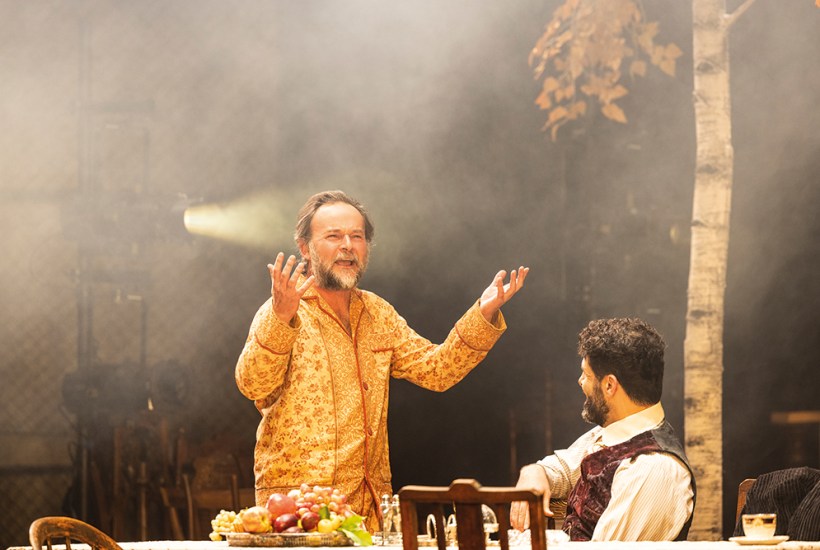
Sonya (who runs the estate with her uncle) comes on in a funny hat, looking a bit like a pirate, and there’s a comparable rakishness in Yelena’s headgear. She’s the glamorous sexy woman who is married to the boring full-of-himself professor (Shaun Micallef), though every male gaze – that is to say Vanya’s (Daniel Henshall’s) and that of his friend, the visiting doctor, Astrov (Fayssal Bazzi) – is directed her way.
Given the extraordinary tug-of-war that ensues between Philippa Northeast’s Sonya and Catherine Văn-Davies’ Yelena the upshot is distinctly weird. It’s a kind of violent latency which gets knocked for six though, in Hamlet’s words, ‘some necessary question of the play is then to be considered’. There’s an energy and a frontal attack on the quietness of the play but it does loosen up the audience. Both the young women in a state of uncharacteristic fury turn the play into farce as we sit in the somewhat chilly environs of the very front stalls and the fir trees tower above us. Dann Barber’s set suggests the spaciousness of this early twentieth-century Russian world which the playwright Joanna Murray-Smith makes a determined effort to give an edge of modernity to. There’s plenty of foul language – more than is common.
The most celebrated twentieth-century production of Uncle Vanya uses Constance Garnett, with no updating. It has Laurence Olivier as Astrov, Michael Redgrave as Vanya, Joan Plowright as Sonya, Rosemary Harris as Yelena, Dame Sybil Thorndike as Nanny and her husband Sir Lewis Casson as Waffles with Max Adrian as the Professor. It is quiet, thoughtful and deeply comic but with no apologia for shrieking.
Vanya and his niece Sonya run the estate self-sacrificingly for the Professor who is vain and self-regarding. Vanya says he writes about matters that educated people know about anyway and other people are not interested in. Vanya has a deep rapport with Astrov, a doctor who blames himself if a patient dies when he is being operated on and who looks forward to a world two hundred years hence when people are adjusted to the tranquility of a future equality.
Fayssal Bazzi was close to being a very fine Benedick in the Melbourne Theatre Company’s Much Ado About Nothing back in 2025. He captures the sinuous brilliance of Astrov but not quite all of the supple intelligence, the capacity for affection and the weakness for the vodka. He is an attractive figure, a touch more so than Daniel Henshall’s Vanya, who despite giving the most recognisably human performance of the ensemble, should ideally have a breakneck quality which is at the edge of hysteria so that his resort to the gun makes sense to him (and to Astrov) but the essential quality in Uncle Vanya is the intimacy between the central figures. And there’s the way Yelena asks Astrov whether he likes Sonya – meaning sexually – but she ends up in Astrov’s arms to Vanya’s uncomprehending horror.
Sir John Gielgud said once of a celebrated production of Chekhov, grumpily, that the characters didn’t seem to know each other very well. (You can watch his own black and white version of The Cherry Orchard on YouTube, with Dame Peggy Ashcroft as Ranevskaya, Gielgud as Gaev, Dorothy Tutin as Varya, Ian Holm as Pyotr and the very young Judi Dench as Anya. The quality that Gielgud highlights is teamwork. Each of the characters is intimately known to the others.)
The comedy in Uncle Vanya runs deep because no one can take Vanya’s attempted murder and putative suicide seriously (though, then again Astrov and Sonya do, as a token of their affection). And this transcends the piteous farce. Evelyn Krape is the most authoritative figure on the stage though she should be allowed to maximise her warmth. We get ‘God will provide’ and Astrov’s response.
Shaun Micallef has authority as the Professor but without the combination of wiliness and whimsy that actors from Max Adrian to Roger Allam have brought to this toweringly self-satisfied figure who must be one of the very greatest figures of intellectual vanity the stage has ever seen. Micallef needs to let rip. He doesn’t get the moment when he makes a joke – a Russian literary joke – that the Government Inspector is coming to town.
But Anne-Louise Sarks’ production of Joanna Murray-Smith’s script is very domestically and scatologically Australian. It is written in an idiom we speak rather than one we approach from a discernible distance and this gives it a familiar colour which allows for all the makeshift hilarities as diversions from something much deeper and much sadder than we know.
Is there an irony that the National Theatre Live screening of Les Liaisons Dangereuses has started its run at the same time? It’s the Christopher Hampton version and it stars a luminously grand Lesley Manville in the Glenn Close role and Aidan Turner (the Irish heart-throb from Rivals as well as Poldark) in the role made famous by John Malkovich. We should be grateful for it but it’s a pity that it is so much greater than this energised but also compromised Uncle Vanya.
Got something to add? Join the discussion and comment below.
You might disagree with half of it, but you’ll enjoy reading all of it. Try your first month for free, then just $2 a week for the remainder of your first year.