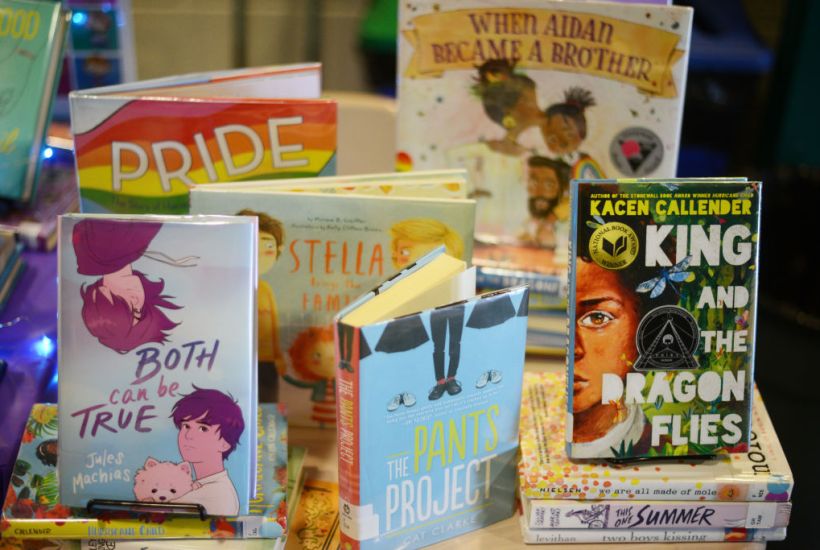
Self-immolation is a horrible way to go, but no one seems to have told that to the children’s publishing industry. Driven by religious and ideological fervour, children’s literature has rushed to adopt ‘inclusivity’ and progressivism at the cost of diversity of thought. The result is a stream of turgid books obsessed with ‘trans’.
On 17 June the group SEEN in Publishing (SiP) launched its latest report in the House of Lords, hosted by Baroness Jenkin of Kennington. It’s a document that publishers should heed, though they have a history of sticking their fingers in their ears. That obtuseness is all part of their desperation to burnish their devotion to ‘progressiveness’ at all costs – even, in the case of transgenderism, at the cost of children’s wellbeing.
The report, Through the Looking Glass, as its title suggests, is an exploration of a world where reality is inverted and truth distorted. It hears from authors and children’s advocates, and is backed up by contributions from medical authorities. Its conclusions are damning, its seven recommendations sane and urgent. It’s a pity, then, that sanity is unfashionable in the world of children’s literature. It’s far from clear that the report will be accepted by those who should take it very seriously indeed.
That obtuseness is all part of their desperation to burnish their devotion to ‘progressiveness’ at all costs – even, in the case of transgenderism, at the cost of children’s wellbeing.
In 2025, only a third of children between the ages of eight and 18 were reading for pleasure – a fall of 36 per cent since 2005 – according to the National Literacy Trust (NLT). This is so disastrous that a tiny uptick of 2 per cent in 2026 was celebrated by industry news sheet the Bookseller as divine salvation rather than a potential margin of error. The NLT’s list of possible solutions – TV tie-ins, digital formats – reads like a prescription from 2005, studiously avoiding the central problem: that the publishing industry is churning out books for children with an agenda – and the books are terrible.
Spare a thought and a moment’s pity for the report’s contributors (I was one of them), who had to read the unscientific, inaccurate and downright dangerous bilge that major publishers have been publishing since at least 2015. Bilge might be halfway excusable if the books were readable, but they’re turgid, predictable, preachy; it’s inclusivity by spreadsheet.
Propaganda starts even before school. Stephanie Davies-Arai, a British author and the founder of Transgender Trend, points out that one of the earliest offenders, the Penguin Land series, loads all responsibility for massive, life-altering decisions on to the shoulders of very young children. In these books, parents are no more than witless, literally irresponsible ‘affirmers’. That message alone should have set alarms ringing; instead the likes of Bloomsbury joined the party with Introducing Teddy, wherein the titular bear becomes a girl bear by moving his bow tie to the top of his head.
It’s as if the children’s publishing industry has never heard of child protection. That extends to its ecosystem, not least libraries. Sibyl Ruth, an author who lost work over her view on sex and gender, describes how the industry fails girls in particular at every level, from the Chartered Institute of Library and Information Professionals’ devotion to trans to the wilful mis-shelving of teenage books in the junior sections. Far too many ‘queer’ books pitched to children glorify self-harm, celebrate medical intervention, and describe and recommend adult kinks and sexual practices. The Young Adult sector is wildly homophobic, too: girls win the love of gay men by cutting off their breasts and changing their pronouns. The very successful Heartstopper series is the sugary idolisation of gay romance for teenage girls; talk about appropriation.
In the industry there is effectively censorship of biological reality, as well as women’s and gay rights. Should an author be reckless enough to submit a book on these themes to a major publisher, it will be strangled at the commissioning stage and the writer blacklisted. It’s ironic that the NLT recommends ‘freedom to choose’ as one way of reversing reading decline – when there is no choice for readers.
This is where commercial self-harm kicks in. It’s not just editors’ airy disregard for fact-checking and legal jeopardy; it’s that this stuff isn’t wanted (bar the aforementioned Heartstopper, which is very popular with straight girls). The television and film industries are finding this out the hard way. If people wanted a Queer Theory sermon, Starfleet Academy and latter-day Doctor Who wouldn’t have been catastrophic failures.
Ultimately, the publishing industry is destroying its own talent base, and I’m not talking about the brutal cancellations of authors from jealousy and spite. A lesbian, disabled author who has contributed to Through the Looking Glass had to remain anonymous because she doesn’t believe in trans dogma.
A fog of fear and timidity is strangling children’s literature; even the writers who remain are too afraid to think independently, to veer from the path demanded by their less talented peers, to risk a challenging theme or a complex character. Publishing’s current output is grey and didactic. Unreadable, in fact.
That’s why children don’t read, and that’s why the industry might as well douse itself in petrol and strike a match.