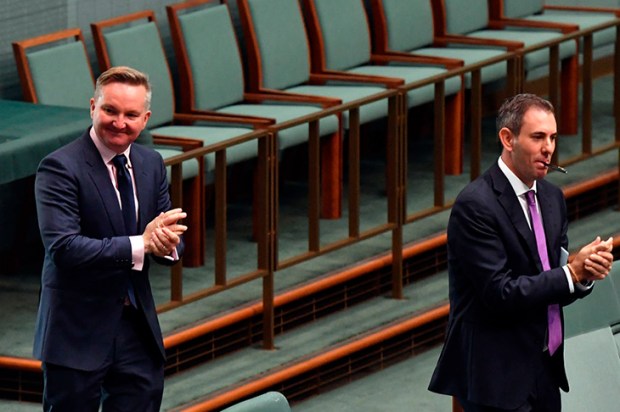
Jim Chalmers has a big job which he’s not executing very well – reduce government expenditure to align with income, repay debt, and increase economic growth.
Why he bothered with ‘reforming’ the Capital Gains Tax and Negative Gearing regimes is a mystery as the measures contribute only marginally to his main job while breaking an election promise completely destroying Labor’s credibility.
A good rule in financial repair is to go where the big wins are, and not to waste time on marginal gains. But the changes to CGT and NG will yield very little revenue, at the same time they decrease the efficiency of the economy and the housing market making it tougher for renters, and no easier for home buyers.
Jim’s minimum KPI should be tied to getting spending back in line with income. The Commonwealth currently spends around 26.8 per cent of GDP but raises only 25.8 per cent in total with taxes contributing 23.7 per cent of GDP.
The long-term average for Commonwealth government income since 1975 (when the adults got back in control after Whitlam) has been of the order of 24 per cent of GDP, which gives him a 3 per cent of GDP savings target to meet – or somewhere around $95 billion. (And I mean genuine savings, not describing a tax increase as a saving.)
How much will the combined changes bring in? None for the next two years, and in 2028-29 only $1.35 billion, which is 1.42 per cent of the treasurer’s KPI requirement. The Treasurer and the Prime Minister have torched their credibility over rats and mice.
The fact that the Treasury secretary supports this because ‘the tax has to come from somewhere’ demonstrates the descent into midwittery of that office since the days of John Stone.
Why are they chasing the wrong targets? It lies in politics and ideology, not economics and the days of student union debates where it was assumed the rich were always getting away with not paying their fair share. This has informed a progressive drumbeat for decades calling for government to abolish negative gearing and tax capital gains as income.
The Greens pushed these policies, along with rent controls, at the last election, and while the Liberal Party is currently in an existential fight with One Nation, Labor is less visibly wrestling with the Greens.
Current policy marries Chalmers’ ideological predilections with the tactical political exigencies of the moment and can be sold to the faithful as making the rich ‘pay their fair share’ and making housing ‘more affordable’.
The problem with both those propositions is that they aren’t true. The capital gains taxes might have been aimed at the housing sector, but it’s captured all capital gains on all asset classes. That includes those earned by investors in their teens, twenties, and thirties saving for their first home.
Unlike their parents they don’t put their savings into bank accounts with their derisory rates of interest, but into cryptos and ETFs. Now they find, despite earning less than the average wage, they will pay a minimum tax of 30 per cent on their investments when they try to realise them for that home deposit.
It also catches all the small businesspeople who work for a take-home pay less than average in the expectation of selling their business at some stage for a profit. And the entrepreneurs, who are building the productivity boosting financial unicorns of the future, who can get a much better CGT regime incorporating in New Zealand, Singapore, or Switzerland, and might just do that now.
Nor will it have much of a long-term effect on the housing market. As everyone agrees, supply is the key to increased housing affordability, and the budget admits there will actually be fewer houses built as a result of these ‘reforms’.
We’ve modelled the last 10 years of housing investment for the existing tax regime, along with the counterfactual of what would have happened had Chalmer’s regime been in place over the same period.
What that shows is, counter to popular opinion, that the homeowner gets the biggest tax advantage, not the investor. This is because they don’t pay any capital gains tax at all, and as they are effectively also their own landlord, they ‘pay’ themselves rent in before-tax dollars.
These tax advantages more than make up for the ability of the investor to deduct expenses from income, and they are already paying a CGT, even if only on half their profits.
When we run our simulations, we find that over the last ten-year period the top marginal rate homeowner would have got a theoretical return on their investment of 16.08 per cent after tax if they borrowed 95 per cent of the value of the residence, and 11.90 per cent if they borrowed only 80 per cent. This compares to the investor on 15.19 per cent and 9.99 per cent respectively on the same tax rate and borrowing conditions.
When they’ve both paid off their mortgages the homeowner is still well ahead with a return of 7.6 per cent versus 5.14 per cent.
Under the Chalmers’ regime the returns are not as good, but they’re not much worse either. On the leveraged scenarios the top rate homeowner gets the same return, while the investor drops to 13.54 per cent and 9.81 per cent respectively.
Is this enough to keep them out of the market or will there still be investors for residential housing? Well, on our hindcast the alternative investments we looked at of superannuation, shares and cash all returned much less. 8.21 per cent for super, 5.83 per cent for shares and 1.05 per cent for cash.
Investors will eventually work this maths out and the dips we are currently seeing in the markets will most likely reverse. Particularly as there is no evidence the government intends to slow immigration.
As reported by The Australian: ‘Labor is arguing the opposition Leader’s plan to bring net overseas migration below 200,000 a year would cost about $50bn over nine years.’
Immigration is now a profit centre for the government, returning more than their CGT and negative gearing ‘reforms’ entirely.
But if Chalmers was serious about housing affordability the one thing he could do to fix the problem is reduce net migration not to the opposition’s unambitious target of 200,000, but to Canadian Prime Minister Mark Carney’s target of a very low sustainable level.
Instead, the government is trying to boost supply by retaining the current tax treatment for new home buyers. But in the March Quarter this year there were loans for investors of 57,342 and housing starts (not completions) of 53,567. If investors take the government’s bait, the new home market will be overwhelmed.
The industry is working pretty much at capacity, one reason being the high rate of government spending on things like train tunnels, the energy transition, the Olympic Games, infrastructure to cope with migration, and buildings to house new public servants, along with other projects that add nothing to the economy, and debt to budgets.
So all that extra demand won’t boost supply it will boost prices in the new home market which will then flow over into the established housing market. It’s Economics 101 that you can’t quarantine economic effects to one sector by government fiat (any more than you can quarantine people from respiratory viruses).
The Labor government obviously doesn’t know what it is doing, but the real question after the budget is, ‘Does anyone, in any of the three major parties, understand what needs to be done for the economy, and will they articulate it?’
Taylor’s pledge to index marginal rates of tax is a good start, as it implies he will keep increases in government expenditure to no more than inflation, but there needs to be much more detail. Hanson was on the right track with immigration, but again, real detail is missing as well as a frame within which the opposition parties can coherently attack the government’s budget and pave the way for their own potential government after an election.
With Chalmers’ credibility gone there is the opportunity for a new, accurate narrative to assert itself and describe the situation we actually face, rather than the student union version, and the moral imperative to put some real solutions in place.