If our ancestors knew half the things we know about their contemporary politicians, would they have voted the same way?
Think of Churchill, Asquith, or Curtin and their Olympian drinking habits or the fact Churchill wasn’t out of bed until at least 11am every morning?
What about one of Australia’s favourite Prime Ministers, Bob Hawke, who was fond of extramarital associations. Or what of the vocabulary of Gough Whitlam, Margaret Thatcher, Tony Benn, and John Howard’s dining room table talk behind closed doors?
I’d wager that the most intelligent among us wouldn’t care. They’d judge them on their record. What they achieved. What they failed to achieve. Sure, there’s passing interest and intrigue – but that comes only afterwards through the reality of what they’d accomplished.
While some personal characteristics and hobbies – such as Churchill’s regular recreational bricklaying are universally appealing – in posterity the wisest historians judge the full sum of character, achievements and life, rather than the exaggerating and magnifying their shortcomings and character flaws. Flaws we all possess.
All’s fair in love and political reportage
If we look at recent electoral commentary across the anglosphere and wider Western world – but most prominently in the UK and Australia – we see such a scramble to uncover the hidden elements of the candidate(s), rather than discussing the merits of their ideas to better represent their constituents and the nation on the whole.
Some would say this is natural human curiosity, while others would call it diversionary to the task at hand: choosing who can represent you best, and picking which party can govern best.
In the by-election context, free from wider electoral distraction, the focus of the media can be concentrated and searing in intensity. Only the battlefront here isn’t immediately your ideas, it’s increasingly become your current and historical digital footprint.
Yes, we’ve all heard about ‘cancel culture’ – and with the column inches so deep on it I promise to not linger long such is the tedium it spawns. But despite this near global societal awareness of the problem, and widespread condemnation, the trend continues at pace. The fatigue on the right in talking about it, let alone reversing it, seems to be having a deleterious effect in carving a new standard of discourse.
Partly originated as a by-product of 75 years of celebrity worship, everyone would have heard the phrase ‘politics is showbusiness for ugly people’ – a quip no doubt invented by those who benefited most from this cultural creation – and so the national dramatisation and character-dissection of politics is the new normal. Just as digital addictions and curated algorithms have rendered us even more subservient to a 24-hour news cycle, so too has intellectual depth vanished from light commentary.
Increasingly though, character assassination – and the right is not immune – has become an ideological reflex the left first reaches for rather than debating the issues head-on. No matter how you shake it, particularly for activists, one can’t help but see those of a certain side of politics all too eager to play and the man and not the ball.
You’ve probably seen it firsthand in your personal life. Think of those in your personal circle who like to discuss contentious political topics and who can bear to have their views challenged, and who can’t. What are their philosophical or political persuasions?
We see the same thing on a national, even continental scale. Rather, than discredit a policy position through strength of argument, empirical evidence or rhetorical ingenuity, rather concentrate your efforts on the man (or woman) because they said a rude or mean thing on the internet and render their suitability for public speech invalidated.
Journalists and activists alike (yes, they’re meant to be two different things) will comb through decades of online activity just to capture a crumb of ideological infidelity. What eventuates is the rampant casting of aspersions on the character and ‘fit and proper personhood’ of a candidate because they utter a quip or fleeting opinion on a topic deemed insensitive or off-limits due to Wokery/political correctness (which the more couth tactfully summarise as ‘the prevailing orthodoxy’).
Yes. Rather than drill into the details of how to fix the problems plaguing a community, it’s far easier to just hurl a stone at the person raising the problem. We’re now incentivised not to notice. And while the majority of the populace now very vividly notices this tactic, its practitioners labour on unchecked with growing converts on the left, and concerningly, the right.
The right to rule
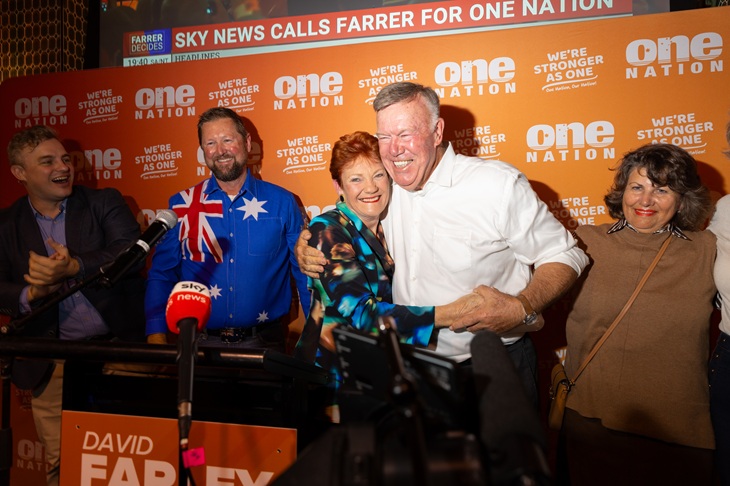
Consider the recent Farrer by-election in rural New South Wales, where the One Nation candidate’s curly personal political history was fair game for the Coalition. Rather than focusing ammunition on dismantling One Nation’s policies or championing their own for the region or nation, they desperately attacked the fact the candidate had once been a member of the Labor Party – as if political party preference should always be static and if you ever change your preference, you’ve committed some form of politico-adultery. I admit it had some tactical merit, but did it deliver a better dialogue for the people of Farrer?
The reality is, real people often play a tug-of-war in their hearts and minds with their political persuasions and swinging voters have long been known to win elections, rather than tribal voters. Expectedly, the tactic backfired, as the electorate had had enough of all three of the major parties (Liberal, Labor, and National) and were themselves moving on from previous allegiances.
In the UK context, this same awakening permeates throughout the unravelling Conservative Party, where much of its aspirational base is flocking to Reform UK due to the Tories’ bitterly disappointing 14 years in power.
This tenure was marked by the instability of constant leadership changes, unfathomably high immigration to appease big business, low growth and high inflation, declining living standards, a botched Brexit, further deindustrialisation, a defence force and defence industry crippled by lack of funding and a complete failure to reverse New Labour’s complete institutional capture of the public sector and the now all-pervasive taint of Wokery which has shaped the very machinery of Whitehall and every government department. I mean, it’s hard to list their achievements. Perhaps in fairness, winning the Scottish independence Referendum was one (albeit which they played a small role in).
Given the circumstances, faced with a new digital age where ordinary people see the super-rich flaunting their newfound wealth in ever more opulent ways, it’s more natural for people to seek pastures new in the face of such failure, than to hold fast to the ideal of a once noble party’s God-given right to rule. Particularly with red tape, compliance and income taxes strangling the individuals’ sense of self and sapping the fruits of their labour.
Throw in the fact that Reform is now attracting Old Labour votes – the former ‘bolted on’ white working-class voters – in droves, means the insurgent party can fairly be ascribed to have broken class-divides that for a century defined UK politics between red and blue.
But rather than marvel at this feat, the UK journalist corps seems unimpressed if not furious. Rather than listen to working people and why they are opting to switch their vote, the journalist corps seems to exist to prevent such a switch occurring, such is its befuddlement.
Which brings me the UK’s current Makerfield by-election.
Makerfield – the incumbent Labour government’s next litmus test and potential return to Parliament of a popular challenger to Sir Kier Starmer’s Premiership
Reform UK, currently polling around 27-30 per cent for a good 20 months now and leading the polls everywhere except in London and Scotland, is often maligned by the UK journalist corps, who consider it somewhere on the spectrum of a temporal protest vote and a very dangerous joke. Yet the reality appears to be neither. I wonder how many last laugh’s will Farage have to have before the penny drops?
Reform’s Lancastrian candidate Robert Kenyon – much like the previous by-election candidate in Gorton and Denton, Matthew Goodwin – has been lambasted on social, local, and national media to the point of attempted character assassination, due to his turquoise allegiance and his former controversial online commentary made as an ordinary man, outside politics.
Consider a current Manchester Evening News article claiming that Kenyon – a local plumber and army reservist – said some ‘sexist’ things regarding a television personality some five years ago.
Far from swerving, Kenyon apologised and equated it to be a bad joke made in poor taste. The media and many an online chorus didn’t take it as a joke. They took it as a cardinal sin and a permanent blip on his character which warranted punishment. What’s really intriguing is the way some of public (or the perceived public) responded.
One commentator – and I cannot tell if they’re a local, a bot, or an activist clogging up the comments feed to craftily influence perception – said, ‘To say ‘no offence was meant’ is nonsense. Offence was meant otherwise he wouldn’t have said it.’ What a perspective. Nowadays offence is always given and not taken? People only say things to offend, not for any other reason?
Another read, ‘He knows exactly what he said and he meant it – it defines him as a man and we all see exactly who he is.’ And on and on it went. Stone after stone by the many ‘sinless saints’ we find offering their verdicts online, safe in the knowledge they are morally superior to people due to the rude things they apparently do not and never say.
Every media outlet in the land has been pushing this story for a couple of weeks alongside other claims.
What kind of politicians do we want?
Comparable to how real people – men and women alike – talk amongst each other in private, every minute of every hour of every day.
And the barometer for what’s acceptable in life should not be an online pile-on, but the consensus of consenting individuals speaking between themselves.
Yet there’s thousands – tens of thousands – of examples in the UK alone of people losing their job, getting arrested or being banished from formerly eminent groups and societies – see what happened to Sir Roger Scruton in 2019 for one example – all for having an opinion.
And as we see from Sir Roger, it doesn’t matter how well you express some opinions, they’ll happily tear down a life’s work if you throw out an inconvenient truth. Reputational damage cuts only one way thought in this new world.
Consider the numerous people arrested for silently praying near abortion centres. Something is seriously very wrong when in the home of modern democracy you can be arrested for simply praying or offending someone online.
Now let me be clear – inciting violence is different than simply talking insensitively and causing offence. Inciting violence is different and I have a lot of time for arguments opting for arrest in the face of a clear and verifiable incitement of violence with intent.
But in the birthplace of Magna Carta. In the nation who once ruled – mostly benignly – one quarter of earth’s surface and did so much for inventing individual civil liberties and a free media and academia, it’s hard to comprehend such an affront on the concept of the individual for his speech to be policed – even leading to incarceration – lest it merely offend a ‘protected group’. A said protected group that can claim its protected status just by self-testimony.
How do they honestly think civility will be restored to public discourse through these measures? This is another form of play the man, not the game. Leaving thoughtcrimes aside, to near criminalise unvarnished speech in the public square, and the voicing or having of unpopular opinions, has arguably had unintended consequences that are very serious indeed.
The end result: promotion of perceived emotional discomfort, superseding physical harm in the grievance hierarchy
Consider now briefly a prominent case in Southampton recently, where a young man, Henry Nowak, was stabbed by a man with a ‘ceremonially religious’ blade walking home after a night out. As widely reported now that bodycam footage has been released, when officers arrived on the scene, they handcuffed the visibly wounded man and failed to administer timely medical help as he lay dying. It has been alleged this was because of what police were told by the attacker.
Some have suggested that there is now a hierarchy of offences, where the emotional wound has now superseded the physical. That’s the end result here if we allow the hysteria over minor comments bubble into societal mollycoddling of its activist and journalist corps town criers. If we don’t stop this, then we will continue to see the insidious metastasising of the phenomenon morph into more thought police and a more brutal vocabulary constabulary. That’s the one-strike-you’re-out culture’s end prognosis.
Let the above sink in. Now, back to Makerfield.
If we want better public speech – it might work a treat to first get better public interviews
Reform’s chances of taking the Makerfield seat, preventing Labor’s Andy Burnham from rejoining Parliament and potentially toppling the Prime Minister, are razor thin.
When we include that Rupert Lowe – a straight-talking former Reform MP and prominent businessman in a bitter feud with Farage – is now brandishing his new Restore Britain Party and may win at least 10 per cent of the vote, it makes a Reform win very difficult in seat technically eminently winnable for Reform (it’s said to be around 90 per cent White British in ethnicity and voted 65 per cent Leave in the Brexit Referendum).
While the vast majority of politically-interested, and even self-improvement interested or aspirational people these days under the age of 50 form their views through copious amounts of podcast listening to a wide array of podcasters and their guests, the established media tends to still go for the ‘Mexican stand-off’ style of interview rather than allow viewers to peer into the soul of the interviewee through curious yet accommodating tone.
Unfortunately, in some parts of the media, it’s as if a whole generation of journalists are combative and quietly passive aggressive. Is this the interview style enjoyed by the public?
Yet rather than offering a satisfyingly thorough interview with which to form an opinion of something or someone, instead the combative approach merely gets you a dialogue full of buzzwords and marketing phrases – which we all loathe – as there’s no time for the interviewee to converse on something cerebrally before they get interrupted. Tension rarely breeds connection.
And it always come across not of wanting to learn from someone, but instead of wanting to confirm a label already assigned. It’s similar to the criticism levelled at the tertiary sector: kids are no longer taught how to think, just what to think.
Now Reform’s Kenyon is hardly a Shakespearean Rhodes Scholar and yet he appears to be a functioning, youngish working-class man of some substance (running a small business is no easy thing and getting into and staying in the Army Reserve is not at all as easy as some insolent types would construe – it takes courage, grit, skill, and determination). So while I’m not here to endorse him, I do think his treatment is conspicuously partisan from a profession which ought to be neutral.
Find perfect, you find an imposter
As disorganised as Reform UK might be, there is no way they would have picked a certifiable idiot to run against one of the most popular politicians in England. Which brings me to the point of this article.
I would wager that most people do not care what was said in a tweet ten years ago by a candidate unless it crossed the lines of legality, grotesque inappropriateness, or comments that cast doubt on cognitive ability and moral constitution.
Ultimately, people care about their family, their community, and their country.
For journalists and activists alike, the question should be, what will this political candidate do with power? For constituents – what are his plans to advance your family, your community and your country?
I’m not saying personal credibility is not a required, essential foundation for anyone seeking public office. You must have something to back up your claims that you can represent the people of your electorate formidably and one would hope you have some kind of analytical, problem-solving flair that means you can propose and scrutinise legislation and weigh up issues with due delicacy, as well as advocate for the interests of your constituents.
I’m saying that in a day and age where we seemingly hate it when the ‘toffs’ or posh, private-schooled and ivy-leagued, rich silver-spooners get given all the roles in politics as well as in business, where we long for the proverbial ‘normal, everyday people’ to be in the halls of power to give the perspective and balance of the common man, please commentariat: find me a ‘common man’ who has not transgressed on the commandments of the Woke worldview?
Why would the common man or woman want to stand up and run for office when the fourth estate isn’t interested in the nitty gritty of how a candidate or party would engage the economic, sociological and ecological problems of the age and the community, when they just want to pick through the candidate’s bin on the verge? Or worse, think incessant activists’ ‘crying of wolves’ in every direction must be amplified and mollycoddled – then repackaged as news.
As I said earlier, it’s curious how despite the appalling effects of this trend, and its widespread acknowledgement, the cancelling epidemic waxes, not wanes. I suppose it creates clicks. Clicks creates ad revenue. Ad revenue means people can get paid. Or is that cynical approach too tacky?
Maybe they really do just want candidates who like playing politics far too much than they ought. Maybe they prefer those who play the man. Are they actually interested in the intellectual mechanics of getting things done?
How boring would it be to be ensconced – imprisoned – in a partisan mindset, ideologically bent permanently into a stubborn shape, rather than approaching issues on a case-by-case basis using the full repertoire of Western Civilisation’s broad orchestra of intellectual tools to help make practicable solutions.
For those sensitive to the common tongue – if we want better, more civil discussion online – perhaps our journalist corps and activists alike could start with how we treat political discussion with those we disagree with?
For those of us at home, bored of this entire topic yet aware of the grave danger to our civilisation – ask yourself if you too should cop some blame, to some degree, for pretending you agree with all the excesses of wokery we see around us, lest disagreement prejudice your employment standing?
Whatever you do, while the wind may be potentially in our electoral sails, the institutional capture is well fortified. Act now to avoid disappointment later.