Every government arrives in office convinced that history is waiting patiently for its grand performance.
The Albanese government was no different.
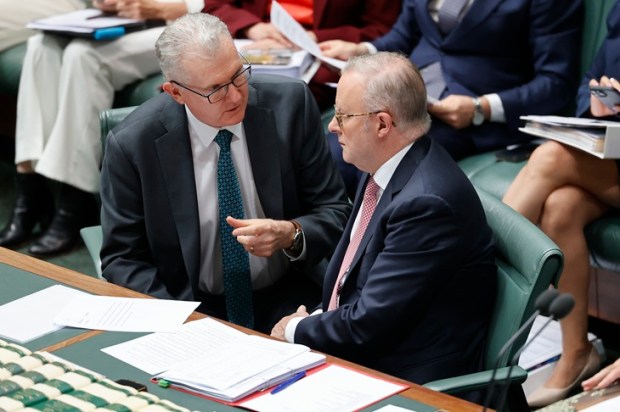
Anthony Albanese and Jim Chalmers appeared to see themselves as the natural heirs to the great Labor partnership of Bob Hawke and Paul Keating: reformers destined to leave an enduring mark on the nation. Yet legacy-building is a perilous business, particularly when one mistakes ambition for achievement, and narrative for delivery.
Politics is littered with leaders who sought to carve their names into the national story only to discover that voters, those inconvenient custodians of democratic reality, have a habit of intervening at precisely the wrong moment for the scriptwriters. Mr Albanese and Dr Chalmers now find themselves confronting that reality. Their political fortunes have become increasingly susceptible not to the effectiveness of an organised opposition, but to the accumulating weight of their own decisions.
Indeed, the Coalition’s continuing struggle to present itself as a coherent alternative has produced the unusual spectacle of the Albanese government effectively serving as its own opposition. Policy corrections, recalibrations, and reversals have become so frequent that they risk forming their own governing philosophy: govern first, rethink later. Meanwhile, smaller parties, most notably One Nation, periodically enjoy surges in support, feeding on the perception that dissatisfaction is no longer confined to traditional partisan lines but is instead diffusing across the electorate.
Whether Anthony Albanese and Jim Chalmers enjoy one another’s company is ultimately irrelevant. Australians did not elect them to curate personal chemistry or stage-managed unity; they elected them to govern competently. Yet in Canberra, leadership speculation is as perennial as the seasonal return of the parliamentary sitting calendar. Senior ministers such as Mark Butler, Tanya Plibersek, and Chris Bowen are inevitably drawn into commentary whenever the centre of gravity in government appears to wobble. Politics abhors a vacuum, and ambition rushes in with the inevitability of gravity.
Dr Chalmers, a noted student of Labor history and an admirer of Paul Keating, undoubtedly hoped to emulate the intellectual authority and reforming legacy of his predecessor. Yet admiration is not replication, and historical analogy is not policy competence. Unlike Keating, who operated in an era of overt economic transformation, Chalmers presides over a more fragmented political economy, where every adjustment is immediately contested and every reform instantly litigated in the court of public opinion. Mandates, it turns out, are not blank cheques but conditional instruments, subject to constant renegotiation by the electorate.
Australians remain deeply attached to aspiration, particularly when it concerns family wealth and home ownership. Any policy direction perceived as weakening that aspiration, especially around intergenerational transfer of assets, inevitably strikes a sensitive nerve. For all the technocratic language surrounding tax reform and equity, voters tend to interpret such measures in more immediate terms: what will it mean for my children, my home, and my ability to pass something on?
The Australian dream, often described in simple terms, retains a stubborn emotional core: a home of one’s own, a degree of financial security, and the ability to leave the next generation better off than the last. Many voters may not consider themselves wealthy in the present tense, but they are intensely protective of the possibility of future prosperity. Governments that appear to place friction between effort and reward tend to discover that this aspiration is politically elastic, but not infinitely so.
Successful tax reform, in the Australian tradition, has always depended on a form of political reciprocity. Governments can introduce new burdens, but only if they are able to clearly demonstrate corresponding relief, simplification, or benefit elsewhere. John Howard understood this with characteristic clarity. So too did earlier political operators who recognised that taxation is not merely an economic instrument but a psychological contract between state and citizen. Kerry Packer’s famously blunt commentary on tax minimisation continues to resonate not because of its elegance, but because it reflects a persistent truth: Australians are pragmatic about obligation, but hostile to perceived imbalance.
In the absence of such reciprocity, policy begins to resemble imposition rather than reform. And imposition, once felt, tends to generate its own political counterforce.
Beyond taxation, the government confronts a broader accumulation of policy pressures that are increasingly difficult to compartmentalise. Housing supply remains a central tension, with announced targets continuing to outstrip actual construction capacity. The result is a widening gap between aspiration and delivery, a gap that translates quickly into electoral impatience, particularly among younger voters seeking entry into an increasingly unaffordable market.
The energy transition, meanwhile, proceeds with the characteristic duality of modern policymaking: ambitious in scope, complex in execution. Renewable generation is championed as both inevitable and desirable, yet concerns about transmission infrastructure, grid stability, and long-term affordability remain persistent. The political challenge lies not in announcing targets but in reconciling them with the physical and financial realities of implementation. In this respect, the Government risks discovering that optimism is not a substitute for engineering.
Defence policy presents its own set of unresolved tensions. Strategic commitments are expanding, procurement timelines are stretching, and questions persist regarding readiness in an increasingly uncertain regional environment. Defence, unlike many areas of domestic policy, does not accommodate rhetorical delay; capability either exists or it does not. The gap between announcement and operational reality is therefore more consequential than in most other portfolios.
At the same time, legal and administrative controversies surrounding changes to war crimes processes have contributed to an impression, fair or otherwise, of a government frequently engaged in reactive adjustment rather than proactive control, to some it may even look as if the government is placing their finger on the scales. In politics, perception often precedes substance, and once a narrative of uncertainty takes hold, it becomes self-reinforcing.
Taken together, these pressures form a cumulative test of political coherence. Great governments are not defined by the volume of their announcements but by their ability to convert intention into durable outcomes. Legacy is not assembled in press conferences or policy launches; it is constructed slowly, often unglamorously, through the steady alignment of promise and performance.
The Albanese government entered office appearing to believe it had secured entry into the company of Hawke and Keating in the department store of Australian political history. Increasingly, however, voters may conclude that what was presented as a premium acquisition bears a closer resemblance to an impulse purchase made under favourable lighting and optimistic assumptions.
And as any experienced shopper eventually learns, the real cost has a habit of arriving long after the enthusiasm has faded.