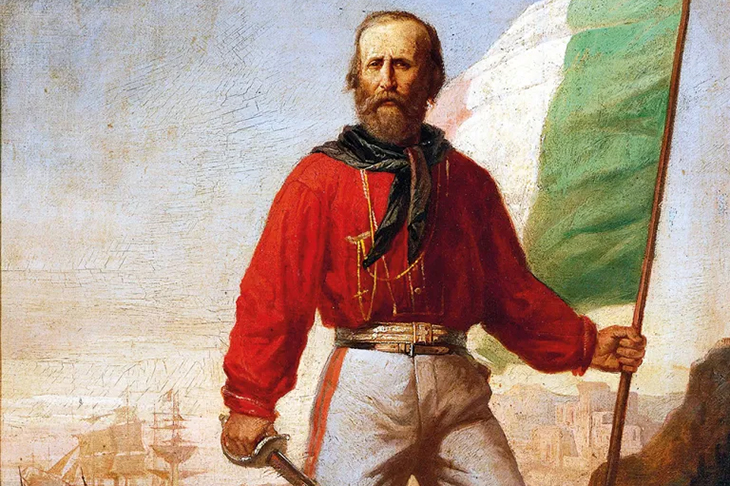
By the time he died in 1882 at the age of 74, Giuseppe Garibaldi had freed the Italian peninsula from its abhorred Habsburg and Bourbon rulers and united all Italy under the liberally inclined House of Savoy. With his whiskery good looks and wardrobe of red blouses, he was the ideal vehicle for romantic notions of free nationality. When he visited London in 1864, crowds flocked to greet the Risorgimento liberator as he got off the train at Nine Elms. A new football club, Nottingham Forest, adopted Garibaldi red as its colour and a ‘squashed fly’ biscuit was named after him. In Queen Victoria’s estimation, though, Garibaldi was an outlaw figure who threatened to subvert the established order. ‘Garibaldi – thank God – is gone!’ she declared on his departure. Like Che Guevara, the Italian patriot combined the adventurer’s contempt for bureaucracy with a deep-dyed hatred of social injustice.
In May 1860, backed by an army of 1,000 eager but ill-armed volunteers, Garibaldi ousted the absolutist Bourbons from Sicily and declared himself lord of the island. The cult of garibaldinismo was born at that moment. Tim Parks, who has lived in Italy for almost half a century, has followed the route the volunteers took that historic year when, against the odds, they sparked a revolution that toppled the old regime. Accompanied by his Italian wife, the translator Eleanora Gallitelli, Parks tramps 80 miles across Sicily from Marsala on the west coast to Palermo on the north, just as Garibaldi had done. It is quite some hike for a 70-year-old recovering from (among other things) sciatica. Armed with trekking poles, the couple endure weeks of ‘knee-challenging’ slog over stubbly shrub, loose scree and scorching plains.
A Garibaldi memorial typically consists of a chipped bust and a couple of cannonballs on a tattered tricolour
Across Sicily with Garibaldi’s Thousand is the book that resulted from their madcap venture. Parks calls it a literary ‘experiment’, when it’s pretty much standard footsteps travel writing. In the absence of plot, the challenge with this sort of book is to create a forward momentum, something that Parks is notably skilled at doing. His wife, who is half his age, turns out to be an indispensable companion, by turns solicitous and practical as they limp along on blistered feet.
Having consulted a wealth of garibaldini memoirs, diaries and letters, Parks is amply qualified to chronicle the heroic march. The troops, a ragtag of mechanics, errand boys, shop assistants, saddle makers, dyers and boatmen, had set sail for Sicily from Genoa. Among them were hundreds of Mazzinians. In the late 1840s, from his exile in London, the conspirator Giuseppe Mazzini had begun to circulate Garibaldi’s name in propaganda material that combined a Risorgimento idealism with a hard-nosed political exigency. Garibaldi’s plain-man persona belied an element of narcissistic Bonapartism, but beneath the vainglory Mazzini divined the master strategist who would one day oversee Italy’s resurgence.
Parks is perhaps best known for his three memoirs, Italian Neighbours, An Italian Education and A Season with Verona, which offer a variation on the Toujours Tuscany-style evocation of local life abroad. This book on Garibaldi complements his 2021 The Hero’s Way, an account of the Italian revolutionary’s march from Rome to Ravenna. In vivid pages he exalts the ‘tumultuous vitality’ of the Thousand as they sleep rough beneath the stars, get drunk on Sicilian wine and chase local women. The battlefield victories against the Bourbon enemy at Calatafimi and Partinico on the way to Palermo proved decisive. The garibaldini, tired and hungry after the fighting, were ready to die to make Italy. But, sad to say, many Italians today could not give two biscuits for national unification and may even wish for Italy to return to the days when it was a federation of different states. The Risorgimento Museum in Palermo is closed indefinitely and the Garibaldi memorials that Parks and his wife encounter are often ugly blocks of concrete, displaying, at best, a chipped marble bust and a couple of cannonballs nestled on a tattered Italian tricolour.
Still, Parks has done Garibaldi and his Redshirts proud in this eccentric hosannah to the travails of walking in the Sicilian uplands. Will he now write a book on Mazzini? No one named a biscuit after him, yet he was the intellectual architect of Italian independence. With his sparse beard and sallow El Greco face, he is easily caricatured as a guasta-feste (kill-joy), and that might explain why there are so few grandiose memorials to him in Italy. As the Voltaire of the new age of national liberation, Mazzini deserves better. Tim Parks: how about it?
Got something to add? Join the discussion and comment below.
You might disagree with half of it, but you’ll enjoy reading all of it. Try your first month for free, then just $2 a week for the remainder of your first year.