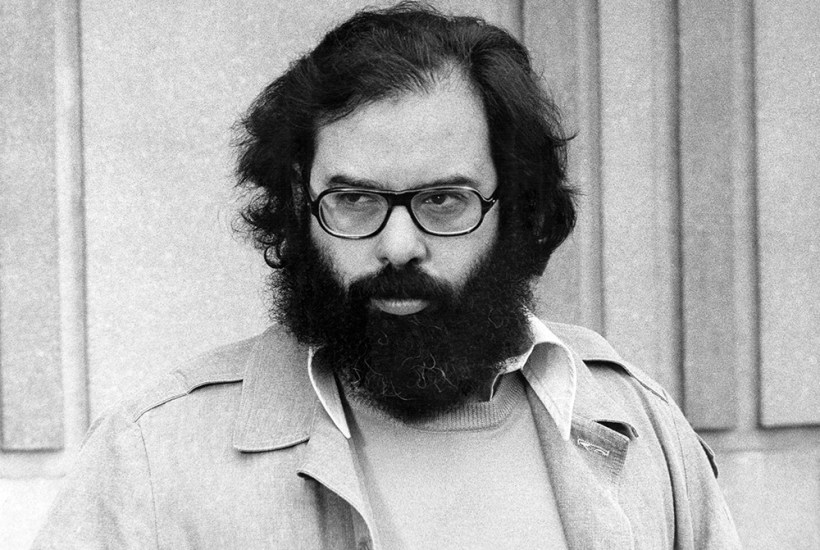
For some people it’s Star Wars; for others it’s Jaws or Close Encounters of the Third Kind. For me not a year goes by without watching Chinatown and the first two parts of The Godfather. This urge to repeatedly live through familiar narratives surely starts with bedtime stories; and though it diminishes in early adulthood as we push ourselves out into the world, the habit returns before long. So, although The Last Kings of Hollywood, Paul Fischer’s partial history of American movie-making focusing on Francis Ford Coppola, Steven Spielberg and George Lucas, tells a familiar story, it will be read by the same people who have already worked their way through the holy scriptures on the period. These include Michael Pye and Linda Myles’s The Movie Brats, Robin Wood’s Hollywood from Vietnam to Reagan, Tom Shone’s Blockbuster, and – the genre’s urtext – Peter Biskind’s Easy Riders, Raging Bulls.
To be fair, Fischer does serve up some eye-opening moments. Coppola is happy to be seen as one of the emblematic director-as-artist figures; but as a young man desperate for a break, Coppola not only worked on low-budget exploitation movies for Roger Corman, he even edited the odd porn flick. Meanwhile, his chum George Lucas, whose Star Wars and Indiana Jones series would pretty much wreck the idea of cinema as the seventh art, started his working life shooting what he called ‘abstract mood poems’ in the Arizona desert.
In the main, however, The Last Kings of Hollywood feels wearily well-worn. You don’t have to be a film buff to know that Marlon Brando never learnt a word of Coppola’s script for Apocalypse Now and had snippets of dialogue taped around the set and even on the foreheads of fellow actors. Nor is it uncommon knowledge that Coppola spent the whole of The Godfather shoot fearful that the corporate honchos at Paramount wanted to fire him. As for Spielberg’s apoplexy over the malfunctioning of the shark in Jaws, it’s been almost as much of a tabloid staple as Lucas’s hysteria when his fellow director Brian de Palma said of an early cut of Star Wars: ‘Who cares? I’m lost!’
What’s oddest about this book is that Fischer’s three heroes aren’t really any kind of a trio. To be sure, Spielberg and Lucas, who conceive of movies as nothing but visual amuse-bouches, are the Castor and Pollux of pop culture. Coppola, on the other hand, is one of those aesthetes who came out of the 1960s insistent that the cinema could dethrone the novel as contemporary America’s key narrative artform.
So it was that while Spielberg and Lucas wanted to transform the cheap Saturday matinee serials they’d grown up with into glittering high-end productions, Coppola dismissed Mario Puzo’s novel The Godfather as ‘this hunk of trash’. Asked by Paramount if he’d like to turn it into a movie, he accepted – on the condition that they acknowledged ‘it’s not a film about organised gangsters, but a family chronicle and a metaphor for capitalism in America’. By the time he came to make Apocalypse Now, Coppola was proudly declaiming that this picture about ’Nam, man, was an hommage to Joseph Conrad’s Heart of Darkness, with Marlon Brando as a colonel so crazed by the conflict that he can do nothing but quote T.S. Eliot’s ‘The Hollow Men’ ad infinitum.
You can love or loathe Coppola for such pomp, but what I don’t think you can do is love The Godfather and Apocalypse Now without loathing Jurassic Park and The Revenge of the Sith. And vice versa, of course. Because while Fischer’s book makes plain how pally Coppola has been with Lucas and Spielberg down the years, it cannot help but show how little he saw eye to eye with them on what movies are for. Coppola and Robert Altman; Coppola and Martin Scorsese; Coppola and Woody Allen; Coppola and Michael Cimino: these pairings would have made sense. But yoking him to Spielberg and Lucas is like yoking Robin Williams to Little and Large.
Fischer tries to get around this structural problem with a narrative that jump-cuts between directors and time-travels from one year to another, pretending that disparate events are part of a seamless whole. Jean-Luc Godard, who said that a film has a beginning, a middle and an end, though not necessarily in that order, would have applauded. But as history, The Last Kings of Hollywood is bunk.
Got something to add? Join the discussion and comment below.
You might disagree with half of it, but you’ll enjoy reading all of it. Try your first month for free, then just $2 a week for the remainder of your first year.