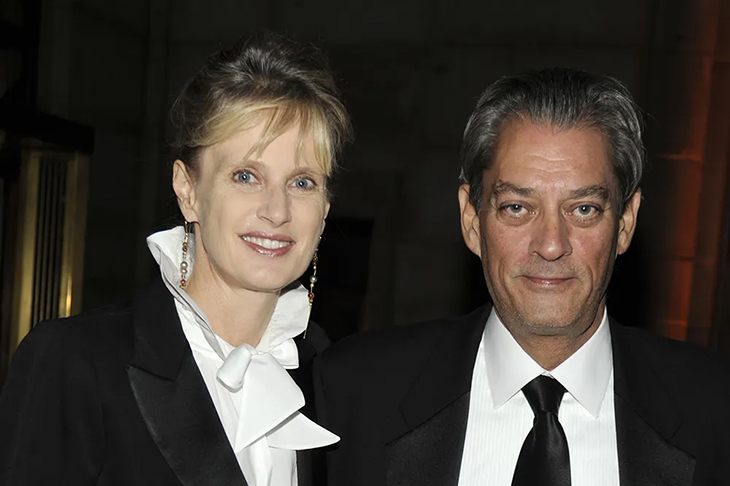
At 6.58 p.m. on 30 April 2024, Siri Hustvedt’s husband of 43 years, the novelist Paul Auster, died of cancer in the library of their Brooklyn home. He was surrounded by family, including his adored daughter Sophie, who three months earlier had given birth to his first grandson, Miles.
Hustvedt and Auster met at a poetry reading in 1981 and married later that year. It was she who proposed to him. Auster, aged 34, was not yet famous and Hustvedt, aged 26, was still a graduate student. By the 1990s, when she too became a novelist, they were New York literary royalty.
In the 1970s, Auster had been married to the translator and short story writer Lydia Davis, with whom he had a son called Daniel. If Sophie was a summer’s day, Daniel was darkness. Since childhood, he had been unreachable; as a teen he became hooked on heroin; as an adult he ran with a crowd of outlaws, who called him ‘the kid from The Omen’. In 1996, when he was 18, he was present at the Hell’s Kitchen party where Andre Melendez, a drug dealer, was bludgeoned with a hammer by a lowlife called Robert Riggs before the party promoter, Michael Alig, poured bleach down Melendez’s throat and sealed his mouth with duct tape. Alig dumped him in a bath for the next few days until the party was over, then dismembered his corpse and threw it into the Hudson. Daniel’s silence was bought with $3,000 of Melendez’s money.
Aged 44 and still an addict, Daniel was charged with criminally negligent homicide following the death of his ten-month-old daughter, Ruby. Alone with the baby, he shot up and went to sleep. When he awoke, Ruby was unresponsive. The coroner concluded that she had died from acute intoxication of heroin and fentanyl. On 20 April 2022, hours after his release on bail, Daniel also died of a heroin and fentanyl overdose. Seven months later, Auster became delirious with a bacterial and fungal infection and a radiologist spotted a mass on his right lung.
So it has been a turbulent few years for Hustvedt. It is hard, she says in Ghost Stories, to see Auster’s grief and rage over the deaths of Daniel and Ruby as unconnected to his rapid demise, but it could just have been rotten luck. ‘After all the horrible things we’ve been through,’ Auster said to her, ‘if I die of cancer it will be a bad story.’ Hustvedt is determined to make the end of his life a good story, but the ‘horrible things’, as she said in Auster’s eulogy (quoted in these pages), ‘cannot be suppressed from Paul’s story or from our family story. They are part of that story.’
They are not, however, the central part of Ghost Stories, in which Daniel appears and disappears in an appropriately spectral fashion, before being conjured up for a final fleeting appearance in the closing pages. This is because, writes Hustvedt, quoting Emily Dickinson: ‘Abyss has no biographer.’ But Hustvedt’s fiction, like Auster’s, is lifted from life, and a version of Daniel’s biography appears in her novel What I Loved (2003), where the deceitful son of a New York couple, Bill and Lucille, is close to the nightlife figure arrested for the murder of a drug dealer, Rafael Hernandez:
Bill loved his changeling child. His blank son, his Ghosty Boy. He loved the boy-man who is still roaming from city to city and is still reaching into this travelling bag to find a face to wear and voice to use.
Hustvedt describes Ghost Stories as ‘a diary of sorts’ covering her first year of widowhood, and at times it can feel too private and painful for a public audience. Extracts from her journal are slotted in alongside email messages to friends describing Auster’s progress through his various treatments, together with snatches of memory in stream-of-consciousness sentences and anecdotes about their courtship and marriage. Her subjects leap from neuroscience to bath oil to Mikhail Bakhtin. Some passages are gripping, others dreary; those in which she describes the depth of their love can sound smug.
This is the first book of hers, Hustvedt says, that Auster didn’t read before it was published, which isn’t entirely true. He did read parts of it, because she includes sections of her student dissertation on Charles Dickens, which he read in full, and two of her early love letters, written to lure him back after he’d returned briefly to his wife and son. Auster even wrote parts of Ghost Stories: several of his letters to Hustvedt are included, as well as ones he penned in his final weeks to his grandson. Auster had hoped that these ‘Letters to Miles’ might make a last, short book: ‘What stories I was planning to tell!’
In a 2020 essay called ‘Mentor Ghosts’, Hustvedt complains about being seen as her husband’s acolyte rather than his equal. ‘Siri is the intellectual in the family, not me,’ Auster pointed out in an interview; but it was hard to tell, she writes in Ghost Stories, where she ended and he began. Both writers unconsciously incorporated into their novels lines written by the other, and Auster consciously took the character of Iris Vegan, the heroine of Hustvedt’s first novel The Blindfold (Iris is Siri backwards) and married her off to the narrator of his own novel Leviathan. Most people assume that it was Hustvedt who lifted Iris from Auster.
‘This book is a need, not a choice,’ she says of Ghost Stories. She needs to get Auster back on the page where he belongs; but whether she needs to write herself out of her grief or further into it isn’t clear, and she herself isn’t sure either: ‘Writing isn’t about what you already know but what you find out you know once you’ve written it.’
What is certain, however, is that Ghost Stories is not simply a memoir of mourning. It is closer to mourning sickness, and Hustvedt honours the state. At one point she describes grief as ‘separation anxiety’, but it is also a form of obsession and self-absorption. She does not want her grieving to end because it is grieving that keeps Auster present. As long as she is still wearing his dressing gown and leather jacket, and can smell his cigar smoke in the room, he is alive to her. Grief is an attempt to stall time, and Hustvedt’s temporal disorientation is described in the first pages: ‘I remember and then forget what day it is. I remember it is the month of May, and then forget. The hours skip ahead but minutes often move slowly.’
By the last pages, when a calendar year has gone by, the smell of Auster’s cigar is beginning to fade and the clock’s steady ticking can be heard once more.
Got something to add? Join the discussion and comment below.
You might disagree with half of it, but you’ll enjoy reading all of it. Try your first month for free, then just $2 a week for the remainder of your first year.