Greed, death, hate and clouds of destruction – this is the cormorant season all right. I was hungry to read Gordon McMullan’s book because I love the birds and looked forward to learning their secrets. But I gathered only a little about the green-glossy, serpentine jewel of a fowl I saw in Hebden Beck recently, hunting in the middle of town where I’d never seen it before. Look elsewhere for the creaturely particulars, such as the spur of bone at the back of the skull from which thick muscles link to the lower mandible, giving the corvus marinus a mighty bitey beak. This book is not concerned with what we know about cormorants but with the cormorants that we ourselves are.
The poor bird, writes McMullan, ‘inhabits a cultural space where prejudice against nonhuman animals and prejudice against human beings meet’. The Norwegians have one positive cormorant folktale. Isak, a struggling fisherman, lands on an enchanted island and asks the resident elf if he might stay the night. The elf tells him he has three sons, good lads really, but they hate the smell of Christians. Three cormorants duly join Isak and the elf for dinner, but they are raucous with complaint. The elf calms his cormorant sons, who in turn tell Isak to sit and behave and drink. Pagan spirits and a Christian worker wassail as friends. The cormorants then show Isak where all the good fish are to be found: a beautiful parable of religions and cultures coexisting.
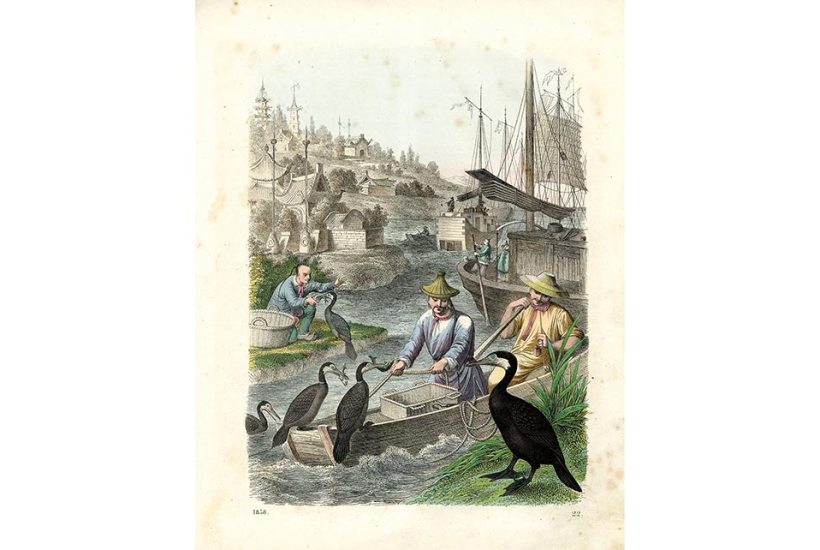
In China and Japan they prized trained cormorants, ringing the birds’ necks so that they couldn’t swallow the catch but would present it to their owners instead; and both James I and Charles I cormorant-fished in the Thames. Otherwise the story is very different.
How we love to hate one another. Human pigs are disgusting, dogs scummy, rats treacherous. Historically, cormorants symbolised moneylenders, Jews, black people, ravening occupiers, migrants, lawyers, thieves, venal politicians, invaders, despoilers, poisoners, terrorists and, thanks to John Milton, the Devil.
The cormorant has three faults. It is a prolific fisher – though population densities adjust to fish stocks. Its excrement over-nitrates the ground, killing the trees it perches on. But, as guano, its droppings made the fortunes of many, notably William Gibbs – by the mid-19th century the richest man in England outside the nobility. His Anglo-Catholic mansion Tyntesfield, transformed in the 1860s, can still be marvelled at in Somerset. Guano, or ‘white gold’, was mined in Peru’s Chincha islands in abhorrent conditions by indentured Chinese labourers, none of whom made it home. (Gibbs built several churches, as well as Keble College, Oxford, out of his bird-turd gold.)
Lastly, the cormorant looks as mean as hell, as black as your hat, psycho-eyed and knifey. Milton nails the bird in our imagination when he has the Devil enter Eden – where, on the tree of life, he
Sat like a cormorant; yet not true life
Thereby regained, but sat devising death…
In flight, half bat, half missile, a cormorant looks as sinister and as businesslike as a drone
In flight, half bat, half missile, a cormorant looks as sinister and businesslike as a drone. In a tree, it seems overlarge, knowing and bulbous. Like lightning, Milton’s image darts down to us through plays, paintings and horror stories. When the poet visited Venice in 1639, he may have been inspired by the cormorant squatting on the branch of a stripped tree in Giovanni Bellini’s ‘Resurrection of Christ’. In common metaphor, the cormorant is damned. Even its wings-out drying pose has been likened to the crucifixion, and not in a good way.
In the first Gulf War, an image of a cormorant covered in oil came to symbolise Saddam Hussein’s environmental terrorism – though it turned out that it wasn’t the despot who caused the slick but the US bombing of Iraqi installations. McMullan must have realised his book would be timely, yet even so it makes eerie reading. Nestor in Troilus and Cressida laments slaughtered Trojans lost to ‘the hot digestion of this cormorant war’.
I used to watch cormorants fishing the Thames on my way to work. The bird will bolt a large silver perch whole and stare back at you as it swallows it into submission, the victim struggling and weakening in its gullet until finally stilled in death. Something about that steely gaze reminds me of those men of power and oppression in their cormorant-dark suits who are leading nations into conflict today. See how easy it is? Poor cormorant indeed.
Got something to add? Join the discussion and comment below.
You might disagree with half of it, but you’ll enjoy reading all of it. Try your first month for free, then just $2 a week for the remainder of your first year.